
The South African Revenue Service has called on employers and other third-party data providers to improve the accuracy and timing of their submissions, warning that poor-quality data continues to disrupt the tax filing process for individuals.
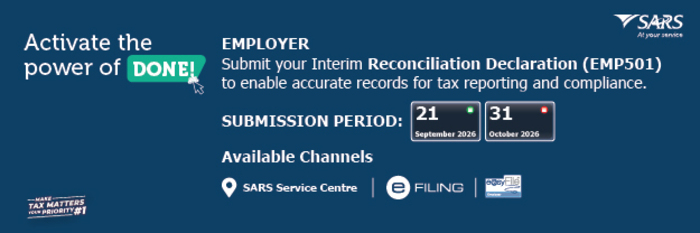
The annual submission window for third-party data opened on 1 April and will run until 31 May 2026. During this period, employers, financial institutions, medical schemes, and other mandated entities are required to submit remuneration and financial data for the 2025/26 tax year.
The reporting obligation applies to a wide range of institutions, including employers, financial institutions, medical schemes, trusts, co-operatives, and approved public benefit organisations.
A detailed list of third-party data providers who are mandated to submit is available at Third Party Data submission at a glance | South African Revenue Service. Employers may refer to the Annual Employer Declaration process.
SARS has indicated it will host technical support sessions during the submission period, where subject matter experts will assist organisations with their filings.
Data submissions underpin filing season
Although public attention typically centres on individual filing season, SARS said the process is heavily dependent on the quality of data submitted in advance by third parties.
The information provided during the April-to-May submission window is used to pre-populate tax returns and enable auto-assessments for individual taxpayers.
SARS relies on this data to auto-assess approximately six million taxpayers each year, allowing individuals to review and confirm their returns rather than complete them manually.
Accurate and timely submissions are therefore critical to ensuring a smoother filing experience, with fewer queries, and disputes.
Incomplete data continues to create friction
SARS has raised concerns that some employers and data providers remain unaware of their reporting obligations or are slow to adapt to evolving regulatory requirements.
Late submissions – often made close to the deadline – can make it difficult to resolve discrepancies, increasing the risk of errors flowing through to taxpayers’ returns.
The impact was evident during the 2025 filing season, where missing or unmatched data triggered a significant number of verification cases:
- 81 588 verifications linked to missing or unmatched employer IRP5 data.
- 27 436 verifications related to retirement contributions.
- 16 819 verifications tied to medical scheme data.
SARS noted that such gaps can exclude taxpayers from the auto-assessment process, resulting in a more complex and time-consuming filing experience.
Focus shifts to earlier, accurate submissions
For the 2026 cycle, SARS said it is aiming to drive behavioural change among employers and third-party data providers by encouraging earlier and more accurate submissions.
The objective is to ensure that organisations are “pre-filing ready” well before the deadline, reducing last-minute pressure and improving overall data quality.
SARS emphasised that submitting complete and accurate data on time enables taxpayers to benefit from auto-assessments and a simplified filing process.
Submission channels and compliance requirements
SARS has urged data providers to use its approved digital channels when submitting information. These include:
- eFiling, noting that this channel accommodates a limited volume of 25 certificates. It accommodates fifty certificates for IT3(d) and IT3(t).
- Connect Direct accommodates an unlimited volume of data submissions.
- Secured File Gateway (HTTPS) accommodates files smaller than 10MB.
- e@syfile: Employers, tax practitioners, and payroll administrators may download a new and enhanced version of e@syfile Employer from the eFiling website at sarsefiling.co.za before submitting their declarations.
Organisations must be registered for eFiling to access these channels.