
The Road Accident Fund (RAF) could face a “massive influx of claims” – liabilities it has not recognised and may not be able to meet – if its controversial RAF 1 claim form is ultimately set aside.
That warning appears in a section of the Standing Committee on Public Accounts’ draft RAF oversight inquiry report, which was discussed at the committee’s meeting on 24 April.
The draft adds that the impact could have “severe financial consequences on the business of the RAF… and society as a whole”.
From hearings to deliberations
SCOPA’s inquiry into the RAF – initiated after concerns about governance failures, misleading information provided to Parliament, and the Fund’s long-standing financial instability – concluded its public hearing phase in early 2026 after months of testimony from the RAF, government departments, regulators, and industry bodies.
Read: SCOPA moves from hearings to hard choices on the RAF
The committee first turned to the structure and scope of its report in February, agreeing on how the findings would be organised and what issues required emphasis.
Given the size and complexity of the report, SCOPA is working through it section by section, beginning with claims-related issues. Once deliberations are complete, relevant portions will be circulated to affected parties for comment before the report is finalised and tabled in the National Assembly.
So far, the committee has considered the section dealing with the change in accounting policy on 17 March, followed by its discussion of the RAF 1 Form on 24 April.
How the RAF 1 Form became a bottleneck
The RAF 1 Form is the statutory entry point for any claim against the Fund. Courts have held that it is intended to facilitate investigation – not determine the merits or value of a claim at the outset.
That changed in 2021, when RAF management introduced stricter lodgement requirements through an internal directive, later formalised through Board Notices and incorporated into the 2022 RAF 1 Form. The stated aim was to improve efficiency and enable claims to be processed within 120 days.
As one RAF official told the inquiry, incomplete submissions made it difficult “to actually process that claim to offer stage”, prompting a decision to require full supporting documentation upfront.
The draft report finds that this changed the function of the form. Instead of initiating claims, it set a threshold many could not meet.
The 2022 version requires extensive documentation – including medical, financial, and legal records – before a claim is registered. If any “compulsory” information is missing, the claim is not accepted or allocated a claim number.
For many claimants, particularly those without legal representation, this has proved prohibitive. The committee heard that even trained professionals struggle to complete the form, raising concerns about access for poorer and rural claimants.
In practice:
- Claimants who cannot meet every requirement are unable to lodge claims.
- Claims are not recorded or allocated a reference number.
- Prescription periods continue to run, potentially extinguishing valid claims.
Claim registrations dropped from nearly 2 000 a week to just over 300 following the introduction of the new form.
The trend is reflected in data from RAF’s annual reports, which show a sustained decline in registered and finalised claims over time.
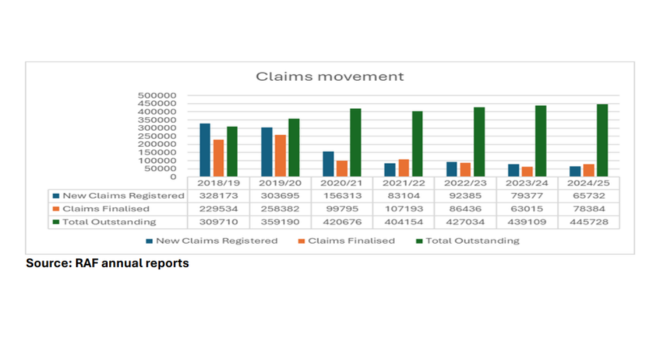
Over the period from 2018/19 to 2024/25, new RAF claims fell from 328 173 to 65 732, while finalised claims declined from 229 534 to 78 384. The draft links the drop, in part, to the introduction of the 2022 RAF 1 Form and the shift away from direct claims.
Of more than 105 000 pre-assessed claims, only 28% were compliant, with the majority rejected for failing to meet documentation requirements.
RAF’s data on pre-assessed claims shows the scale of non-compliance under the current system.
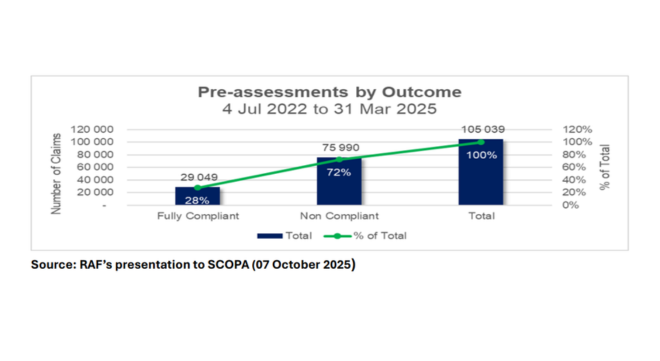
Between July 2022 and March 2025, of 105 039 RAF 1 claims that were pre-assessed, only 29 049 (28%) were compliant, while 75 990 (72%) were rejected for missing required documentation.
With direct claims increasingly impractical, claimants are pushed towards legal representation, raising costs and limiting access. Evidence before SCOPA indicates that legal costs in some matters have escalated to about R100 000, as claimants are forced into litigation simply to have claims recognised.
The committee found that the form has reduced claim registrations, increased litigation rather than curbing it, and undermined the RAF’s core mandate.
It asks the question whether “a claim unfairly denied can ever be said to be more efficient than a claim delayed”.
Litigation, cost and the risk ahead
The stricter RAF 1 Form did not reduce disputes. It moved them into the courts.
The requirements were challenged by the Legal Practice Indemnity Insurance Fund and others in litigation that has been running since 2021. Courts have issued a series of adverse rulings against the RAF, including findings that the process used to introduce the form was unlawful.
The High Court set aside the Board Notice and the 2022 RAF 1 Form, reinstating the 2008 version. The RAF has continued to apply the newer form while pursuing appeals.
Despite repeated losses, the RAF has persisted with litigation. Evidence before SCOPA describes this as “fruitless and wasteful expenditure”, undertaken with limited prospects of success.
One opposing party has incurred about R2 million in legal costs. The RAF’s own legal spend forms part of a broader corporate legal budget of about R160m.
The RAF continues to defend the form in court, even as judgments mount against it. The draft notes that the legal challenge is not opposed by the Minister of Transport, while the RAF persists with its defence of the framework.
The result is a system in which claims are blocked at entry and then disputed through litigation. In some cases, claimants must approach the courts simply to have claims accepted.
Contingent liabilities have already increased from R656.6m to R1.7 billion, driven in part by litigation linked to the claims process.
If the courts confirm that the 2022 RAF 1 Form is unlawful, the RAF could face a wave of claims that were never registered under the stricter regime.
The draft states this would result in a “massive influx of claims”, exposing the Fund to liabilities it has not recognised, without the financial or administrative capacity to manage them.
IT system risk and potential wasteful expenditure
The risks linked to the RAF 1 Form extend beyond claims and litigation. They are built into the RAF’s core IT system.
SCOPA examined the Integrated Claims Management System (ICMS), a project intended to modernise claims processing and reduce delays and fraud in a largely paper-based system. The five-year contract was initially priced at R841.9m and later revised to R881.3m, with R589.9m already spent.
Evidence before the committee shows that the system was designed around the requirements of the 2022 RAF 1 Form. As one RAF official explained, the system is structured on the basis that “we want everything upfront… for the claim to really progress forward to the next stages”.
That design assumption now creates a direct risk.
If the courts confirm that the RAF 1 Form is unlawful, the system will need to be reconfigured. The committee noted that the RAF may be required to process large volumes of claims that were previously rejected, while simultaneously amending the system’s process flows.
This risk is compounded by the fact that the ICMS does not retain records of claims that were not accepted. The committee warned this could lead to claims prescribing without any record of attempted lodgement.
The ICMS is also built on the accounting framework the RAF has since abandoned. Changes to align the system with current standards may therefore already be required, with costs that have not yet been quantified.
The Auditor-General flagged these risks during the inquiry, warning that the RAF 1 Form remained a “risk… with no mitigation whatsoever”, and failure in the litigation could require the system to be reconfigured, with implications for both cost and timelines.
The committee raised concern that additional expenditure on the system – built on a contested framework – could ultimately be classified as fruitless and wasteful.
It also noted the RAF does not appear to have put in place a plan to deal with the possibility that the form may be set aside.
Accounting changes and the liability question
When SCOPA began its deliberations in March, the first section of the draft report it examined was the RAF’s change in accounting policy.
The shift from GRAP to IPSAS 42 significantly lowered the RAF’s reported liabilities – a move National Treasury had criticised as an attempt to “fix liabilities through accounting” rather than address underlying problems.
Read: RAF inquiry | ‘You can’t fix liabilities through accounting’
The committee linked this directly to changes in the claims process. Stricter requirements introduced through the RAF 1 Form delayed or prevented claims from being registered, meaning they were not recognised as contingent liabilities.
Claims that did not pass the administrative threshold were effectively excluded from both the system and the balance sheet.
SCOPA found that the decision to change the accounting approach was not properly supported and may have been driven by efforts to improve the RAF’s financial position.
The change was defended in court in a dispute with the Auditor-General, which cost the RAF more than R11m in legal fees before the interim board finally withdrew the case and accepted the audit findings earlier this year.
Read: RAF drops audit fight as investigation into R1bn media contracts heats up
The committee indicated in the first draft that consequence management and the recovery of losses linked to irregular decisions would form part of its recommendations.
Remedies under consideration
SCOPA has not finalised its recommendations, but the draft report outlines several areas for corrective action.
The draft points to a reset of the claims process, anchored in the principle of “substantial compliance” – allowing claims to be lodged without exhaustive documentation at the outset, with supporting evidence to follow.
It also signals a reassessment of the RAF’s litigation approach. The committee has questioned prolonged court battles with limited prospects of success and rising costs.
Governance failures remain central. The draft highlights the need for stronger oversight, clearer accountability, and decisions grounded in proper legal and technical advice.
There is also recognition that aspects of the current framework may require legislative clarification, particularly where the claims process has diverged from the intent of the RAF Act.
The report is still being refined and will be circulated to affected parties for comment, with SCOPA members expected to consider those inputs before finalising and tabling it in the National Assembly, where it is likely to inform both accountability measures and future reform at the RAF.