

If the first half of 2026 has taught investors one lesson, it’s this: markets rarely stick to the script.
At the start of the year, investors expected falling inflation, lower interest rates, and continued dominance by large US technology companies to shape investment returns. Six months later, the picture looks very different.
Inflation has proved more persistent than forecast, prompting central banks to rethink the pace of monetary easing. Oil prices have swung sharply in response to renewed conflict in the Middle East, while market leadership has broadened beyond the large US technology companies that dominated returns over the past two years. Emerging markets have outperformed many developed markets, investors have become far more selective about which AI-driven companies they back, and South Africa has entered the second half of the year with improving economic fundamentals despite a softer equity market.
During its mid-year investment webinar on 23 July, Morningstar Investment Management examined how those shifts have changed the investment outlook – and what they could mean for the portfolios, fund managers, and investment strategies advisers recommend to clients during the remainder of 2026.
Inflation and interest rates have become harder to predict
At the end of 2025, the consensus was that inflation had largely been brought under control. Central banks had begun cutting interest rates and investors expected that trend to continue through 2026. Instead, inflation has re-emerged as one of the year’s defining risks.
Morningstar attributes much of that shift to energy markets. Renewed conflict in the Middle East pushed Brent crude from about $80 a barrel to above $120 before prices retreated as supply concerns eased. Although oil later recovered, the volatility filtered through to transport costs and consumer prices across many economies.
South Africa has followed a similar pattern. Annual consumer inflation accelerated to 5% in June, its highest level in two years, driven largely by higher fuel and transport costs. Food inflation, by contrast, continued to ease on the back of lower cereal and meat prices and favourable harvests.
Although inflation has moved above the South African Reserve Bank’s new 3% target, introduced late last year to replace the previous 3% to 6% target range, Morningstar does not view the current episode as a repeat of the inflation surge seen in 2021 and 2022.
Michael Dodd, the firm’s director of manager selection services, said the latest increase has been driven primarily by higher energy prices, while global energy supplies are now more diversified than they were during the earlier shock. Morningstar expects inflation to resume its downward trend once energy prices normalise and tariff-related effects work their way through the system.
Even so, central banks have become more cautious. The European Central Bank and the Bank of Japan have raised interest rates, while the US Federal Reserve has kept rates unchanged and signalled that policy may remain restrictive for longer. In South Africa, the Monetary Policy Committee raised the repo rate by 25 basis points to 7% in May, lifting the prime lending rate to 10.50%, before leaving rates unchanged in July while warning that the inflation outlook remains uncertain.
The result is a markedly different environment from the one that investors expected six months ago. Rather than assuming a steady path towards lower inflation and interest rates, they now face a backdrop in which monetary policy remains heavily influenced by geopolitics, energy prices, and the persistence of inflation.
Global equity markets have found new leaders
While inflation and interest rates dominated the macro-economic backdrop, the biggest surprise for equity investors came from where returns were generated.
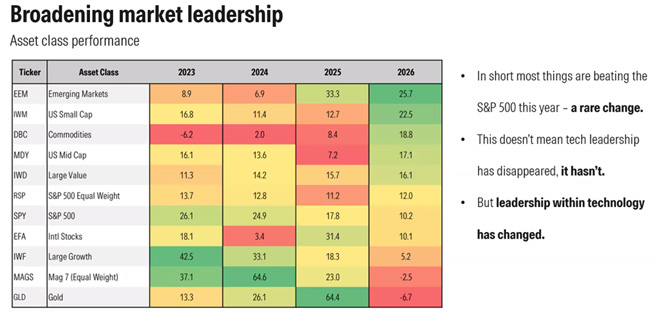
For much of the past two years, global equity markets were driven by a relatively small group of large US technology companies known as the Magnificent Seven: Alphabet, Amazon, Apple, Meta Platforms, Microsoft, Nvidia, and Tesla.
That pattern has started to change.
Emerging markets have been the strongest-performing equity region during the first half of 2026, followed by Japan and, to a lesser extent, the United Kingdom. Anticipating that shift, Morningstar entered the year overweight in selected emerging markets – particularly South Korea, Latin America, and China – while remaining underweight in US equities because it believed many American shares were trading above what the firm considered their fair value.
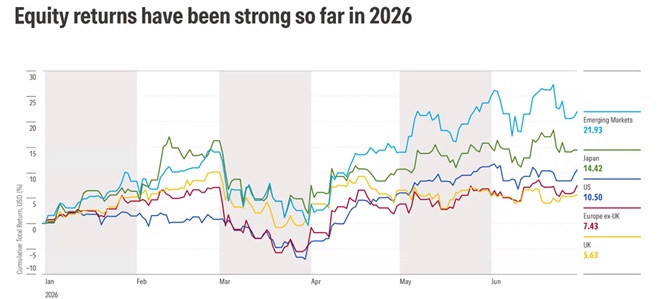
Sean Neethling, the firm’s head of investments, said the decision reflected relative value – how attractively one market is priced compared with another – rather than concerns about the US economy.
Many US companies continue to deliver strong earnings growth, but Morningstar believes much of that optimism is already reflected in share prices, leaving less room for further gains. Several emerging markets, by contrast, still combine solid earnings growth with more attractive valuations.
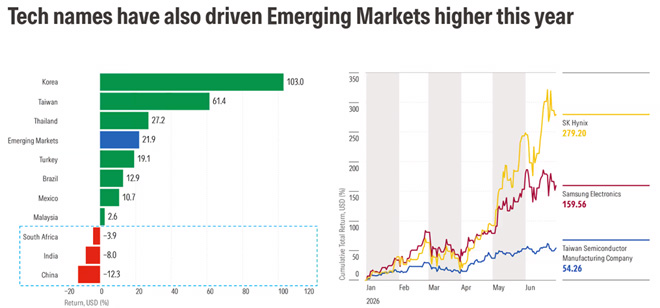
The investment team cautions against viewing emerging markets as a single investment opportunity, because performance has varied widely across countries. South Korea has been one of the standout performers, driven largely by semiconductor manufacturers such as SK Hynix and Samsung Electronics. Taiwan has also benefited from strong demand for AI-related chips, while several Latin American markets have delivered strong returns.
China, by contrast, has lagged, yet Morningstar has maintained an overweight position because it believes many Chinese companies are trading below their fair value, presenting what it sees as attractive long-term investment opportunities despite weaker recent performance.
One of the year’s biggest lessons, Neethling said, is that investors should avoid treating market leadership as permanent. The dominance of the Magnificent Seven has begun to give way to a broader range of opportunities, making valuations increasingly important when deciding where to invest. Markets that have lagged can sometimes offer better long-term value than those that have already enjoyed strong gains.
Technology is still leading – but not every technology company
Artificial intelligence continues to shape global equity markets, but investors have become far more selective about which technology companies they back.
Technology remains the best-performing global sector this year, ahead of industrials and energy. However, Morningstar says the gains are no longer spread evenly across the sector.
Instead, investors have increasingly favoured the companies supplying the infrastructure behind AI. Semiconductor manufacturers such as Taiwan Semiconductor Manufacturing Company (TSMC), SK Hynix, and Samsung Electronics have continued to benefit from strong demand for AI chips, while businesses producing the equipment needed to manufacture those chips have also performed well.
Software companies, by contrast, have struggled. Global software shares have fallen sharply this year because investors have become more cautious about businesses promising future AI benefits without yet translating those investments into stronger earnings.
“The market is becoming much more discerning,” Neethling said. “Investors are rewarding companies where AI is already translating into profits, while becoming less willing to pay high prices for businesses whose benefits remain largely theoretical.”
That same discipline shapes Morningstar’s approach to new technology listings. Rather than chasing high-profile companies, the investment team assesses whether shares are fairly priced, whether excessive amounts of new capital are entering the market, and whether investor enthusiasm has become detached from underlying value.
Neethling cited SpaceX as an example. Although Morningstar views the company as a high-quality business with strong long-term growth prospects, it concluded that the shares were trading well above what the firm considered fair value, limiting the potential returns for new investors.
As Neethling put it: “A great business isn’t necessarily a great investment if you’re paying too much for it.”
South Africa’s market has become more selective
The first half of the year has produced a mixed picture closer to home.
After a standout 2025, South African equities have struggled to keep pace with global markets.
Gold and platinum mining shares, which drove much of last year’s rally, have surrendered some of those gains, while heavyweight shares Naspers and Prosus have also come under pressure. Because Naspers owns a controlling stake in Prosus, and Prosus’s largest asset is its investment in Chinese technology giant Tencent, weakness in China’s technology sector has weighed on both companies’ share prices.
That shift has also created better opportunities for active fund managers. While passive funds are designed to mirror the performance of a market index, active managers seek to outperform it by selecting individual shares.
In 2025, a relatively small group of gold and platinum miners drove much of the market’s gains, making it difficult to outperform broad market indices. This year, returns have become more dispersed. Morningstar found that funds with lower exposure to gold and platinum miners, less invested in Naspers and Prosus, and greater allocations to financials and smaller companies have generally delivered stronger returns.
The broader investment backdrop has improved. South Africa exited the Financial Action Task Force’s grey list at the end of 2025, S&P Global Ratings and Fitch upgraded the country’s foreign-currency credit ratings, and Moody’s revised its outlook from stable to positive. Combined with continued fiscal discipline and Eskom’s achievement of 365 consecutive days without load shedding in May 2026 – the first such milestone since 2018 – Morningstar believes these developments have strengthened investor confidence and encouraged renewed foreign interest in South African government bonds.
Even so, Neethling believes investors can currently find more compelling opportunities elsewhere in the emerging-market universe. While South African equities continue to trade at attractive valuations, Morningstar considers parts of Asia and Latin America even more appealing. Within the local market, however, the investment team continues to favour selected financial, industrial, and resource companies, making careful stock and manager selection increasingly important.
Listed property is one area where the firm remains more cautious. Morningstar believes the sector is broadly fairly valued, offering less upside than South African government bonds, which continue to provide attractive real yields, or selected local equities.
What to watch in the second half of 2026
Rather than attempting to predict the next market move, Morningstar says its attention is now focused on where changing market conditions are creating new investment opportunities. Several themes are expected to shape the second half of the year.
Neethling said portfolios should not be built around a single economic outcome.
“What’s most important is to build portfolios that can continue to deliver performance regardless of what conditions are,” he said. “They shouldn’t be hinged to one specific outcome.”
Emerging markets remain one of the firm’s highest-conviction opportunities. While South Korea and Taiwan have already delivered exceptional returns, Morningstar continues to favour selected emerging markets, including China, where weaker recent performance has created what it considers more attractive long-term valuations.
The US market also continues to offer opportunities, but in different places. Rather than concentrating on the mega-cap technology companies that dominated previous years, Morningstar has become increasingly interested in areas such as US smaller companies and selected European technology businesses, including ASML and SAP, where valuations remain more attractive.
As market leadership broadens, returns are becoming increasingly differentiated across countries, sectors, and individual companies. Morningstar believes this is likely to make manager selection more important than it has been in recent years, creating greater opportunities for active managers to add value.
The investment team will also be watching several risks during the second half of the year, including inflation and interest-rate expectations, geopolitical developments, equity valuations, and the pace of new equity issuance. Rather than reacting to every headline, Morningstar says portfolios should be adjusted only when changing conditions materially alter the underlying investment opportunity.
Closing the webinar, Roné Swanepoel, the head of business development at Morningstar, said successful investing is not about consistently making the perfect call, but about remaining invested in a disciplined way over time.
“The best investors aren’t always in the right place at the right time, all of the time. But they consistently own productive assets, diversify their exposures, and really give compounding time to work.”
Disclaimer: This article reports the views expressed by Morningstar Investment Management during its mid-year investment webinar and is published for news and informational purposes. The content does not constitute financial advice, an investment recommendation or a solicitation to buy or sell any financial product. Publication by Moonstone Information Refinery does not imply endorsement of Morningstar’s investment views. Readers should consult an authorised financial services provider before making investment decisions.