For years, anti-money laundering (AML) compliance was largely regarded as the responsibility of compliance officers and operational teams. Their role was to develop policies, conduct due diligence, submit reports, and ensure the organisation met its obligations under the Financial Intelligence Centre Act (FICA).
That view no longer reflects today’s regulatory landscape.
As South Africa undergoes a new Financial Action Task Force mutual evaluation, regulators are placing increasing emphasis on the effectiveness of governance, risk management, and oversight. The question is no longer simply whether an accountable institution has the required policies and procedures in place. It is whether those policies are understood, supported, and actively overseen by the organisation’s leadership.
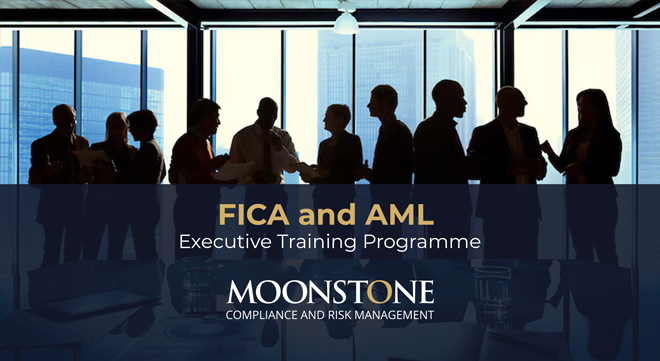
Recognising these changing expectations, Moonstone Compliance has developed its FICA and AML Executive Training Programme specifically for directors, governing bodies, and senior management.
Built around the principle that executive leadership starts with compliance leadership, the programme equips leadership teams with the knowledge and confidence to fulfil their governance responsibilities, strengthen oversight, and foster a culture of compliance throughout the organisation.
Rather than focusing on operational compliance, it is a practical executive-level masterclass designed to help decision-makers understand what regulators expect and how to meet those expectations.
Accountability cannot be delegated
Most accountable institutions employ experienced compliance professionals to manage their FICA obligations. That expertise remains indispensable. However, appointing a compliance officer or Money Laundering Reporting Officer does not transfer responsibility for governance.
Leadership is expected to ensure that the organisation has appropriate systems, controls, and oversight structures in place. This includes approving and overseeing the Risk Management and Compliance Programme (RMCP), understanding the organisation’s Business Risk Assessment (BRA), ensuring adequate resources are available, and promoting a culture that supports compliance throughout the business.
Anyone who has followed regulatory inspections and enforcement action will recognise a familiar pattern. Regulators seldom identify a single catastrophic failure. Instead, they uncover weaknesses in governance: risk assessments that no longer reflect the business, oversight structures that exist on paper rather than in practice, inadequate challenge from senior management, or controls that are poorly aligned with the institution’s risk profile.
These shortcomings increase not only regulatory risk but also the potential for financial loss, reputational damage, and operational disruption.
What the programme covers
The programme examines the regulatory framework established by FICA, the Prevention of Organised Crime Act and the Protection of Constitutional Democracy Against Terrorist and Related Activities Act, with a practical focus on how these laws apply within accountable institutions. Participants explore the compliance ecosystem, the roles of regulators and compliance officers, financial crime typologies, executive accountability, common governance failures, and recent enforcement trends.
Rather than concentrating on legislative detail, the programme focuses on practical application. Leadership teams gain a better understanding of the organisation’s compliance lifecycle, from risk identification and BRAs to reporting obligations and governance oversight, enabling them to engage more effectively with compliance functions and make better-informed strategic decisions.
Practical outcomes for leadership
By the end of the programme, participants will be better equipped to understand their legal and governance responsibilities under FICA, provide effective oversight of AML, CTF, and CPF compliance, critically assess and approve the organisation’s RMCP and BRA, challenge compliance functions constructively, strengthen risk-based decision-making, and contribute to building a sustainable culture of compliance.
The half-day programme can be delivered on-site or virtually and is tailored to each organisation’s business model, governance structures, risk profile, and implementation challenges. Whether presented as an executive briefing or an interactive workshop, the emphasis is always on practical guidance that leadership teams can apply immediately.
Strong compliance starts with informed leadership
Regulatory expectations will continue to evolve, but one principle is unlikely to change: organisations with informed, engaged leadership are better equipped to manage financial crime risk, demonstrate effective governance, and respond confidently to regulatory scrutiny.
Moonstone Compliance’s FICA and AML Executive Training Programme has been designed to help boards, governing bodies, and senior executives build that capability.
To find out more about the programme or to discuss a tailored executive training session for your organisation, visit Moonstone’s FICA Compliance contact page.