
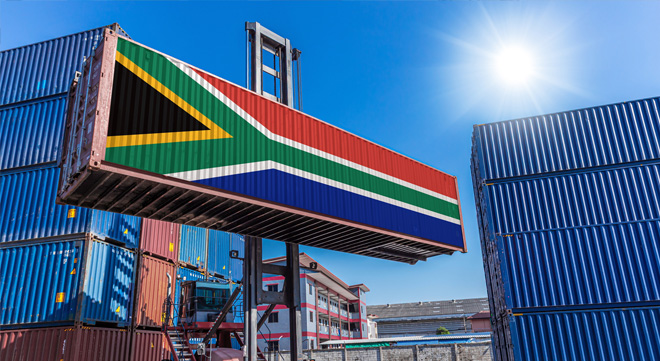

For South African exporters, losing AGOA may feel like a door slamming shut on the US market. But the trade door is not closing completely – and economists say the loss of preferential access may matter less to the wider economy than the headlines suggest.
The United States announced on 2 November its intention to terminate South Africa’s eligibility for the African Growth and Opportunity Act (AGOA) on 1 January 2027, following a 60-day notice period. South Africa remains eligible until the proposed termination takes effect.
The Office of the United States Trade Representative (USTR) said the decision followed a review of South Africa’s eligibility. It cited barriers to US trade and investment, corruption, and concerns about US national security and foreign policy interests.
AGOA eligibility requires participating countries to make progress on market reforms, reduce trade barriers and combat corruption, among other conditions.
AGOA gives qualifying exports from eligible African countries preferential access to the US market. If the termination goes ahead, South African goods can still be exported to the US, but without the programme’s preferential tariff treatment.
The effect will differ by sector. Automotive exports and some agricultural products are more exposed, while other exports may be less affected.
Izak Odendaal, chief investment strategist at Old Mutual Wealth, said about 8% of South Africa’s exports go to the US, about half of which are raw materials that are not affected by the loss of AGOA preferences.
“Therefore, the overall economic knock to the SA economy is relatively small, especially if exporters find alternative markets,” he said. “This will be easier for some than others.”
Odendaal said it was important to remember that losing AGOA access does not mean South Africa can no longer export to the US. It means higher tariffs will apply to South African goods entering the US market.
“It is still up to American consumers to decide what they buy.”
Tshiamo Masike, an economist at Momentum Group, said the announcement was another setback for South Africa’s trade relationship with the US, coming at a time when bilateral relations were already under considerable strain.
However, she stressed that the decision did not mean an immediate suspension of the trade benefits.
“South Africa remains eligible for the programme until the proposed termination takes effect,” she said.
If the termination proceeds, South African exporters would face additional most-favoured-nation tariffs of around 3.4%, on top of the tariffs already imposed by the current US administration.
“This would potentially make those products less competitive in the US market,” Masike said.
South Africa exported about US$1.7 billion in goods under AGOA in 2025, making it the largest beneficiary of the US programme, according to Masike.
AGOA-related exports accounted for approximately 10% of South Africa’s total exports to the US. However, measured against the country’s total exports globally, they accounted for only about 1%.
Masike said this suggested that the direct impact on overall GDP was likely to be relatively small.
“However, the impact on employment could be more significant, particularly in industries that are heavily reliant on access to the US market.”
The automotive and agricultural sectors, among others, could face increased pressure on their competitiveness, with potential implications for production, investment and jobs.
Johann Els, chief economist at PSG Financial Services, said South Africa was probably the largest beneficiary of AGOA, accounting for more than 50% of all AGOA-related exports to the US.
However, he said the figures needed to be put into perspective.
Only around 7% of South Africa’s total goods exports went to the US in 2025, amounting to approximately US$16.5bn. Of this, only about US$1.6bn entered under AGOA preferences.
“So, while the absolute numbers may look significant, the share of our overall exports directly affected is relatively small,” Els said.
He said it was important not to confuse South Africa’s large share of AGOA trade with the much smaller share of its own exports that depends on the programme.
“This does not mean that all South African exports to the US will suddenly face new tariffs or disappear. Exports will continue, but some products will become less competitive.”
Els said automotive, agriculture – including citrus, wine and grapes – and certain manufacturing and metals industries were more exposed.
AGOA removes ordinary import duties on qualifying products, he said, but does not necessarily exempt them from additional US tariffs.
Els said the direct impact on overall economic growth was likely to be small, given that less than 1% of South Africa’s total goods exports currently entered the US under AGOA.
“This is not insignificant for the businesses and workers affected,” he said.
“But the bigger concern is the signal it sends to investors and the potential impact on confidence, investment and our broader relationship with the US.”
What it means for markets
Odendaal said the AGOA announcement was not a surprise and was therefore “not market moving”.
“In general, markets do not respond to news about trade agreements and tend to react more to things like interest rate decisions or the Budget that have a direct impact on asset class returns,” he said.
President Donald Trump’s “Liberation Day” tariffs were different, Odendaal said, because they affected the whole global economy.
Announced on 2 April 2025, the tariffs imposed a 10% baseline duty on imports from nearly all US trading partners, with higher rates for some countries. The announcement unsettled global markets and raised fears of a trade war and recession.
South Africa was assigned a 30% tariff, in addition to separate duties on vehicles and parts. The Supreme Court later struck down the IEEPA tariffs. The 30% IEEPA tariff was replaced by a temporary 10% global tariff, which was later replaced by a 12.5% Section 301 tariff. The 12.5% is not necessarily the total tariff on every product; other duties may apply, and some goods are exempt.
The industries most exposed to the loss of AGOA preferences are largely not listed on the JSE, Odendaal said.
“The automotive industry has been hit hard by US tariffs in general (more so than this AGOA announcement in particular), but Mercedes Benz is listed in Germany.”
Similarly, South Africa’s agricultural sector faces headwinds, but the farms affected tend to be privately owned.
There could be an indirect effect if workers lose their jobs and spend less at retailers such as Mr Price or Shoprite, Odendaal said, but “this will be small in the context of an R8 trillion economy”.
Odendaal said the decision was unlikely to change the attractiveness of South African assets to foreign investors.
Although relations between the US and South Africa have deteriorated, and this probably played some role in the decision, he said South Africa was always at risk of losing AGOA access.
“AGOA was set up to support African countries to grow trade with the US and industrialise. SA was always a bit of an outlier in this regard, being much more industrialised than other African countries.”
South Africa should therefore not have expected to remain a permanent member of AGOA, he said, and should have expected to “graduate” at some point.
The risk to South African asset valuations would arise if relations with the US deteriorated further and the US implemented broad sanctions.
“This is unlikely but could happen,” Odendaal said.
For investors trying to distinguish a temporary market reaction from a lasting change in South Africa’s risk profile, Odendaal said the easiest way was to look at how the country trades compared with other emerging markets and commodity exporters.
“If the rand falls, but other emerging market currencies also fall, it is probably something to do with US interest rates or geopolitics, and not anything specific to the country.”
If the rand falls while other emerging markets remain unchanged, the cause is more likely to be domestic.
That does not mean investors should react to every market movement, however.
“Markets are always volatile in the short-term, so it is also important to not overreact,” Odendaal said. “It is better to pay attention to fundamentals on the ground than day-to-day market reactions.”
He said the AGOA decision was a classic example of an event that generated extensive media coverage but had a relatively small impact on the economy.
By contrast, the size of the government’s budget deficit, which receives far less public attention, has significant implications for the economy and markets.
Odendaal said Old Mutual Wealth’s asset allocation process is driven by current valuations and the medium-term outlook, rather than the immediate market reaction to the AGOA decision.
“SA assets are still priced to deliver solid real returns, and we think that the fundamentals of the SA economy are improving, notwithstanding the AGOA decision.”
What happens next?
Masike said South Africa’s eligibility is not being suspended immediately and remains in place until the proposed termination date. She said the decision introduces further uncertainty into South Africa’s relationship with an important trading and investment partner.
South Africa’s trade ministry has reiterated that Washington remains an important trade and investment partner, while indicating that the country will accelerate efforts to diversify its export markets.
However, Masike cautioned that finding alternative markets of comparable size and value is “neither immediate nor costless”.
“This makes continued diplomatic engagement particularly important ahead of the proposed termination date.”