

South Africa’s grey-list status was unchanged at the Financial Action Task Force’s October Plenary. But with the country’s next mutual evaluation under way, the FATF’s decision to accelerate reviews of virtual-asset oversight puts the sector in sharper focus for South African authorities and the financial industry.
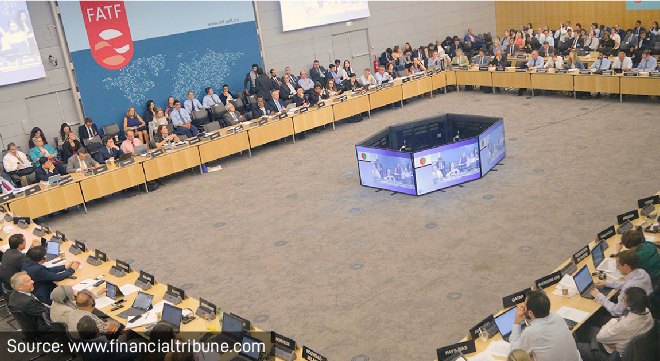
Delegates from across the FATF’s global network of more than 200 jurisdictions and observers gathered in Paris from 28 to 30 October 2026. Representatives of Barbados, Namibia, and Thailand participated under their own flags for the first time through the FATF’s Guest Initiative, at the invitation of the FATF president.
The FATF agreed to launch a targeted review of jurisdictions with materially important virtual-asset activity. The review will use objective criteria and take account of each jurisdiction’s current assessment status. Initial findings are due in June 2027, with further results expected in October.
The review follows the FATF’s April 2026 Ministerial Declaration, which called for faster implementation of its standards for virtual assets and virtual-asset service providers (VASPs). The FATF said implementation remains uneven across its global network, while criminal networks continue to exploit gaps in oversight.
The organisation will work with relevant jurisdictions through engagement, training, and capacity-building. Its announcement does not identify which countries will be included.
FATF signals a more targeted approach to reform
The FATF updated its statements on jurisdictions subject to a call for action. North Korea and Iran remain subject to countermeasures, while Myanmar remains subject to enhanced due diligence.
The FATF reiterated concerns about North Korea’s links to illicit activity and proliferation financing and urged jurisdictions to continue applying countermeasures and enhanced due diligence. It said Iran had made limited progress on its action plan, but that fundamental deficiencies remain, including gaps in criminalising terrorist financing and establishing targeted financial sanctions. The FATF again called for effective countermeasures against Iran.
Myanmar remains subject to enhanced due diligence because of ongoing deficiencies and risks linked to fraud and cyber scams. The FATF said it would consider countermeasures if the country made no further progress by February 2027.
The FATF also expressed concern about Vietnam’s pace of progress in addressing its strategic deficiencies. It said it would consider next steps if Vietnam did not make tangible improvements before the next Plenary.
The Plenary approved a report on illicit financial flows linked to scam compounds, due to be published the following week. The report examines how money moves through these operations and draws on information from across the FATF’s global network. It is the first output in the UK presidency’s roadmap on fraud and is intended to help authorities disrupt the criminal networks and business models behind scam compounds. The FATF said the report will inform further work on how its standards and tools can be used to combat fraud more broadly.
Bulgaria, Côte d’Ivoire, the Democratic Republic of the Congo, and Monaco were removed from increased monitoring after completing their action plans and undergoing successful on-site visits. The FATF also adopted mutual-evaluation reports on Mexico and the United States. The reports are due to be published in December, following a quality and consistency review.
The Plenary agreed to introduce a more tailored approach to mutual evaluations for a subset of developing countries with limited capacity. The FATF said this would help to prioritise high-impact reforms according to risk, alongside improved assessor training and greater support for capacity-building.
The FATF also discussed how public authorities and the private sector apply a risk-based approach to financial crime. It plans to hold a forum in Dallas on 1 and 2 December, bringing together supervisors, financial intelligence units, law enforcement, and financial and non-financial institutions. The forum is expected to inform a policy statement on how the risk-based approach should be applied in practice.
Grey-list exit was only the first hurdle
South Africa was removed from increased monitoring in October 2025 after completing the 22 action items in its FATF action plan. Its fifth-round mutual evaluation began in mid-2026 and is expected to run until October 2027.
The evaluation will assess whether the country has sustained the progress that secured its removal from the grey list. Assessors will look not only at whether the necessary laws and regulations are in place, but also at whether authorities use them effectively and produce tangible results.
The next round places greater emphasis on a country’s risks and context. It will also assess the effectiveness of the financial sector separately from that of non-financial businesses and professions.
Virtual assets are already covered by South Africa’s anti-money laundering and counter-terrorist financing framework. Crypto-asset service providers are subject to relevant requirements, including rules on information accompanying certain crypto-asset transfers.
A jurisdiction’s virtual-asset activity and current assessment status are among the factors the review will consider.
Concerns over law enforcement and anti-corruption
The evaluation comes as questions remain about whether South Africa can sustain its anti-corruption and law-enforcement reforms.
In its October 2026 Reform Tracker, Business Leadership South Africa warned that stalled progress on FATF-related and anti-corruption reforms could put the country at risk of returning to the grey list. It pointed to weaknesses in investigating and prosecuting complex crimes, recovering criminal assets and implementing recommendations arising from the state-capture inquiry.
The tracker recorded that its corruption reform index remained unchanged at 51.2 in the July-to-September quarter.
Read: Grey list comeback? South Africa’s anti-corruption warning
South Africa had to demonstrate a sustained increase in investigations and prosecutions of money-laundering networks to secure its removal from the grey list. The fifth-round evaluation will assess whether the country continues to deliver results in areas such as these.