

The global economy may keep growing in 2027, but that does not mean all borrowers will find the year any easier. Companies and governments are heading into a period in which debt will cost more to refinance, energy prices remain a concern, and the returns on massive investments in artificial intelligence will come under closer scrutiny.
That is the outlook from Moody’s Ratings, which expects credit conditions to weaken despite continued expansion in major economies. The pressure is unlikely to fall evenly. Highly leveraged companies, interest-sensitive sectors, and borrowers with substantial refinancing needs are particularly exposed.
Moody’s identifies four forces that will shape credit quality over the coming year: costlier credit, the transformation brought about by AI, greater political intervention, and the “security premium” – the rising cost of securing energy, critical minerals, defence equipment, and other strategic supplies.
Each brings risks and opportunities. Borrowers with strong cash flows, manageable debt, and room to adapt are better placed to navigate the changes. Those with less financial flexibility face a tougher year.
Refinancing will become more expensive
For companies that borrowed heavily when interest rates were at historic lows, the bill is coming due.
Credit markets remain open and functioning, but replacing maturing debt is becoming more expensive. The pressure comes from higher interest rates across the yield curve, rather than wider credit spreads, which remain tight. Investors are also becoming more selective about to whom they lend.
Companies with longer debt maturities, ample liquidity, and simpler capital structures are better placed to absorb higher debt-servicing costs. Those with high leverage and limited room to manoeuvre face a tougher refinancing environment.
Speculative-grade companies are particularly exposed. More than 60% of global high-yield bonds maturing between 2027 and 2029 were issued during the low-rate period of 2019 to 2021.
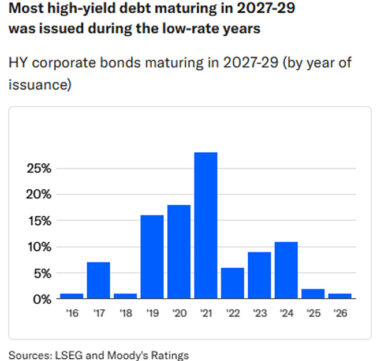
New high-yield bonds are now being issued at rates about 100 basis points higher than the debt they replace. Much of the earlier borrowing funded leveraged buyouts struck at high leverage and low interest rates. The first large batch falls due in 2027, with more maturities in 2028 and 2029. Because borrowers often refinance ahead of maturity, Moody’s expects the higher costs to start showing up in 2027.
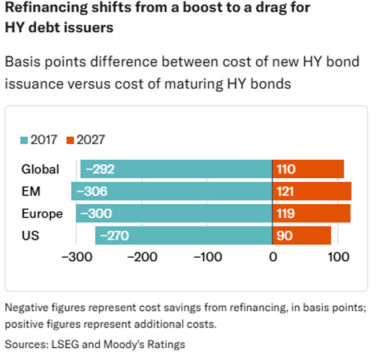
A broad increase in speculative-grade defaults is not inevitable. Moody’s is not forecasting one. Companies with strong franchises, ample cash, and low leverage should be able to refinance without materially weakening their credit quality. Some may even find opportunities to acquire financially stretched competitors or their assets.
The pressure is more apparent among leveraged-loan borrowers. Higher short-term interest rates are eroding their interest cover and reducing their ability to refinance. Business models that depended on cheap financing may no longer be viable.
Private credit will continue to fund some borrowers with limited access to public markets, including those with higher leverage or more complex capital structures. But lending standards are tightening, and lenders are becoming more selective. Greater reliance on payment-in-kind (PIK) interest, maturity extensions, and other measures to preserve liquidity suggests that stress is building.
The risks extend to investors. Less frequent valuations, limited transparency, and complex structures could lead to abrupt valuation resets. Funds backed by long-term committed capital are likely to keep lending, while vehicles that allow investors to withdraw at short notice may pull back first. Some semi-liquid funds are already facing redemption pressure. Borrowers shut out of both syndicated loan and direct lending markets may have to resort to distressed exchanges or amend-and-extend transactions to manage their debt.
Governments face their own refinancing challenge. Moody’s forecasts a $39-trillion increase in government debt over the next few years, with interest expenses the leading driver.
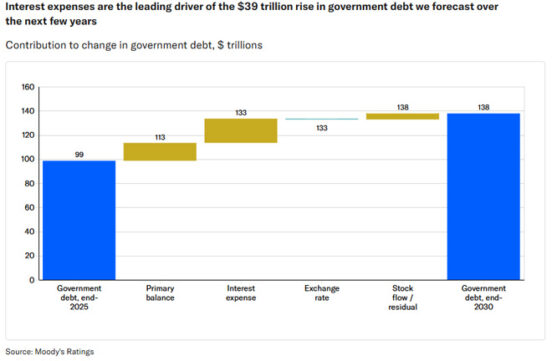
Long-term government bond yields are at multi-decade highs. Moody’s attributes this to heavier debt issuance, AI-related capital spending, and weaker investor demand for long-dated bonds, rather than concerns about government solvency. Countries with persistent deficits, short-dated debt, and substantial borrowing needs face the greatest pressure as maturing debt is refinanced at higher rates.
Higher borrowing costs are also affecting property finance. Mortgage affordability is under pressure, while borrowers in markets outside the United States with shorter fixed-rate periods will feel higher repayments sooner. In commercial property, loans maturing in a higher-rate environment face refinancing risks, particularly in office markets where property values have fallen. Some borrowers may need to extend their debt, inject additional equity, or sell assets at discounted prices. Infrastructure borrowers refinancing long-dated funding also face higher costs, although projects with fully amortising debt are less exposed.
Higher rates are not bad news for every financial institution. Banks can benefit when deposits reprice more slowly than loans, supporting net interest margins, although higher wholesale funding costs and deposit competition can offset some of the gains. Life insurers also benefit from better returns on reinvested premiums and maturing assets. Their growing allocations to private credit, however, bring greater exposure to less transparent investments.
The AI investment boom faces a returns test
The money flowing into AI is not drying up, but the next phase of the boom may be harder to justify.
US hyper-scaler capital expenditure is expected to approach $1 trillion in 2027, with another $2.8 trillion in future commitments. The build-out has benefited semiconductor and IT companies, power providers, and industrial manufacturers. Large US hyper-scalers also have the cash reserves and earnings growth to absorb 12 to 24 months of high capital expenditure without materially weakening their credit quality, Moody’s says.
But with investment on this scale, the returns will come under closer scrutiny. Moody’s expects spending to remain substantial but grow more slowly. Investors will pay closer attention to whether completed and planned projects can generate enough revenue to cover their costs and debt servicing.
The benefits are unevenly distributed. Regulatory, resource and community constraints are emerging in parts of the US, Europe, and Asia. Parts of Asia-Pacific are seeing faster growth, while many emerging markets remain outside the investment cycle and risk absorbing the disruption without capturing the gains.
Much will depend on how businesses put AI to work, rather than simply on the infrastructure being built. Companies that use the technology effectively could improve efficiency, lower costs, and develop new products. Chip and memory makers are among the clearest beneficiaries. Software, IT services, professional services, and media face greater pressure because of their reliance on text, code, and video.
Within these industries, companies with proprietary assets, strong customer relationships, and established market positions are better placed. Those that fall behind risk losing market share and pricing power.
Even successful adopters may not keep all the savings. If AI reduces the cost of delivering a service, competition could force businesses to pass some of that benefit on to customers, limiting improvements in margins.
There is also a sizeable hurdle to clear before current investment levels can be justified. Moody’s estimates that AI needs to add 0.3 to 0.8 percentage points annually to labour productivity growth just to break even. That is demanding, although not implausible when compared with the productivity gains during the late-1990s technology boom.
The credit risks are concentrated less among the large hyper-scalers than among the more leveraged developers, lenders, and structured-finance vehicles funding the build-out. If a major sponsor slows its spending, the effects could spread quickly across several rated sectors. Data-centre asset-backed financing is creating further exposures, while heavy AI borrowing could add pressure to long-term interest rates.
Government decisions will increasingly shape credit risk
Government policy is becoming a more direct influence on the credit outlook for businesses operating across borders.
Tariffs, export controls, regulation, investment screening, and support for strategic industries are giving governments greater influence over markets. High debt levels in some advanced economies are limiting the scope for fiscal support, prompting greater use of these other tools.
The difficulty for businesses and investors is the speed at which policy can change. Measures can be introduced, expanded, or reversed, often through executive action, leaving limited time to adjust. This kind of policy variability has long been familiar in some emerging markets; Moody’s says advanced economies are increasingly experiencing it too.
The consequences will depend on which industries are affected. Defence, semiconductors, and parts of the energy transition may benefit from subsidies, protection, and strategic investment. Others could face higher input costs, additional regulatory requirements, or restrictions on access to markets. Government intervention can stabilise markets, but it can also distort competition and shift costs elsewhere.
Governments also face limits on how far they can go. Guarantees and equity investments used to support industrial, trade, energy, and climate objectives can create contingent liabilities that do not appear as direct spending in the budget. The way policies are implemented, and whether they remain consistent, will matter to credit outcomes. Elections in several major economies in 2027 could accelerate, slow, or redirect existing priorities.
Security and resilience will come at a higher price
The pursuit of cheaper supplies is giving way to a greater emphasis on security. After successive supply-chain disruptions, geopolitical tensions, and the pandemic, companies and governments are increasingly willing to pay more to secure energy, critical minerals, and other strategic inputs.
Moody’s calls this the “security premium”. It is not just about securing supplies, but also about protecting infrastructure from physical climate risks. Both carry costs for companies, balance sheets, and public finances.
Several developments will test this shift in 2027, including the review of the US-Mexico-Canada Agreement (USMCA), export controls on critical minerals and rare earths, and disruption to energy trade routes in the Middle East.
Some producers stand to gain. Aerospace and defence suppliers could benefit as NATO members increase military spending, while critical mineral exporters in Latin America and Australian liquefied natural gas exporters may see stronger demand. Industries that rely heavily on strategic inputs, however, face higher costs and weaker competitiveness. European chemicals producers remain exposed to elevated energy prices, although some have benefited from supply disruptions linked to the Middle East conflict.
The cost of resilience is also showing up in infrastructure investment. Electricity grid operators need to strengthen ageing networks against more frequent and severe weather, at a time when data centres are adding to power demand. Water availability is becoming a credit issue in some regions, with investment needed in storage, desalination, and new infrastructure. Low water levels on the Rhine and Danube, as well as weather-related disruption to agriculture and food production, can affect supply chains, costs, and market access.
Moody’s expects much of the credit impact in 2027 to come from the spending required to manage these risks, rather than from individual climate events themselves.
The implications for sovereigns will depend on their trade balances, reliance on imported energy, and fiscal capacity. Commodity and energy producers may benefit from stronger demand and investment, while import-dependent economies face higher costs. Political fragmentation could make it harder to co-ordinate responses to supply shocks and climate risks.
What Moody’s will be watching in 2027
- Interest cover and liquidity among lower-rated borrowers facing refinancing needs, alongside developments in private credit valuations and redemptions.
- Long-term government bond yields, mortgage payment resets, and commercial property refinancing.
- AI investment compared with revenue, particularly among hyper-scalers, and the performance of data-centre financing.
- New tariffs, export controls, and changes to government support for strategic industries.
- The USMCA review, critical mineral supply chains, and disruption to major energy trade routes.
- Spending on infrastructure resilience, utility cost recovery, and progress towards NATO defence spending targets.