
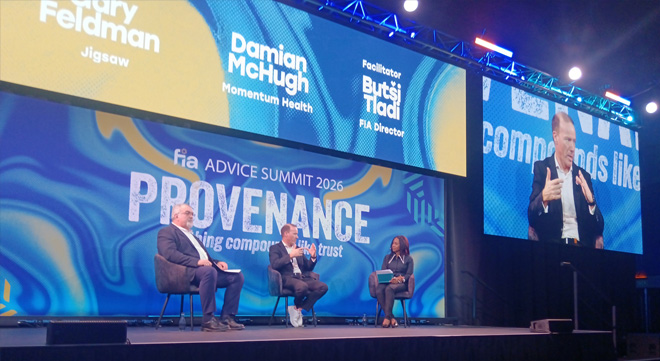
South Africa’s healthcare technology is moving into the future. Its legislative framework, according to Momentum Health’s Damian McHugh, is still catching up with the past.
“We have a Medical Schemes Act that was written in 1998,” said McHugh, chief marketing officer at Momentum Health, during a panel discussion on healthcare, artificial intelligence, and predictive underwriting at the FIA Advice Summit 2026.
“1998 to 2026 is a long time away,” he said. “How much of that legislation is in touch with where our industry will be in three or four or five years’ time? I don’t think it is.”
McHugh pointed to telehealth as an example of how the regulatory environment can shape the way healthcare is delivered.
“Just before COVID, it was illegal to provide healthcare advice over a telephone,” he said. The pandemic changed that, allowing doctors to provide advice remotely rather than requiring patients to travel to a consulting room.
“We literally take a doctor and put it in someone’s home rather than having to go to a doctor’s rooms,” he said.
Remote consultations can cost less than in-person visits and remove practical barriers to accessing care, particularly for people without reliable transport or who need medical advice at night. Not every condition can be assessed remotely, but telehealth illustrates how technology can open more accessible ways of delivering healthcare.
For McHugh, the next challenge is ensuring that legislation keeps pace with technological developments, including the potential of AI to transform healthcare delivery, risk assessment, and administration.
“We need a refresh of our legislative space to enable more innovation, to enable us to be able to create the solutions that we would like to in order to cover more people,” he said.
AI’s biggest opportunity may be in delivering healthcare, not administering it
Healthcare generates enormous volumes of data. Medical schemes process billions of transactions, and within that information are patterns that can help to identify risks, predict future needs, and improve decision-making.
“AI has an unbelievable capability in dealing with large volumes of data and predicting patterns, and there isn’t more data and more volume than in healthcare,” McHugh said.
AI can work through decision trees – sequences of questions and possible answers that lead to a decision – far faster than a person. In underwriting, those questions might concern someone’s age, medical history, or chronic conditions. Doctors follow a similar process when assessing symptoms and working towards a diagnosis.
The advantage lies in the speed and scale at which AI can process information, potentially identifying trends that might take a human much longer to uncover.
For medical schemes and administrators, this creates opportunities to improve claims processing, risk assessment, and customer service. AI-powered chatbots could respond to members’ queries more quickly, while comparative tools could help advisers to navigate the growing range of medical schemes, health insurance, primary care, and gap cover products.
Gary Feldman, executive head of health insurance at Jigsaw, pointed to the gap cover market as an example. Claims data can reveal geographical patterns in costs, including areas where doctors charge substantially more than medical scheme rates. AI can process that information to help providers generate quotations faster.
But McHugh sees the more profound possibilities beyond administration.
“I think more than in the administration or funding of healthcare, I think in the delivery of healthcare,” he said.
AI could help identify people at risk of hospitalisation, allowing healthcare providers to intervene earlier. Combined with advances in remote care and other medical technologies, it could also change the range of services patients can access, and how and where they receive them.
That does not mean every consultation can happen remotely or that technology can replace physical examinations, scans, and tests. Some conditions still require a doctor to see and examine the patient.
The possibilities extend beyond diagnosis and early intervention to technology that could fundamentally change patients’ lives.
“Imagine being in a wheelchair and having technology that can help you walk. Imagine having almost an exoskeleton that adapts to you, giving you freedom of movement again.”
Smarter healthcare does not automatically mean cheaper healthcare
Can AI help bring down medical scheme contributions? Not necessarily, said McHugh. Although technology can improve administration and service delivery, administration makes up only a small part of what members pay.
“To make products cheaper, we need more young, healthy people in our environment to join,” he said.
Feldman said medical schemes had researched what would happen if every formally employed South African were required to join a private medical scheme.
“If the legislation in South Africa were to change, and the medical schemes have done this research, that every formally employed South African was forced to join a private healthcare medical scheme, the contribution rate will come down by approximately 30%,” he said.
Feldman said he would rather consider this option than force the implementation of the National Health Insurance (NHI) system, which he described as unaffordable and unsustainable given the country’s available resources.
And even if AI can identify health risks earlier, it cannot make people act on the information.
Predictive tools could flag members whose health indicators or behaviour suggest they are more likely to end up in hospital, giving schemes an opportunity to intervene before a problem becomes more serious. Whether members change their behaviour is another matter.
AI can warn someone about the consequences of smoking or consuming too much sugar. It cannot make the choice for them.
“The information we share needs to be owned by the individual,” McHugh said.
The same applies when people choose healthcare cover. AI can compare benefits and process information, but it may not know the full picture: a client’s medical history, financial circumstances, or particular needs.
Feldman said an adviser’s knowledge of a client’s pre-existing conditions can be important when explaining waiting periods and what cover will provide.
“The role of the broker is a trusted element of giving advice,” he said. “AI can do it, but AI is not trusted.”
From virtual agents to AI advisers: Insurance tests the limits
AI is already being used in the insurance industry, but McHugh said it is difficult to predict just how far the technology will go.
Some applications focus on customer interaction, from digital humans designed to answer questions to AI tools that help consumers to understand insurance products and compare cover.
DeepBrain AI, for example, markets an interactive AI insurance agent that uses a realistic face and voice to answer questions, explain policies, and guide customers through coverage decisions. The company says the avatar can be customised to resemble an actual insurance agent and operate around the clock, referring more complex cases to human staff. Its technology has been used by South Korea’s Hana Insurance, although the insurer’s documented applications have focused on staff training, communications, and promotional content rather than live customer advice.
A case study published by technology developer True Image Interactive describes an interactive avatar created for Highmark Insurance, a US health insurance organisation, to guide prospective customers through health insurance plan selection. The avatar asked questions and used Highmark’s sales algorithm to suggest suitable plans. True Image Interactive reported that more than 30% of users who began the process applied for cover.
More recently, design agency MONOGRID documented an interactive AI avatar developed for Generali Jeniot installations at Generali agencies. Published in March 2026, the project allows visitors to ask questions in real time about four mobility insurance solutions. The system uses voice recognition and AI-generated responses delivered through a digital avatar.
AI is also being used to personalise insurance recommendations without a digital human. In July 2025, South Korea’s Hana Life Insurance announced an AI recommendation service that analyses customer contract information and other data to suggest combinations of cover, simulate premiums and provide supporting explanations. The service was initially available when designing cover for a specific health insurance product, with plans to extend it to other products.
In India, Shriram Life Insurance announced an AI-created advertising campaign featuring cricketer Rahul Dravid in February 2026. The campaign comprised three television advertisements in six languages. AI was used to reproduce Dravid’s expressions, voice, and movements across the different versions. This was a marketing application rather than a live insurance consultation, but it illustrates how the technology can reproduce a recognisable person across multiple formats and languages.
South Africa has examples of more functional, text-based assistance. Legal&Tax launched an AI business assistant on WhatsApp in 2020, using LivePerson’s conversational platform. The assistant was designed to help customers access services, log insurance claims, and obtain legal, tax and debt-related assistance, with the option of switching to a human agent.
These examples show how insurers are experimenting with increasingly personalised, interactive ways of explaining products and serving customers. But McHugh is wary of taking the same approach to healthcare advice, where a mistake can have serious consequences.
“I think healthcare is too important for that,” he said. “If it goes wrong, it’s materially wrong.”
If AI’s intelligence keeps growing, what happens to the adviser?
Could advisers, doctors, and administrators still be doing the same jobs in a few years’ time? McHugh said he did not know.
AI’s capabilities are improving quickly, but there is no single measure that can reliably predict what the technology will be able to do next.
Stanford University’s 2026 AI Index found that leading AI models made substantial gains on demanding benchmarks during 2025, while some tests became outdated within months. But progress is uneven. A model can perform at an exceptional level on a complex mathematical problem and still struggle with a seemingly simple task.
Researchers are also measuring how much work AI systems can complete reliably, rather than simply how well they answer questions. Even these assessments have limits: success on a defined technical task does not establish that an AI system can reliably perform an entire job.
The International AI Safety Report, led by AI researcher Yoshua Bengio, concluded that AI capabilities could advance slowly, rapidly, or extremely rapidly in the coming years. Experts remain divided over which trajectory is most likely.
For McHugh, that uncertainty is no reason for the industry to stand still.
“If we don’t embrace the technology, the younger consumer who’s coming through is going to embrace it. Therefore, we as advisers and healthcare providers need to also embrace technology to make it happen.”
For brokers, that means getting to grips with AI now. Feldman encouraged advisers to use AI and comparative tools to process information more efficiently, freeing up time to work directly with clients.
But using AI to support advice is not the same as handing responsibility over to it. Feldman warned that advisers remain accountable for what they present to clients.
“If you just take a report that you pull off AI and you present that to your client, which is incorrect factually, who is going to be sued? AI cannot be sued. You as the broker will be sued,” he said.
AI-generated reports and comparisons therefore need to be checked before they inform a recommendation. Advisers must verify the facts and be prepared to stand behind the advice they give.
Client confidentiality is another consideration. Feldman cautioned against entering personal information into third-party AI platforms without first understanding where the data is stored and how it is protected.
His advice was to get familiar with AI sooner rather than later, while using it in a secure environment and understanding its limitations.
The information is available. Understanding it is another matter.
AI may make healthcare information easier to access, but that does not mean clients will understand their cover, read their contracts, or make better decisions.
Feldman said people often pay little attention to policy contracts until they need to claim. Only then do they discover exclusions or limitations they had not understood.
“They only start taking note of it when it’s too late, when it’s at a claim stage,” he said.
That leaves advisers with a responsibility that technology cannot simply take over: educating clients about what they are buying, what it covers, and where its limitations lie.
Feldman described the broker’s role as one of education, information, advice, and ongoing reviews. The relationship should not end when a product is selected. Clients’ needs change, and their cover needs to be reviewed accordingly.
Privacy is part of that responsibility, too. During the discussion, facilitator Butši Tladi, FIA director and CEO of Alexforbes Corporate, questioned what people might be giving up when they accept terms and conditions without reading them. AI services may become increasingly adept at predicting individual needs, but the use of personal data raises questions about how it is processed, stored, and shared.
McHugh argued that data should be used to help consumers and advisers make better decisions, provided it is protected from misuse. Feldman emphasised the need for transparency and secure handling of client information.
The adviser’s value, in this environment, is not simply access to information. It is the ability to put that information into context, understand the client’s circumstances, and explain the implications of a decision.
AI may make healthcare information easier to access, but the adviser’s role is to help clients understand what that information means for them.