
A commercial property owner whose fire-damage claim was rejected after a blaze spread through four leased shops failed to persuade the National Financial Ombud Scheme’s Non-life Insurance Division that the insurer had acted unfairly.
The case, drawn from the NFO’s 2025 annual report, shows that policyholders cannot avoid responsibility for an increased risk simply because a tenant created or contributed to it. Where the condition of the property or the conduct of a tenant increases the hazard, the insured must inform the insurer so that it can reassess the risk and, if necessary, amend the cover.
Nomvelo Kunene, an adjudicator in the Non-life Insurance Division, said the duty to disclose changes in risk remains important even where the insured says the change was outside its control. That is particularly so where policy warranties are breached or exclusions are triggered by a change in circumstances.
Hazardous electrical system
The complaint arose after the insurer rejected a fire-damage claim under a commercial policy covering a building made up of several shops leased to different tenants. The fire affected four shops.
In support of the rejection, the insurer referenced the fire investigator’s findings, the damage report prepared by the specialist assessor, the South African National Building Regulations (SANS), and the following policy exclusion:
“The insured shall take all reasonable steps and precautions to prevent accidents or losses including but not limited to compliance and adherence to laws and regulations which are material to the risk. The insured warrants that all laws, regulations, by-laws, and rules that apply to the business or to any other matter for which cover is provided in terms of this policy (irrespective of whether the laws, regulations, by-laws, and rules are in force at the date the policy is issued, or are enacted after that date) shall be adhered to at all times. The failure to adhere to any applicable law, regulation, by-law, or rule shall entitle the insurer to reject any claim where such failure is material to the claim.”
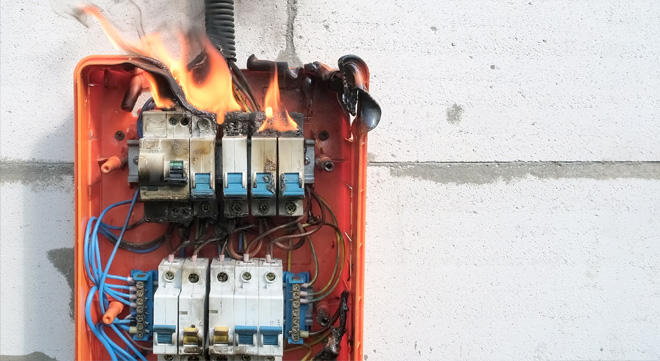
The investigation found that the fire had started at the wall socket directly below the distribution board to which an overused extension cord running through Shop 7 and Shop 8 was permanently connected.
It was also found that the divisions between the shops in the building were not built according to SANS 10400; in other words, they did not form a fire wall, which requires construction with fire-retardant materials reaching roof height.
Additionally, the electrical distribution board and wiring did not comply with SANS 10142, with reports noting poor joints, incorrect cabling, and unprotected entry into draw and plug boxes.
The fire was caused by high electrical resistance from the overloaded extension cord between Shops 7 and 8, which was worsened by poor building practices, resulting in damage to Shops 9 and 10.
No knowledge of tenant’s non-compliance
In subsequent correspondence with the Non-life Division, the complainant stated that, before the claim event, it had made numerous unsuccessful attempts to contact the tenant leasing Shop 7 and, as a result, was unable to conduct compliance inspections.
According to the complainant, the appropriate actions, including an eviction process, were taken to regain access to the property.
The complainant therefore denied knowledge of the tenant’s non-compliant use of the extension cord, which allegedly started the fire, or any of the non-compliant practices present on the insured property.
The complainant also referred to the Tenant’s Clause in the Clauses and Extensions section of the policy, which stated the following:
“The company’s liability to the insured shall not be affected by any act or omission on the part of any tenant (other than the insured) without the insured’s knowledge. The insured shall, however, inform the company as soon as any such act or omission which is a contravention of any of the terms, exceptions, or conditions of this section comes to their knowledge and will be responsible for any additional premium payable from the date any increased hazard shall be assumed by the company.”
According to the complainant, the insurer was not entitled to reject liability for the claim because the cause of loss was primarily attributed to the tenant’s actions or omissions, of which the complainant had no knowledge.
Regarding the building’s failure to comply with SANS regulations, the insurer noted that the complainant was solely responsible for the building’s construction and ongoing maintenance. It also noted that any non-compliance would have been obvious before handing over Shop 7 to the tenant. Therefore, the complainant could not deny knowledge of the building’s poor construction or blame this on the tenant.
Additionally, although the complainant claimed it did not have access to Shop 7, the extension cable used as a permanent fixture between Shop 7 and Shop 8 would have been noticeable if the complainant had fulfilled its ongoing duty to inspect Shop 8.
The insurer concluded that if the building had been constructed in accordance with SANS 10400, it would not have been possible to run an extension cable between the shops, and the damage to Shops 8, 9, and 10 would not have occurred because of the required fire-retardant wall.
Responsibility lay with the owner
The NFO found it was the complainant’s responsibility, as the property owner, to ensure that the property complied with applicable building laws. It followed that a reasonable landlord in similar circumstances would have regularly inspected the shops and ensured that they complied with the relevant regulations.
According to the complainant’s later submissions, the property was undergoing renovations before the loss occurred. Therefore, the complainant should have been reasonably aware of the building’s defective construction, including the dangerous manipulation of the electrical system that caused the loss.
The Tenant’s Clause required that the complainant inform the insurer of an increased hazard, to allow for the necessary underwriting adjustments.
Based on the information presented, the NFO found that the probabilities favoured the conclusion that the complainant had failed to take the necessary steps to prevent the loss. The insurer had provided sufficient evidence to support its case on a balance of probabilities. The complaint, therefore, could not be upheld.