


South Africa has spent more than a decade debating National Health Insurance (NHI), but progress towards expanding affordable healthcare has been slow.
“We’ve been stuck in this vortex for more than a decade,” Professor Roseanne Harris (pictured), executive head of policy and regulatory affairs at Discovery Health, told delegates at Discovery Corporate and Employee Benefits’ inaugural Retirement Fund Forum.
Harris believes, however, that the debate may finally be entering a new phase. The NHI Act was signed into law more than two years ago, but multiple court challenges have since put its implementation on hold. President Cyril Ramaphosa has undertaken not to bring any provisions of the Act into operation until the Constitutional Court has ruled on procedural challenges, while Health Minister Dr Aaron Motsoaledi has similarly undertaken not to implement the legislation pending the outcome of those proceedings.
Read: High Court order stalls NHI roll-out until ConCourt decision
Harris argues South Africa cannot afford to wait for the courts to decide the future of the NHI Act before expanding access to affordable healthcare.
While the litigation runs its course, she believes practical reforms could move the country closer to universal health coverage immediately.
Central to her proposal is allowing medical schemes to build on a market that already provides affordable primary healthcare cover to about two million South Africans. Moving similar products into the medical schemes environment could eventually extend affordable healthcare cover to as many as 10 million people, she argued, while remaining consistent with the broader goal of universal health coverage.
Build on what already exists
The success of the existing primary healthcare insurance products means policymakers should stop treating them as a temporary experiment, Harris argued.
“I think it’s past the point of no return here in terms of this coverage. We estimate there’s around two million people on these policies. It’s not a market that can easily be squashed,” she said.
Rather than allowing those products to disappear, Harris believes they should become the foundation for expanding affordable healthcare.
South Africa has already spent years testing a model that reaches lower-income households, she said. The next step is to move those products into the medical schemes environment, expanding affordable cover for employed South Africans who currently fall outside medical schemes.
People covered by exempted health insurance products do not qualify for the medical scheme tax credits available to scheme members.
“The moment you bring them into medical schemes, they qualify for the tax credit,” she said.
Low-cost benefit options (LCBOs) are affordable medical scheme options aimed primarily at lower-income workers. Because they offer a more limited package of benefits than conventional medical schemes, they require exemptions from some of the Medical Schemes Act’s requirements, particularly prescribed minimum benefits (PMBs).
The medical schemes industry has argued for almost a decade that LCBOs could give millions more South Africans access to affordable private healthcare. Instead of introducing a permanent framework, however, the Council for Medical Schemes has, since 2017, granted temporary exemptions allowing certain insurers to offer comparable primary healthcare insurance products.
The permanent framework has yet to materialise. Instead, LCBOs have become the subject of prolonged policy disagreement and litigation involving the Board of Healthcare Funders, the CMS, and the Department of Health.
Read: BHF slams CMS report on LCBOs as flawed and politically motivated
Discovery estimates that allowing medical schemes to offer equivalent primary healthcare options could eventually extend affordable healthcare cover to about 10 million South Africans.
Harris emphasised that this should not be seen as an alternative to universal health coverage.
“We’re highlighting that these are initiatives that are entirely consistent with what the NHI is trying to achieve,” she said.
Expanding affordable private primary healthcare would, she argued, strengthen rather than weaken the public healthcare system.
She described it as a “virtuous cycle”. As more people move from relying exclusively on the public sector to affordable private primary healthcare, fewer people depend on state-funded services.
“As you take more people who are relying on the public sector out of that dependence, then you actually increase the per capita amount that’s available for the people who do depend on the public sector,” she said.
Harris added that Discovery also sees a role for the private sector in strengthening public healthcare directly through initiatives such as helping to clear treatment backlogs and contributing to the training of healthcare professionals.
Can the numbers add up?
Harris accepts the premise behind NHI: South Africa must tackle unequal access to healthcare.
Where she differs from the government is over whether the NHI’s proposed single-fund model – in which a central NHI Fund would become the main purchaser of healthcare services – is financially feasible.
“The current model is not feasible – that’s the problem. We need to address the levels of inequality and access to healthcare in South Africa. So, the imperative is to find a model that is workable,” she said.
To explain why, Harris points to the way healthcare is financed in South Africa. Discovery’s analysis begins with the country’s population distribution. It shows that only about 14% of South Africans belong to medical schemes, while much larger groups fall outside medical schemes, including people in the informal sector and those who are unemployed. The challenge, she argued, is what happens when that population distribution translates into the country’s tax base.
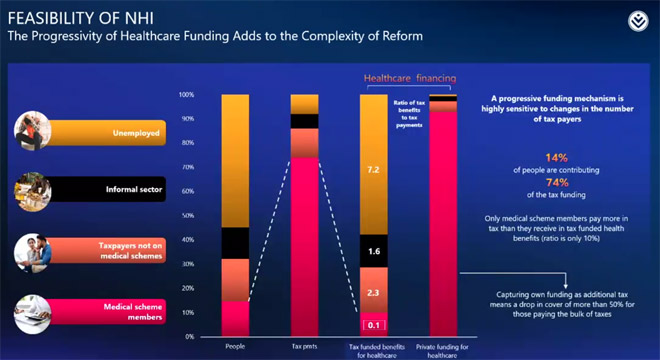
Although medical scheme members make up only about 14% of the population, they contribute roughly 74% of personal income tax. Discovery’s analysis also suggests they are the only group that pays more in tax than it receives back in tax-funded healthcare benefits, with those benefits amounting to only about 10% of the tax they contribute.
One of the biggest problems with the NHI debate, Harris argued, is that it often treats two very different sources of healthcare funding as though they are interchangeable.
One is public healthcare, funded through taxes. The other is private healthcare, funded through medical scheme contributions paid from households’ after-tax income.
“They’re often conveniently lumped together,” she said.
That creates the impression that the money South Africans already spend on medical schemes can simply be redirected into a single NHI Fund.
Medical scheme contributions, she said, are private household spending, not public revenue.
“The only way for that last block to become part of any kind of public health financing is for the taxes to be raised,” she said.
Discovery estimates that replacing today’s private healthcare spending through taxation would require taxes paid by this relatively small taxpayer base to increase by more than 50%.
“You’re asking people to pay much more in taxes, and then that gets redistributed. What they get back is obviously a much smaller proportion,” Harris said.
If those taxpayers still needed to buy supplementary cover because the NHI package did not meet all their healthcare needs, “the net cost is huge”.
“It’s a big ask.”
WHO guidance and the costing debate
The funding debate feeds into one of the central questions in the litigation surrounding the NHI Act: can a reform of this scale be meaningfully costed?
That question was argued before the Constitutional Court in May, with judgment expected later this year or early next year.
Read: NHI case hinges on one question: was the public truly heard?
The government has argued that because NHI will be implemented over many years, it cannot realistically be reduced to a single upfront price tag. During the Constitutional Court hearing, Parliament’s legal team argued that costs should instead be assessed as implementation progresses, saying this reflects how large health reforms are rolled out internationally.
Harris believes that interpretation misreads the World Health Organization’s guidance.
According to Harris, the WHO is not saying governments should avoid costing major health reforms. Rather, it recommends modelling different implementation scenarios so policymakers can assess the financial implications of different pathways towards universal health coverage.
She said that is precisely the approach Genesis Analytics adopted on behalf of the Healthcare Funders Association in its challenge to the NHI Act. Instead of producing a single headline cost, the analysis modelled a range of funding scenarios based on different assumptions about how universal health coverage could be implemented.
For Harris, the purpose of that work is not simply to argue that the current NHI model is unaffordable. It is to demonstrate that even where long-term reforms cannot be priced with certainty, policymakers should still test different funding options and understand their likely fiscal consequences before choosing a path.
She hopes the evidence before the courts will contribute to a more informed policy debate if Parliament is ultimately required to reconsider the legislation following the Constitutional Court’s ruling.
Litigation has changed the conversation
Harris believes the NHI Act is unlikely to remain in its current form.
“I think there has been a significant shift,” she said.
She pointed to the Government of National Unity, noting that it is a different government from the one that passed the NHI Act. She also said the Department of Health’s court affidavits reflect a change in official thinking compared with the positions advanced during the original parliamentary process. If the Constitutional Court ultimately refers the legislation back to Parliament because of procedural shortcomings, Harris believes lawmakers will have an opportunity to improve the Act rather than simply repeat the original legislative process.
“It would provide the opportunity for these kinds of amendments to make the NHI Act more workable,” she said.
Harris also stressed that any changes remain some way off. With the implementation of the Act effectively on hold pending the Constitutional Court’s ruling, she noted that the Department of Health’s own court papers indicate medical schemes are unlikely to be materially affected for at least another 15 years.
Perhaps the biggest change, she suggested, is that the litigation has created space for more meaningful engagement between the government and the private sector.
“I’m not sure we would have got to a workable engagement process without this push of the litigation,” she said.


