

A client walks into your office and tells you they have been holding Bitcoin since 2020.
They did not mention it when you last reviewed their portfolio. They bought it themselves, moved some of it into a private wallet, and, at some point, transferred a portion to an offshore exchange.
Now they want your advice.
For financial advisers, the question is no longer whether digital assets belong in the conversation. The harder questions are what an adviser can advise on, where a client can move those assets, and what happens when the South African Revenue Service comes looking for the tax trail.
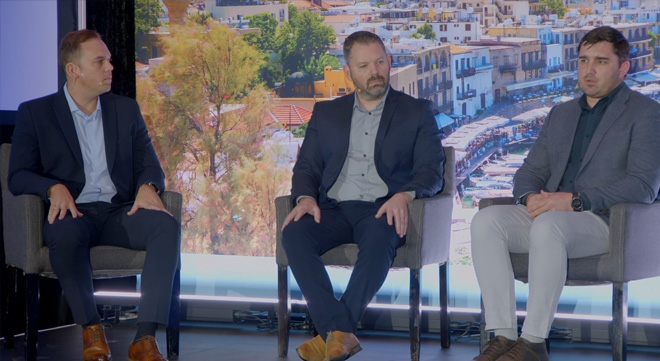
Those were the three questions at the centre of a digital asset fireside chat at the International Investing Symposium in Cape Town on 1 October 2026, moderated by Jason Carpenter, founder of EtherBridge, with Marius Reitz, general manager for Africa at Luno, and Dr Wiehann Olivier, a partner and global co-head of digital assets at Forvis Mazars.
Carpenter put the issue in practical terms.
“There is plenty of clients who went and bought Bitcoin back in 2017 or 2020 and failed to mention it to you.”
It may have been possible to treat that as a client investing outside the traditional financial system. It is harder to do that now.
“SARS disagrees, the Reserve Bank disagrees, and the FSCA has disagreed for about four years,” Carpenter said.
Who can touch the asset?
Reitz said the market has moved well beyond Bitcoin and Ethereum. Digital assets now include stablecoins and tokenised versions of equities, commodities, private credit, and other real-world assets.
An adviser without the relevant crypto asset permissions can still help a client to understand the risks around an investment. Reitz pointed to questions such as liquidity, custody, and the platform being used.
An adviser might, for example, look at whether an asset can be sold without significant price slippage, or whether the platform holding it provides adequate evidence that the client assets exist.
“Context obviously is super important,” Reitz said.
Writing a newsletter about Bitcoin reaching an all-time high is very different from sitting with a client approaching retirement and discussing whether that client should buy Bitcoin.
The regulatory position has also changed.
Crypto assets are now a defined product category under the South African regulatory framework, with about 300 financial services providers approved to provide advice or intermediary services in relation to crypto assets.
For an existing FSP, obtaining the relevant permission does not necessarily mean starting again with an entirely new licence. Reitz explained that an FSP can apply for the additional crypto asset product category on its existing licence.
The Financial Sector Conduct Authority will, however, want to see that the FSP understands the product. Reitz said relevant experience could include having invested in crypto assets, worked in compliance, or advised businesses operating in the sector.
And the assets themselves are changing.
When a share becomes a token
A client might hold a token representing an Apple share or a Treasury bill. The underlying asset is familiar. The token sits on a blockchain.
Olivier said the regulatory treatment depends on what the token represents.
The evolution began with Bitcoin, followed by smart-contract blockchains such as Ethereum. That technology made it possible to create digital representations of other assets, from artwork to currencies and eventually financial assets.
“Everything is being digitised: currency, property, stocks, equity, the lot, everything is being tokenized,” Olivier said.
Regulators internationally are grappling with whether a tokenised asset should be regulated according to the token itself or according to what the token represents.
South Africa is still working through that question.
A tokenised share available through a local crypto asset service provider may still be treated as a crypto asset for South African regulatory purposes, even though it provides exposure to a conventional share.
Where can the asset move?
Things become more complicated when a client wants to move digital assets across borders.
South Africa’s exchange control framework was designed around a financial system in which banks and other authorised intermediaries act as gatekeepers for cross-border flows.
Bitcoin does not necessarily need one.
As Reitz pointed out, two people holding Bitcoin themselves can transact directly without a bank facilitating the transfer.
The legal position has also been unsettled.
In May 2025, the High Court in Pretoria ruled that cryptocurrencies do not fall within the definitions of “money” or “capital” in the Exchange Control Regulations. The case involved Standard Bank and the South African Reserve Bank and centred on the treatment of funds linked to cryptocurrency transactions.
Moonstone reported on the judgment at the time:
Read: Cryptocurrencies outside Exchange Control Regulations, court rules
That judgment did not settle the matter. The SARB applied for leave to appeal, and the judgment was suspended pending the appeal.
Read: High Court ruling on crypto exchange control suspended pending appeal
Then, in June 2026, the High Court in Johannesburg reached the opposite conclusion. Judge Stuart Wilson found that cryptocurrency is both “money” and “capital” for purposes of Regulation 10(1)(c) of the Exchange Control Regulations. He described the earlier Pretoria finding as “clearly wrong”.
Read: Judgment adds to uncertainty over crypto’s exchange control status
The two judgments leave the legal position unsettled while the appeal remains outstanding.
At the same time, National Treasury has been working on a new framework. The Draft Capital Flow Management Regulations published in April 2026 propose replacing the 1961 Exchange Control Regulations and incorporating crypto assets into the capital flow framework.
Olivier explained what that could mean in practice. Under the proposed framework, sending cryptocurrency to a foreign exchange or service provider could constitute an externalisation event. Self-custody also becomes relevant because moving assets from a regulated platform into a private wallet takes them outside the custody of that platform.
The effect will not be the same for every investor.
Reitz said more than 90% of Luno’s customers never send or receive their crypto. They simply buy and sell it on the platform.
For those clients, the proposed changes would have little practical effect.
The more difficult case is the client who wants to hold the asset personally, particularly where the attraction of Bitcoin is that it can be transferred directly from one wallet to another.
Self-custody means self-responsibility
With a conventional investment, losing access to an account does not usually mean losing the underlying asset. There is generally a financial institution, administrator, or other intermediary that can help to reconstruct the position.
Self-custodied digital assets do not necessarily offer that option.
Olivier explained the difference between a public key, which can be shared, and the private key that controls access to the assets.
Lose the private key and the asset may effectively be lost.
There is no intermediary to call.
Third-party custody removes some of that risk but creates another dependency: the client is relying on the custodian’s security and operating arrangements.
The collapse of FTX in November 2022 is a useful example of how problems at a major crypto exchange can spread through the market. FTX, then one of the world’s largest cryptocurrency exchanges, filed for bankruptcy after a wave of customer withdrawals exposed serious problems with its finances and the use of customer funds. The collapse left other firms that had exposure to FTX or its related businesses under pressure.
Olivier pointed to a related risk in custody arrangements: one custodian may rely on another, which may rely on another, creating a chain of exposure.
If one link fails, the effects can spread through the chain.
So, the conversation with the client needs to go beyond where the Bitcoin is held.
Reitz suggested two practical questions: does the client have a recovery plan if the seed phrase or private key is lost, and does anyone else know that the assets exist?
The second question becomes particularly relevant when a client dies.
A client can die with substantial digital assets that never appear in the information available to the executor or family.
The asset may still exist. The problem is that nobody knows where it is or how to access it.
SARS can see more than clients think
The third question is tax.
Here, Olivier said, some misconceptions remain.
One is that cryptocurrency sits outside the tax system because it operates outside the traditional financial system.
It does not.
A South African tax resident is generally taxed on worldwide income, and receiving cryptocurrency can therefore have tax consequences.
Another misconception is that tax arises only when cryptocurrency is converted back into rands.
Olivier said crypto-to-crypto transactions can also constitute taxable events because they are treated as barter transactions.
Moving Bitcoin into another cryptocurrency does not make the transaction disappear for tax purposes.
Nor does holding an asset for three years automatically make the resulting gain capital in nature. Olivier pointed out that the three-year rule in section 9C of the Income Tax Act applies to qualifying equity shares, not cryptocurrency.
Then there is the belief that SARS cannot see what happens on the blockchain.
Blockchain transactions are publicly visible. Although addresses are pseudonymous rather than necessarily linked to a person’s name, blockchain analytics can be used to identify transaction patterns. Information obtained from service providers can then be used to connect those transactions to taxpayers.
“The thing about blockchain technology is transparent,” Olivier said.
The same applies when assets are moved between legal entities.
Olivier gave the example of a client moving cryptocurrency from a personal account into a trust or company. The transfer may happen seamlessly, but that does not mean nothing happened for tax purposes. It can be treated as a disposal, potentially triggering a capital gain or loss even though the client has not sold the cryptocurrency for cash.
What if the client has already got it wrong?
Then an adviser may find themselves sitting across from a client with several years of undeclared cryptocurrency transactions.
South Africa’s Voluntary Disclosure Programme (VDP) provides a mechanism through which taxpayers can approach SARS to regularise their affairs.
Olivier emphasised that timing matters. Once SARS has begun an audit, inspection, or interrogation into the taxpayer’s affairs, the taxpayer loses the ability to enter the VDP.
The VDP can provide relief from penalties, although interest remains payable.
The assumption that SARS can go back only five years is also unsafe. Olivier said SARS can go back further where it believes there has been an understatement of tax.
For an adviser, the question is not necessarily how to calculate the tax. It is knowing when the client needs specialist tax advice and making sure the client deals with the issue.
There are more options than buying Bitcoin
The final part of the discussion moved towards the growing range of ways clients can obtain digital asset exposure.
Direct ownership of Bitcoin or Ethereum remains one option.
There are also bundled products providing exposure to multiple crypto assets, tokenised equities, tokenised commodities, funds, and offshore ETFs. Stablecoins provide another route for clients seeking exposure to major currencies.
Tokenised equities can provide exposure to the price of an underlying share and, depending on the structure, dividends, but the investor does not necessarily receive the voting rights attached to the underlying equity.
The structure also affects the tax treatment.
Reitz pointed out that an adviser cannot assume that a product containing several assets has the same tax treatment as a conventional investment portfolio. Olivier added that rebalancing a crypto bundle can itself create crypto-to-crypto transactions, potentially creating taxable events.
Crypto assets also do not fall within the conventional collective investment scheme structure.
The product label alone is not enough. Advisers also need to consider the terms and conditions, custody arrangements, underlying assets, and how the product works.
The conversation has moved on
The digital asset conversation in financial advice is no longer simply about whether Bitcoin is too risky or whether a client should have 5% of their portfolio in crypto.
The harder questions are operational:
- Who is permitted to advise on it?
- Where can the client hold and move it?
- Who can see the transactions, and what are the tax consequences?
Those questions run through licensing, exchange control, custody, estate planning, and tax.
The technology allows an asset to move almost instantly. Regulation, tax, and estate planning do not move quite so quickly.
It is less about predicting where Bitcoin’s price will go and more about understanding what happens around it.
“We should flip the discussion around advice and really make sure that the clients understand what it is that they are investing in,” Reitz said.


