

The Financial Sector Conduct Authority imposed almost R2.9 billion in administrative penalties in the year to 31 March 2026, a sharp increase driven largely by three cases, significant market abuse actions, and Financial Intelligence Centre Act compliance failures.
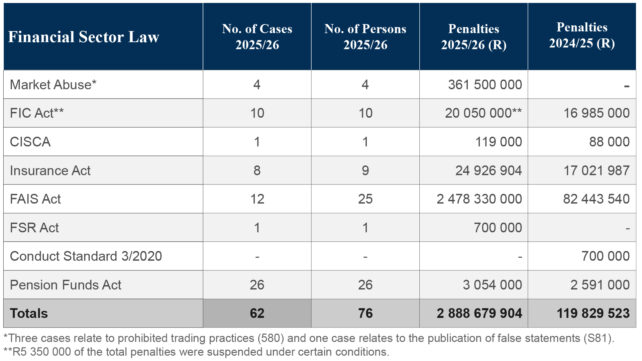
The FSCA’s fourth annual Regulatory Actions Report shows that administrative penalties rose to R2 888 679 904, from R119.8 million in the previous reporting period. The penalties were imposed on 76 persons and entities in 62 cases.
FSCA Commissioner Unathi Kamlana told a media briefing on 31 July that the report has become an important transparency instrument, bringing together enforcement actions already in the public domain to give a clearer view of the regulator’s strategic focus areas, enforcement trends, and use of resources during the year.
Kamlana said enforcement forms part of a broader continuum of regulatory actions used to deliver a risk-based and outcomes-focused approach to conduct regulation and supervision.
He said the FSCA directs its limited resources to areas where they will have the greatest impact, particularly misconduct that poses the greatest risk of harm to financial customers or has serious implications for market integrity and confidence in the financial sector.
Presenting the report, Gerhard van Deventer, divisional executive: enforcement, said the Authority’s enforcement approach is based on “credible, timely, and proportionate enforcement”, which he said is central to addressing misconduct and maintaining trust in the financial sector.
Van Deventer said the regulator does not have a single “go-to sanction” in every case, but considers what sanction, or combination of sanctions, will best address the misconduct.
More investigations finalised
The FSCA finalised 678 investigations in 2025/26, up from 633 in 2024/25 and 430 in 2023/24. Ongoing investigations decreased to 340, from 494 in 2024/25 and 360 in 2023/24. New cases declined to 524, from 767 in the previous year, although they remained above the 483 new cases recorded in 2023/24.
The report states the increase in finalised investigations was achieved despite a sustained inflow of complaints and new matters. It attributed the improvement to operational efficiencies, a more risk-based and data-driven enforcement approach, the enhanced use of intelligence and analytics, and increased enforcement capacity.
FAIS Act matters accounted for the largest share of finalised investigations. The FSCA finalised 515 FAIS investigations, compared with 347 in 2024/25 and 265 in 2023/24. Insurance Act investigations accounted for 68 finalised matters, down from 131 in 2024/25 and equal to the 68 recorded in 2023/24. Insider-trading finalisations decreased to 19, from 41 the previous year, while prohibited-trading-practice finalisations declined to 10, from 23.
The report says cases with the greatest impact on financial customers, particularly those involving vulnerable individuals or suspected misconduct by regulated entities, continue to be prioritised.
The FSCA also referred 46 matters to the South African Police Service during the review period and is assisting with 12 active criminal investigations and prosecutions.
Penalties concentrated in major cases
Although the total value of penalties rose sharply, Van Deventer said the increase was not spread evenly across the FSCA’s enforcement work. He said the FAIS Act penalties were driven mainly by two major cases, Banxso and Medbond, while the market abuse figure was driven largely by the latest Steinhoff-related enforcement action.
FAIS Act penalties increased to R2.478 billion, from R82.4m in 2024/25. Financial Intelligence Centre Act penalties increased to R20.05m, from R16.985m in the previous year, while Insurance Act penalties rose to R24.9m, from R17m. Market abuse penalties totalled R361.5m in 2025/26.
Kamlana said a question that “invariably arises” when the FSCA publishes the report or imposes administrative sanctions is whether administrative penalties are recoverable.
He said the FSCA pursues all reasonable and lawful avenues to recover penalties because it is required to do so under the Public Finance Management Act. But recovery is not always possible, particularly where an entity becomes insolvent, enters liquidation, or where other legal complications arise. This, he said, does not diminish the importance of administrative penalties as a regulatory tool to hold wrongdoers accountable, deter future misconduct, and reinforce confidence in the integrity of the financial sector.
Banxso: deepfakes, CFDs, and client funds
The largest enforcement matter was the FSCA’s action against Banxso (Pty) Ltd, which involved deepfake advertising, contracts for difference (CFDs), unauthorised over-the-counter derivative activity, and misappropriation of client funds.
The FSCA opened its investigation in March 2024 after receiving information about the use of deepfake advertisements. The report says Banxso had misappropriated the identities of well-known individuals to promote a fraudulent online investment offering branded as Immediate Matrix. People who responded to the advertisements were redirected to Banxso representatives and encouraged to trade mainly in CFDs, which the FSCA described as complex, high-risk derivative instruments regarded as unsuitable for most retail investors.
The investigation found that client funds were not placed with legitimate liquidity providers or authorised over-the-counter derivative providers. Instead, the funds were controlled internally by Banxso, commingled, transferred between non-designated accounts, rendered difficult to trace, and misappropriated for personal and business expenses.
The FSCA imposed a R2bn administrative penalty jointly and severally on Banxso and two individuals. It also imposed additional penalties of R16m on Banxso, R20m on Manuel de Andrade, R10m on Mohammed Bux, and R5m on Henry Simpson.
Banxso’s FSP licence was withdrawn. Harel Sekler, Warwick Sneider, De Andrade, and Bux were debarred for 30 years, while Simpson was debarred for 10 years.
In December 2025, the Financial Services Tribunal dismissed an application for reconsideration of Banxso’s licence withdrawal. In February 2026, the five individuals lodged reconsideration applications in respect of the debarments and penalties. These matters are pending.
Van Deventer said the case was particularly concerning because Banxso was a licensed entity. In his view, it was later “infiltrated” and linked to deepfake advertising.
He said the case illustrated that the FSCA’s response was not only punitive, because licence withdrawal and long debarments were aimed at protecting the public by removing unsuitable persons from the industry.
The FSCA referred its findings and supporting evidence to the Directorate for Priority Crime Investigation (Hawks), to support potential criminal proceedings.
The Western Cape High Court placed Banxso into final liquidation in March 2026.
Van Deventer said the FSCA had approached the Financial Intelligence Centre to freeze about R100m spread across several bank accounts and had assisted the Asset Forfeiture Unit in obtaining a preservation order, after which the funds were transferred to the liquidator.
He said the FSCA may provide information, including an investigation report, where it could assist a court, but it does not manage the liquidation process.
Medbond: fictitious investment product
The second major FAIS-related case involved Medbond Insurance Brokers (Pty) Ltd and related entities and individuals.
The FSCA investigated complaints from investors about investments facilitated by Medbond Insurance. It found that clients had been induced to invest in a purported fixed-term group variable annuity product allegedly issued by Lombard International Life Ltd, a Bermuda-based insurer. Lombard International confirmed that it had not issued any such product to the Medbond entities and held no client funds on their behalf.
Bank records showed that investor funds were not invested but misappropriated. The FSCA said investors suffered losses of about R194m after being misled into subscribing to a non-existent financial product.
The Authority imposed a R197m penalty jointly and severally on Jacobus Meyer and Medbond Insurance. It also imposed penalties of R5m each on Medbond Markets, Masjamplan, and Medbond Fund Managers.
The FSCA withdrew the FSP licences of Medbond Insurance and Medbond Markets. Meyer was debarred for 30 years, while Frederick van Heerden was debarred for four years.
The report records that Van Heerden provided extensive and material co-operation during the investigation, which assisted the FSCA in clarifying the operational structure of the scheme and quantifying client losses. It says the evidence indicated that Van Heerden had entrusted his own personal investments to Meyer, supporting the conclusion that he was not aware of the misappropriation.
Van Deventer told the media that the Medbond matter had provided a useful precedent for how the FSCA can deal with co-operation from an internal person, even where the matter does not result in a formal leniency agreement.
Steinhoff: further penalty in market abuse investigation
The Steinhoff investigation produced another significant penalty during the year. The FSCA imposed an administrative penalty of R358.75m on Stehan Grobler for his role in publishing false financial statements for the period 2014 to the 2017 half-year.
Grobler held several senior roles at Steinhoff International during the relevant period, including company secretary, head of treasury, director of several subsidiaries, and in-house legal counsel. The FSCA found that he contravened sections 81(1)(a) and 81(1)(b) of the Financial Markets Act by participating in the scheme involving misleading annual financial statements and integrated reports.
Grobler has lodged an application for reconsideration with the Financial Services Tribunal, and the matter remains pending.
Van Deventer said the broader Steinhoff market abuse investigation was not yet finalised but was “very close” to being completed.
Debarments and licence actions
The FSCA debarred 68 individuals following investigations during the reporting period. Dishonesty and integrity-related failures remained the leading reason for these actions: 66 debarments related to non-compliance with the personal character qualities of honesty and integrity, while two related to competence requirements.
FSPs separately debarred 1 792 representatives, down from 1 879 in 2024/25 but still above the 1 361 recorded in 2023/24. Dishonesty accounted for 1 740 of the 2025/26 FSP-led debarments, compared with 1 879 in 2024/25 and 1 312 in 2023/24.
Van Deventer said debarments and licence withdrawals are aimed at removing unfit participants from the industry. He said integrity remains the cornerstone of market participation, and people and entities that lack it should not be in the market.
The FSCA suspended 31 licences, up from 24 in 2024/25, but far below the 1 061 suspensions recorded in 2023/24. Licence withdrawals fell sharply to 14, compared with 382 in 2024/25 and 75 in 2023/24. Reinstatements declined to 12, from 58 in 2024/25 and 621 in 2023/24.
Directives and enforceable undertakings
The FSCA issued 11 directives during the year. Nine were issued in the anti-money-laundering (AML) context, and two were issued to funeral parlours conducting unregistered insurance business. The funeral parlours were directed to cease unlawful insurance business, transfer their clients to a regulated entity, and inform clients of the developments.
The Authority also accepted 36 enforceable undertakings, up from 14 in 2024/25 but below the 41 recorded in 2023/24. Insurance accounted for 34 undertakings in 2025/26, compared with 12 in 2024/25 and 35 in 2023/24, reflecting the continued focus on funeral-related cases.
Van Deventer said directives and enforceable undertakings are used where harm can be reversed or a compliance problem can be fixed, and where the FSCA does not necessarily need to impose harsher sanctions or remove the firm from the market.
The FSCA said enforceable undertakings remain an important tool in funeral parlour investigations because they allow the regulator to require corrective action and address compliance deficiencies without necessarily resorting to lengthy enforcement proceedings or administrative penalties.
AML/FICA penalties
Anti-money-laundering and counter-terrorist financing compliance remained a significant enforcement area. FICA penalties totalled R20.05m across 10 cases, compared with R16.985m in 2024/25. Of the 2025/26 amount, R5.35m was conditionally suspended.
The FSCA identified recurring weaknesses including failures to conduct comprehensive Business Risk Assessments, inadequate Risk Management and Compliance Programmes, deficient customer due diligence, and failures to screen against the Targeted Financial Sanctions lists.
Van Deventer emphasised that the FSCA does not investigate money laundering. He said that responsibility rests with other agencies, while the FSCA’s role is to supervise whether accountable institutions under its jurisdiction have the right systems in place and comply with AML requirements.
Click here to download the 2026 Regulatory Actions Report.