
Medihelp will increase its weighted average contribution by 7.5% in 2027, with the scheme saying 60% of its members will face increases of 7% or less.
The increase continues a downward trend after two years in which members absorbed substantially higher increases. Contributions rose by 15.96% in 2024 and 10.8% in 2025 as Medihelp implemented a three-year financial recovery plan approved by the Council for Medical Schemes (CMS), after the scheme’s solvency ratio fell below the statutory 25% minimum. The plan was aimed at rebuilding Medihelp’s reserves through higher contributions, alongside claims management and operational measures.
Medihelp’s solvency ratio subsequently recovered to 27.01% at the end of 2025, a year ahead of the original recovery timetable.
Read: Medihelp’s turnaround: How the scheme rebuilt its business before its balance sheet
The contribution increase moderated to 8.46% in 2026 and will fall again to 7.5% in 2027.
Medihelp has also added or enhanced benefits covering emergency room treatment for children, mental health, maternity, preventive screening, and telehealth.
“Our responsibility extends beyond maintaining strong reserves. It includes ensuring that healthcare remains accessible, affordable, and sustainable for the people who place their trust in us,” said Varsha Vala, chief executive and principal officer of Medihelp.
What members will pay in 2027
The increase varies by option. The table below shows the monthly contribution for a main member. MedVital Elect and MedVital have the lowest increases, at about 6.5%, while MedSaver and MedElite will increase by about 8.5%.
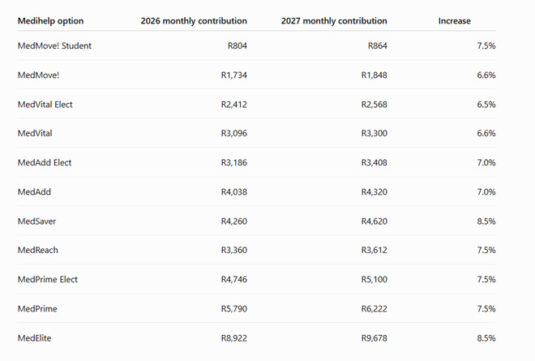
Note: The table compares the main-member monthly contributions listed in Medihelp’s 2026 and 2027 product guides. MedPlus is mentioned in the 2027 product range, but no MedPlus contribution is provided in the 2027 contribution table, so it is not included above.
Mental health gets more room
Mental healthcare is one of the areas Medihelp has strengthened for 2027.
The scheme already offered an out-of-hospital benefit for the treatment of depression in 2026. For 2027, it is structured as a Depression Support Programme, with increased benefits on the applicable options.
Depending on the option, members will have between R3 500 and R5 500 per beneficiary a year for out-of-hospital treatment by psychiatrists, clinical psychologists, social workers, occupational therapists, psychiatric nurses, and registered counsellors.
The monthly medicine benefit ranges from R130 to R170 per beneficiary, depending on the plan. Medihelp says the mental health benefit will also be available on MedMove!.
Two extra GP visits for getting screened
Medihelp is also expanding the Care Extender benefit, which rewards members for completing preventive screening.
In 2026, qualifying screening unlocked one additional GP consultation and R1 000 towards self-medication. From 2027, members can unlock two additional GP consultations.
The first qualifying screening test unlocks one consultation, and a second test unlocks another. Completing the required combination health screening also gives the family an additional R1 050 towards non-prescribed or acute medication.
Qualifying tests include a Pap smear, mammogram, prostate test, faecal occult blood test, and bone mineral density test.
Emergency room cover for children
Medihelp is introducing a standalone emergency room benefit for beneficiaries under the age of 19.
It will apply at hospital-based emergency rooms and qualifying 24-hour practices designated by Medihelp, with cover determined by the triage level assigned by the emergency unit.
Levels 1 to 3 – ranging from immediate, life-threatening cases to urgent cases – qualify for the emergency consultation. At Level 2 and Level 3, the facility fee is also covered. At Level 1, the facility fee is usually not applicable if the patient is admitted.
Level 4 cases, classified as less urgent or non-urgent, are not covered by the new benefit. Those cases may instead be paid from available savings or consultation benefits, depending on the member’s plan.
The benefit does not apply to MedMove!, which already covers an emergency room facility fee. In 2026, emergency room facility fees were otherwise listed among Medihelp’s exclusions.
More support around pregnancy and parenthood
Medihelp has also expanded its maternity support for 2027, including a clinical psychologist consultation to support mothers’ mental health.
Depending on the plan, maternity benefits include antenatal and postnatal consultations with a midwife, GP, or gynaecologist, as well as access to a dietitian, lactation specialist, or antenatal classes.
Medihelp’s Parenting journey, which continues after birth, includes Parent Sense content, weekly mailers, webinars and access to the “aiah” app. Other benefits include paediatric care, vaccination support, and newborn hearing screening.
Support continues into the toddler years, with information on sleep, feeding, routines, development, tantrums, and starting school.
Telehealth and other changes
Telehealth consultations also form part of the day-to-day benefit structure for 2027, alongside virtual GP consultations and other primary-care services on applicable plans.
Other changes are contraceptive benefits for women from age 12 until menopause or age 55, and meningococcal vaccination for specified age groups.
MedMove! members older than 12 will also have access to one scale-and-polish treatment per beneficiary a year.
Medihelp’s 2027 product guide notes that the information is subject to CMS approval and that the scheme’s registered rules take precedence.
The solvency turnaround
The roots of Medihelp’s solvency problem go back to the pandemic. In 2021, the scheme decided not to increase contributions, and for 2022 it reduced its weighted average contribution by 0.45%. The move returned about R800 million to members at a time when many households were under financial pressure.
It also meant that the scheme’s reserves did not grow as they otherwise might have. As healthcare utilisation returned to more normal levels, claims increased and the pressure on the scheme’s finances became apparent.
Medihelp increased contributions by 7.5% in 2023, but its solvency ratio fell to 23.84%, below the statutory 25% minimum. Its relevant healthcare expenditure ratio had climbed to 100.8%, and it reported a deficit before other comprehensive income of R286.6m.
The scheme responded with a three-year financial recovery plan, which was approved by the CMS. It combined higher contributions with claims management and operational measures aimed at rebuilding Medihelp’s reserves.
Members felt the effects in their contributions, which increased by 15.96% in 2024 and 10.8% in 2025.
The balance sheet did not turn around immediately. At the end of 2024, Medihelp’s solvency ratio had fallen further to 20.99%. Its operating performance, however, had begun to improve.
The relevant healthcare expenditure ratio fell from 100.8% in 2023 to 94% in 2024 and 91.2% in 2025. After the R286.6m deficit in 2023, Medihelp reported a surplus before other comprehensive income of R30.7m in 2024, rising to R282.3m in 2025.
The disposal of an Allan Gray-linked investment also contributed to the recovery. The transaction converted previously unrealised investment gains into realised gains that could be recognised in the statutory solvency calculation. In 2025, R201.2m in previously unrealised gains strengthened accumulated funds for solvency purposes, while R79.5m was recognised in the year’s surplus.
By the end of 2025, Medihelp’s solvency ratio had recovered to 27.01%. The scheme says it reached the statutory 25% level a full year ahead of the timetable in its original three-year recovery plan.
“Our responsibility extends beyond maintaining strong reserves. It includes ensuring that healthcare remains accessible, affordable, and sustainable for the people who place their trust in us,” says Vala.