
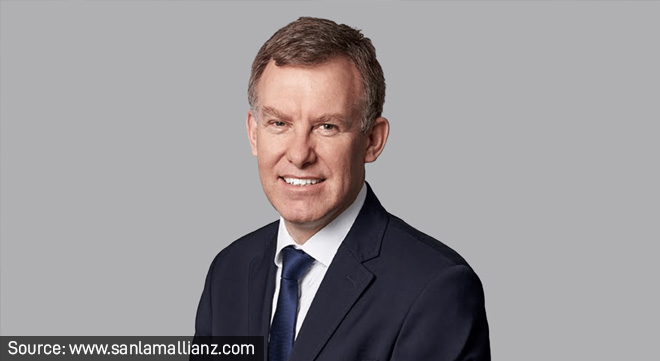
“It’s actually quite a simple story,” Hennie Nel (pictured) told investors at Sanlam’s Capital Markets Day on 15 October 2026.
The chief executive of SanlamAllianz was describing a business that had spent three years building a platform across Africa. The next task, he said, was to start earning from it.
According to Nel, the hard work of bringing the businesses together is largely done. The results, however, show that there is still plenty to sort out.
Sanlam and Allianz have completed 11 regulatory integrations in overlapping markets, at a one-off cost of R961 million. The group says it is now realising annualised pre-tax cost synergies of R934m. Its life insurance operations have delivered strong growth, and SanlamAllianz has declared its first dividend.
But general insurance has underperformed, overall earnings have come under pressure, and SanlamAllianz Re (SAZ Re) has required substantial shareholder support after serious legacy accounting and governance problems came to light.
Now comes the make-or-break moment. The industry and investors will be watching to see whether SanlamAllianz can turn its scale into sustained profits.
Building the platform
SanlamAllianz began operating in October 2023, bringing together Sanlam’s African operations outside South Africa, excluding Namibia, and Allianz’s African businesses. The joint venture gave the partners a larger footprint across a continent where insurance penetration averages about 3.5% of GDP, roughly half the global rate.
In his presentation, Nel described SanlamAllianz as the largest pan-African insurance business on the continent, with a presence in 25 countries. He said it held a top-three position in 15 of 21 life insurance markets and 17 of 23 general insurance markets, with an average market share of about 16%.
The combination also gives Sanlam access to Allianz’s international technical capabilities, while Allianz gains Sanlam’s local market knowledge and established distribution networks.
Allianz’s wider business is performing strongly. In a report published on 23 October, S&P Global Ratings revised its outlook on Allianz SE and its core and highly strategic subsidiaries from stable to positive, while affirming its ‘AA’ ratings.
Allianz’s net income rose 15.5% to nearly €6.4 billion in the first half of 2026, with its return on equity above 19% over the preceding 12 months. S&P expects annual net income of between €11bn and €14bn over 2026 to 2028, with return on equity exceeding 17%.
But assembling businesses across multiple countries is not the same as making them operate as one. Different regulatory requirements, licences, systems, and reporting arrangements had to be aligned before management could focus fully on growth.
At the Capital Markets Day, Nel said all 11 regulatory integrations had been completed in three years, with final approval for Morocco received in July 2026. The Moroccan rebranding was scheduled for October, while operational integration was expected to be completed in the first quarter of 2027.
He described the integration expenditure as “a really good investment”, pointing to the savings already built into the business. The R934m annual run-rate in pre-tax synergies is close to the R961m spent on integration.
On paper, that looks convincing. But the numbers need closer scrutiny. R934m is an annualised run-rate, not confirmation that the group has already recovered the integration cost in realised cash savings. The question is whether those savings will stick and, more importantly, whether they will make a meaningful difference to the bottom line.
One business surges as the other stumbles
SanlamAllianz’s earnings have barely moved in two years. Core earnings, measured at constant currency using December 2025 average exchange rates, came to R2.041 billion in 2024 and R1.971bn in 2025. For the first half of 2026, they were R901m.
Life insurance is doing its bit. Core earnings rose from R1.219bn in 2024 to R1.664bn in 2025, reaching R986m in the first half of 2026. Nel pointed to growth in new business and value of new business, with bancassurance partnerships and agency distribution helping to drive the numbers.
“The life business demonstrated that this platform can actually really provide good profitability,” he said.
General insurance, though, is struggling. Core earnings fell from R1.478bn in 2024 to R915m in 2025, then slumped to R187m in the first half of 2026. Nel’s own scorecard at Capital Markets Day labelled the division’s performance “below target”.
“I’m sure it’s something that we can fix, and we need to fix it in order to achieve our ambitions for 2030,” he said.
Sanlam’s annual results show similar pressure in the wider pan-African operation. General insurance’s net result from financial services dropped from R1.004bn in 2024 to R589m in 2025. Life business also slipped, from R827m to R761m. Across the full Pan-African operation, including investment management, credit and structuring, and corporate and other activities, the total fell from R1.809bn to R1.367bn.
The first half of 2026 brought another hit. Sanlam’s share of SanlamAllianz’s general insurance core earnings fell to R89m, from R343m in the same period last year. Nel attributed the pressure to natural catastrophes and other large claims, including flooding in Morocco, a cyclone in Madagascar and large claims in Mauritius.
He also pointed to expenses outpacing growth in net earned premiums and the ongoing clean-up at SAZ Re, the group’s reinsurance operation.
SAZ Re: the problem behind the reset
One of the biggest headaches for SanlamAllianz has been its Mauritius-based reinsurance operation, SanlamAllianz Re, formerly known as Saham Re.
In its October 2026 rating action, AM Best traced the problems to serious weaknesses in SAZ Re’s corporate governance and controls, including a US$71m write-off of receivables. A review by the company’s new management team uncovered further legacy accounting misstatements, delaying the finalisation of its 2025 financial statements.
The financial damage has been considerable. AM Best reported that SAZ Re recorded a net loss of US$20.4m in 2025 and incurred further losses in the first half of 2026. Sanlam and Allianz injected US$47m into the business by the end of 2025, followed by another US$27m in 2026.
On 2 October 2026, AM Best – a global credit rating agency specialising in the insurance and reinsurance industry – downgraded SAZ Re’s Financial Strength Rating from A- (Excellent) to B++ (Good), and its Long-Term Issuer Credit Rating from a- (Excellent) to bbb+ (Good). It also lowered its assessment of the company’s enterprise risk management from “appropriate” to “marginal”, citing the governance and control failures. The ratings remain under review with developing implications while AM Best awaits a recapitalisation plan and the company’s 2026 year-end financial statements.
The leadership changes began before the latest downgrade. Financial Afrik reported in August 2025 that SAZ Re had parted ways with its then chief executive, Ilyes Hassib. The following month, Reinsurance News reported that Tobias Suek, an Allianz veteran who had most recently headed global lines at Allianz Re, had been appointed CEO, effective 15 October 2025, subject to regulatory approval. Reinsurance News later reported that Shawn Kriedemann’s appointment as chief underwriting officer would take effect on 1 January 2026.
The new team began reviewing the historical accounts and strengthening underwriting, financial controls and the monitoring of outstanding receivables. Nel said a new system had gone live in August 2026 and that controls had been strengthened.
“I think that reset has been done,” he said.
AM Best, however, cautioned in its October rating action that the new controls and governance measures had not yet been tested over time and needed to become embedded in the business. Further action may also be needed to address any capital shortfall, although the timing and method of recapitalisation remained uncertain.
From integration to returns
With the integration work largely complete, Nel’s plan is to improve general insurance profitability while maintaining life insurance’s momentum. That means tightening underwriting and financial controls, reviewing how the business operates across its markets, and repricing unprofitable products.
Health insurance is one area where changes have already been made. Nel said certain health portfolios had underperformed significantly and had been repriced to improve profitability. Health remains important in African markets, he said, but the business needs to write it profitably.
There are growth opportunities, too. SanlamAllianz wants to draw more on Santam’s specialist expertise to pursue larger corporate and specialist insurance business across Africa. It also plans to expand partnerships with banks and other distribution platforms, cross-sell life and general insurance products more effectively and optimise its reinsurance programme.
Further out, the group wants to grow retail general insurance by developing products and distribution channels that reach more of Africa’s uninsured population. Simplifying systems and processes, using data more effectively and reducing overhead costs are intended to improve efficiency as the business expands.
And one thing the company has in abundance, it seems, is financial ambition. SanlamAllianz wants to more than double its 2024 core earnings of R2.041bn to more than twice that amount by 2030.
Its targets include annual growth of 12% to 15% in life volumes, value of new business growth of 15% to 20%, and general insurance net earned premium growth of 12% to 15%. The group has also set a 2030 net insurance ratio target of 16% to 21% on an IFRS 17 basis. Overall core earnings are targeted to grow at more than South African consumer price inflation plus 10%.
Those targets put the pressure on general insurance to recover while the group converts its broader reach and cost synergies into stronger, sustained earnings. The first dividend signals a move towards cash generation, but investors will want to see that translate into consistent returns.
Nel is confident the group can deliver.
“I believe if I look at the opportunity, having the 25 countries on the continent, the platform that we’ve built, and the areas that we need to fix, which I believe is fixable, I’m very confident that we can deliver on these numbers and these sort of targets by 2030.”