

Funeral benefits remained the biggest source of complaints in the National Financial Ombud Scheme’s Life Division in 2025, accounting for 46.23% of formal cases closed. Life policies accounted for 33.92% of formal cases closed, followed by disability at 7.43%.
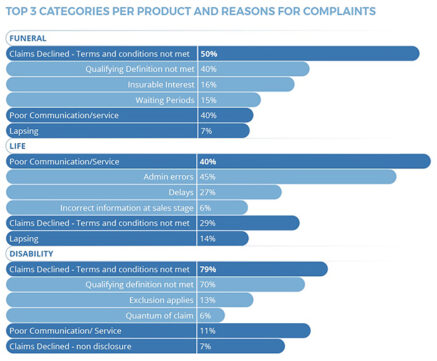
According to NFO’s annual report, released last week, declined claims remained the biggest cause of complaint in funeral-benefit (50%) and disability matters, while poor communication and service was the biggest cause of complaint in life-policy disputes (40%).
Overall, as in previous years, claims declined remained the biggest cause of complaint, followed by poor communication and service, and lapsing.
The Ombud Scheme recovered R442 994 504 for complainants in 2025, of which R299 629 812 came from the Life Division. That placed Life ahead of Non-life Insurance at R82 888 820, Banking at R53 002 204, and Credit at R7 473 666.
By complaint volume, however, Life was not the largest division. It registered 6 701 complaints, compared with 10 054 in Non-life, and 14 685 in Banking.
Funeral benefits remained the most complained-about product in the Life division, while life and disability together accounted for just over 41% of formal cases closed.
In funeral matters, the leading causes of complaint included claims declined because terms and conditions were not met, poor communication/service, insurable-interest disputes, waiting periods, and lapsing.
In disability matters, the report points to disputes over whether the qualifying definition had been met, as well as administrative errors and declined claims.
In life-policy disputes, poor communication/service was the biggest cause of complaint, ahead of declined claims and delays.
Cases opened and closed
The Life division registered 6 701 complaints in 2025, an increase of 18.8% compared with the 5 638 registered for the full year in 2024.
The Division finalised 5 824 cases, of which 4 631 were formal cases (those requiring investigation) and 1 193 were premature (those not previously seen by the insurer and resolved by them on referral), compared with 5 977 in 2024, when 3 943 were formal and 2 034 premature.
Although the total number of cases finalised declined by 2.6% compared with the previous year, formal cases increased by 17.4%.
The average time taken to finalise a complaint improved to 103 days, from 153 days in 2024.
The report says 27% of complaints finalised were found wholly or partly in favour of complainants, compared with 25% in the previous year.
Life insurers with the most complaints
The report’s top-25 participant table adds some insurer-level texture to the overall statistics, but it does not support strong insurer-to-insurer conclusions. It shows that complaint volumes were concentrated among a relatively small number of life insurers, with Old Mutual accounting for 18.56% of total formal cases opened, followed by Liberty Group at 9.29%, Centriq at 7.21%, Hollard at 5.36%, and Sanlam at 4.88%.
The annual report does not provide enough context – such as policies in force, claims volumes, or market share – to support direct comparisons of complaint performance between life insurers.
The Life Division issued four final rulings against insurers during the year. One of those was successfully appealed, while the insurers abided by the other three final rulings.
Consumers who won’t take no for an answer
Denise Gabriels, the Lead Ombud, said the Division was plagued by “unreasonable complainants” in 2025. Although this phenomenon was not new, she said it seemed to have intensified, possibly because of increased access to social media and the tough economic times.
The Division has also noted that an increasing number of consumers continue to pursue complaints in the media, to the Ombud Council, or in Parliament and persist in demanding answers and explanations long after the complaint has run its full course, including the appeal process, sometimes years after conclusion of the matter, Gabriels said. Dealing with these complaints and having to answer to the various bodies or media outlets is resource intensive.
Invariably, an unreasonable, disgruntled complainant will accuse the staff dealing with their complaint of malice or bias or both, Gabriels said.