

Global bond yields are rising, while major global stock indexes are losing momentum as geopolitical tensions rise because of the war in the Middle East and increasing concerns about the future of the United States-China trade truce after President Donald Trump again claimed China interfered in the 2020 US presidential election. This raises the question: where are we in the investment cycle?
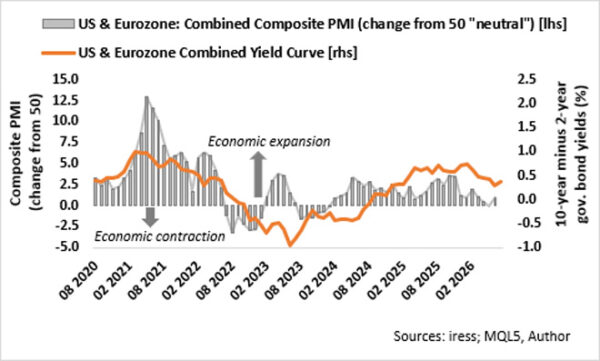
The inflationary impact of the Middle East war because of surging energy prices saw Western economies cooling off sharply. The average S&P Global Composite PMIs (manufacturing and services) for the US and the Eurozone fell to 50 (the threshold between economic expansion and contraction) in May from a relatively robust reading of 53.5 in November last year.
US and Eurozone government bond yield curves reflect slowing economies, with 2-year yields increasing 50 basis points more than 10-year yields in an environment of rising inflation. The combined US and Eurozone yield curve is still about 40 basis points above a flat yield curve that would indicate economic contraction ahead.
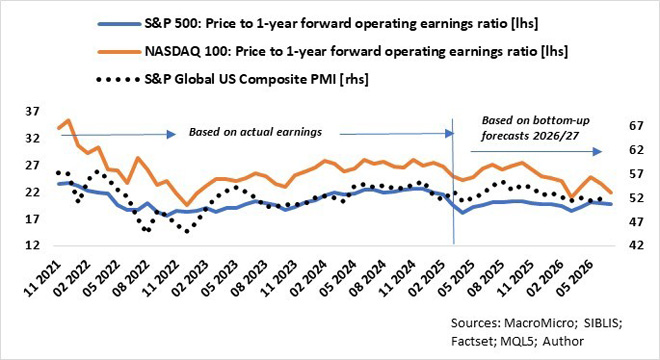
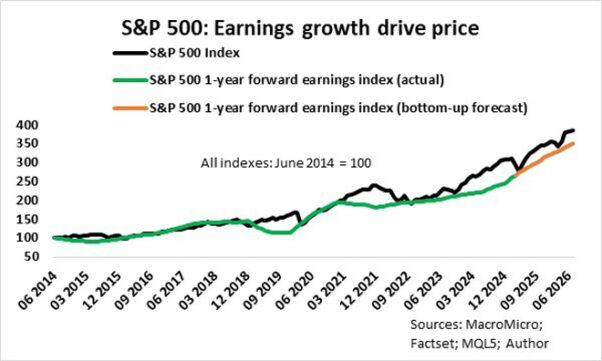
Over the past five years, the relationship between the S&P Global US Composite PMI and the S&P 500 price to 1-year forward operating earnings has been linear: rising PMIs are synonymous with a stronger US economy and correspond with higher price to 1-year forward operating earnings ratios. Vice versa, decreasing PMIs correspond with lower price to 1-year forward operating earnings ratios. The same applies to the NASDAQ 100 index. The S&P 500 bottom-up quarterly operating profit forecasts for 2026 through to the end of are based on data from MacroMicro, linearly interpolated to monthly figures, while data for the NASDAQ 100 are from Siblis Research.
From the accompanying graph, it is evident that the price-to-forward earnings ratios indicate that both the S&P 500 and the NASDAQ 100 are priced in line with the latest S&P Global US Composite PMI based on bottom-up operating earnings forecasts and therefore correctly reflect the current weaker state of the US economy.
The S&P 500 earnings growth forecasts and the US economy as measured by the S&P Global US Composite PMI are diverging, driven mainly by strong growth expectations in the technology sectors.
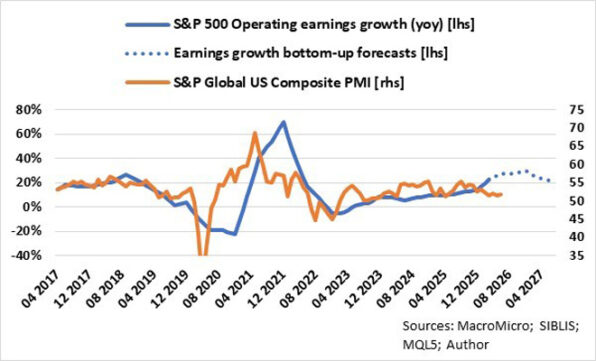
How the massive capital investment in the AI build-out by technology firms will pan out remains to be seen, though. One thing is certain – it will come with high forecast risk, specifically earnings growth.
In a scenario where the actual forward growth rates come in 10% lower than the bottom-up growth rate forecasts, the S&P forward P/E ratio will increase to approximately 21 from 20 times currently – representing a 5% decline in the S&P 500 index.
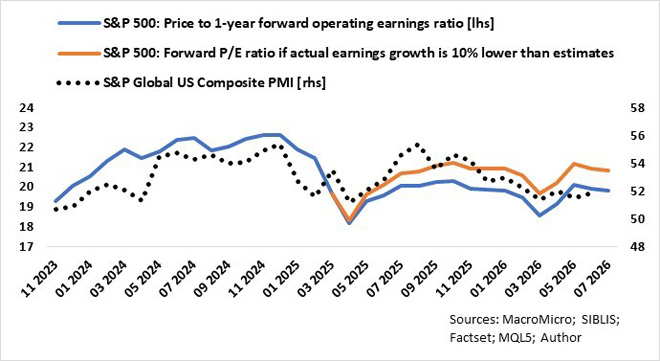
Considering the linear relationship between the S&P 500 forward P/E ratio and the S&P Global US Composite PMI, it is evident that significant changes in the PMI will have a more profound impact on the forward P/E ratio and therefore the price of the S&P 500 index than earnings surprises.
Stock prices, specifically AI-related prices, are likely to continue to be driven by corporate profits.
As things stand, it appears that yield curves and PMIs indicate that major developed economies (US and Eurozone) are experiencing a mid-cycle pause or a temporary period of low growth with high inflation expectations. Worsening geopolitical tensions and a prolonged Middle East war may, however, tip the global economy into recessionary territory, resulting in flat yield curves and sell-offs in stocks.
Yes, a mid-cycle pause with high forecast risk, specifically earnings growth.
Ryk de Klerk is an independent investment analyst.
Disclaimer: The views expressed in this article are those of the writer and are not necessarily shared by Moonstone Information Refinery or its sister companies. The information in this article does not constitute investment or financial planning advice that is appropriate for every individual’s needs and circumstances.

