
Bitcoin gave digital assets their name in the public imagination. Price charts, spectacular rallies, and crashes dominated the conversation, along with the debate over whether cryptocurrency belonged in mainstream finance.
The technology behind it is now finding applications much closer to the machinery of finance itself.
Blockchain is essentially a shared digital ledger: a record of transactions and ownership that can be maintained across a network rather than by a single central database. The technology is now being explored across securities, payments, collateral management, and other parts of financial-market infrastructure.
Tokenisation takes an existing asset, such as a share, bond, or property interest, and creates a digital representation of it on a blockchain. Stablecoins, meanwhile, are digital tokens designed to maintain a value linked to an underlying currency or other reference asset.
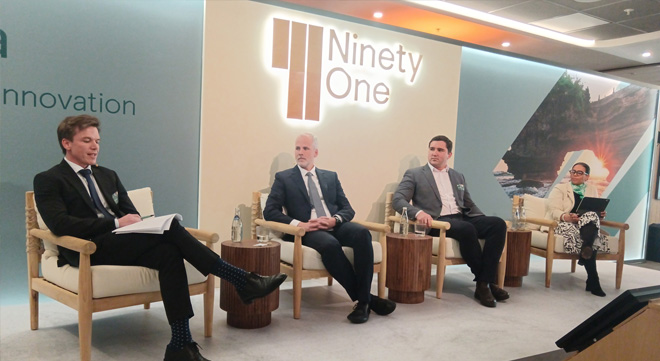
At Ninety One’s Beyond Alpha event on 17 September 2026, the session “SA’s digital asset moment – Turning digital assets into a national competitiveness opportunity”, hosted by Deon Smith, global head of product development at Ninety One, looked beyond cryptocurrency prices to the role digital assets could play in South Africa’s financial infrastructure – from settlement and collateral management to custody, regulation, and the movement of capital.
One of the attractions lies in something relatively mundane: getting different parts of the financial system to work together.
Today, financial assets and the money used to settle them can sit on separate systems, creating the need for intermediaries and reconciliation between them. A shared ledger could give participants a common view of the information. Programmability could allow conditions to be written into transactions, while putting the asset and the money used to settle it on the same platform could shorten the time between agreeing a trade and completing it.
Lyle Horsley, divisional head of the South African Reserve Bank’s Fintech Unit, sees those three features – a shared ledger, programmability, and the ability to move value more quickly – as some of the technology’s most significant possibilities.
For the financial system, that is less about replacing what exists than changing some of the processes underneath it.
“Finance is finance. Moving money around is moving money around,” said Jacques le Roux, the chief executive of Sanlam Financial Markets.
The risks attached to that money do not disappear with a new technology. Market, credit, and liquidity risk must still be managed.
Where things could change is in the mechanics.
Take collateral. Banks and other financial institutions routinely move collateral between counterparties, with people and systems checking whether agreed conditions have been met. A programmable contract could allow those conditions to trigger the transfer automatically.
“If we don’t need to have a human sitting there transferring collateral … and that can happen every second, every hour of the day, automatically,” le Roux said, “that reduces true financial risk in the financial system.”
From crypto speculation to tokenised assets
The same infrastructure is opening a different set of possibilities for investors.
The market’s early years were dominated by people taking a view on the price of Bitcoin and other cryptocurrencies. It has since moved towards institutional participation and the creation of tokenised on-chain value, with private credit, equities, real estate, and commodities among the assets being represented digitally.
Stablecoins form a significant part of that market. In some emerging economies, their appeal has been driven by instability in local currencies and financial systems. In South Africa, the attraction is more about efficiency – moving value more quickly and cheaply through an already sophisticated payments environment.
A tokenised share offers a simple illustration.
An investor wanting exposure to Apple would traditionally need to buy a whole share. At the time of the discussion, that meant about $4 000, according to Marius Reitz, general manager for Africa at digital-asset platform Luno. A tokenised share allows the exposure to be divided into smaller pieces, with investments of R10 or R20.
The transaction can also settle faster. Rather than waiting for the conventional T+5 offshore settlement period, the investor can receive the cash almost immediately when the tokenised share is sold.
The numbers suggest that this is reaching beyond the existing crypto audience. Luno has about 50 000 clients holding tokenised stocks, Reitz said, and about 10% did not own cryptocurrency before joining the platform.
That makes tokenisation less about putting crypto into an existing investment portfolio and more about changing how some conventional investments can be accessed.
Transparency has its limits
The technology comes with a different kind of visibility too.
Transactions on a blockchain can be seen on the ledger, and on a regulated platform a customer’s wallet can be linked to a verified identity through KYC. Reitz contrasted that with cash, where a bank may know that a customer withdrew or spent money without knowing where it ultimately went. The additional visibility, in his view, can be useful in managing financial-crime risk.
That visibility changes when an investor takes custody of the asset themselves. The wallet address remains visible, but there is not necessarily a verified identity attached to it. Self-custody therefore introduces a different set of monitoring and custody challenges, alongside questions about privacy.
And a visible transaction is not necessarily a fully understood transaction.
Blockchain can produce a large amount of data while still leaving important information unclear. Its pseudonymous nature can make it difficult to establish who the counterparty is, where they are located, or what the purpose of a transfer was. Traditional finance has some of the same blind spots, which is why Horsley cautioned against treating blockchain as automatically more transparent simply because the transactions can be seen.
There is another practical problem: the blockchain itself is not one system.
Different networks serve different purposes and offer different costs and speeds. Without sufficient interoperability, those networks can become separate highways along which funds travel, creating fragmentation rather than a seamless financial infrastructure.
That is why the promise of the technology comes with a qualification that Smith made early in the discussion: “if designed right”.
Those institutions that dismissed crypto assets in their early years must now look again at what the technology has become and what it could mean for their businesses and customers.
Le Roux’s advice: “We need to reassess this for what it is today, not what you understood the first time that you actually got to know it.”
A South African digital rail
There is a bigger issue behind all of this: whose infrastructure will carry the next generation of digital financial activity?
The digital-asset infrastructure taking shape globally is heavily dollar-based. Nearly 99% of stablecoins are denominated in US dollars, according to the IMF, giving the dollar an early advantage as digital assets became part of the infrastructure through which money and financial assets move.
For South Africa, the concern is not simply whether local investors will use digital assets. It is whether the country can develop its own trusted infrastructure rather than becoming a user of systems built elsewhere.
Smith’s proposition was a rand-denominated digital rail linking digital assets with asset management, banking, and payments.
There is already an example of traditional finance moving into that space. Sanlam acts as asset manager for the Universal Rand (ZARU) stablecoin. Le Roux described the role as bringing financial-market expertise and risk management to technology that sits outside the traditional financial system.
It is also an example of why the emerging market is unlikely to be built by technology companies alone. The technology may sit on one side, but financial institutions bring another set of capabilities – risk management, market infrastructure, custody and knowledge of how financial products work.
That becomes particularly relevant if South Africa wants to position itself as a gateway for digital-asset activity into the rest of the continent and other emerging markets.
Farzam Ehsani, co-founder and chief executive of VALR, Africa’s largest crypto exchange by trade volume, sees South Africa’s exchange-control regime as a potential constraint on that ambition. He has argued that the controls should be reviewed to determine whether they still serve the country’s needs.
His comparison was with the internet economy: “It’s almost like saying how do we become a global internet economy leader, but we don’t allow data to cross our borders.”
The regulatory question is broader than exchange controls. South Africa already has an established regulatory base for digital-asset services. By the end of March 2026, the Financial Sector Conduct Authority had approved 310 applications for licences to provide crypto-asset services.
Ehsani’s position is that regulation should follow the activity and the risk rather than the technology used to carry it out: “Let’s understand what the activity is. Let’s understand what the risk is,” he said, arguing that those risks should be regulated consistently across the financial system.
From experimentation to implementation
South Africa has already been testing what this technology can do.
Project Khokha, launched by the SARB in 2018, explored whether distributed ledger technology could be used for interbank settlement. Its second phase expanded the work to tokenised securities and digital settlement money.
For Horsley, experiments such as these and regulatory sandboxes are useful because they produce “data points” – a way for public institutions and the private sector to work through the technology and its policy implications together.
The difficulty comes after the experiment.
“I think where we’ve been a little bit less effective is in being able to chart pathways out of those processes and be clear about what the regulatory framework looks like, or what the licensing process looks like after that.”
Other jurisdictions have created more structured routes from proof of concept to prototype, sandbox testing, and live production. South Africa has an opportunity to do the same.
That requires more than a technology team. Security, technology, policy, and legal expertise need to come together, backed by a clear purpose, resources, and senior-level sponsorship.
And that may be the more consequential part of South Africa’s digital-asset moment. The technology is moving into the financial system. The work now is deciding how that system should accommodate it.