


South African investors have steadily increased their offshore exposure over the past two decades, but Allan Gray believes one group remains surprisingly underrepresented on dedicated offshore investment platforms: affluent investors with between R5 million and R15 million to invest.
At Allan Gray’s annual The Times investment update on 28 May, Shaun Duddy (pictured), the head of retail product development, shared data suggesting that although offshore investing has become increasingly mainstream, dedicated offshore platforms remain underutilised by both advisers and clients.
An offshore platform allows investors to hold investments directly in foreign currency and access international funds and investment managers outside South Africa. Investors can also gain offshore exposure through balanced funds and feeder funds, but offshore platforms provide direct access to hard-currency investments and a broader range of global opportunities.
The finding reflects a broader shift towards global diversification. Allan Gray’s data shows offshore exposure on its platform has risen from about 20% of assets on a look-through basis in 2005 to just over 50% today. According to Duddy, South African investors have effectively moved from having a strong home bias to being increasingly comparable with investors in more globally diversified markets.
Duddy noted that investors are accessing offshore exposure through several channels, including balanced funds, feeder funds, and direct hard-currency investments. Although all three remain relevant, offshore platforms have experienced the strongest growth. Since 2010, offshore platform allocations on the Allan Gray Investment Platform have increased 2.6-fold, compared with 1.4 times for feeder funds and 1.6 times for the foreign component of local funds.
Despite the broader shift towards offshore investing, Duddy said there still appears to be “low absolute and relative utilisation” of dedicated offshore platform solutions.
To understand why, Allan Gray analysed its platform data through three questions:
- Do offshore platform investors stay invested for longer?
- Is offshore platform adoption associated with stronger adviser businesses?
- Which clients are using offshore platforms?
Do offshore investors stay invested for longer?
According to Duddy, the answer appears to be yes.
Using platform data, Allan Gray compared retention rates across local discretionary investments, local endowments, and offshore discretionary investments. Five years after investing, about 80% of offshore discretionary investors remained invested, compared with roughly 70% of local endowment investors and about 63% of local discretionary investors.
Duddy cautioned that different investment types naturally attract different kinds of investors, but said the findings suggest that clients willing to externalise capital into hard-currency investments tend to have a longer-term investment mindset.
The finding is significant because client retention depends not only on investment performance, but also on investor behaviour and commitment to long-term financial goals.
Are offshore platforms linked to stronger adviser businesses?
The second question examined whether advisers who make greater use of offshore platforms tend to attract stronger inflows and larger client balances.
Again, Allan Gray’s data suggested a positive relationship.
The firm analysed advice practices according to the proportion of assets invested through offshore platform solutions and compared these against average client balances and net inflows. Businesses with higher offshore platform utilisation generally reported higher average client balances and stronger inflows.
Duddy acknowledged that the data does not establish causation.
“We can debate: does the chicken come first or the egg?” he said. “Is it the adoption that comes first and then the clients, or do the clients come first, then you have to wake up and adopt the products?”
The data suggests that offshore-platform adoption is at least associated with stronger business metrics, even if the direction of causality remains unclear.
What was clear, he said, was that the advice businesses that have been most successful in attracting flows and more affluent clients were also the businesses that have integrated offshore platform solutions most successfully into their advice processes.
Who is using offshore platforms?
The third question produced perhaps the most surprising finding.
Although offshore platform usage rises as client wealth increases, Duddy said a relatively small proportion of affluent investors are making use of offshore platform solutions.
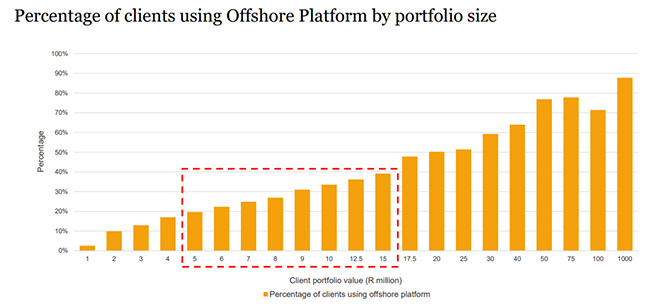
Usage rises steadily with portfolio size but remains surprisingly low even among wealthy investors. Around one in five clients with portfolios of approximately R5m use offshore platform solutions, while adoption approaches only 40% among clients with portfolios closer to R15m.
Duddy described this as “quite an obvious gap”.
The age profile of offshore platform investors is also changing. Duddy said although offshore investing has traditionally been associated with older and wealthier clients, younger investors are increasingly making use of these products.
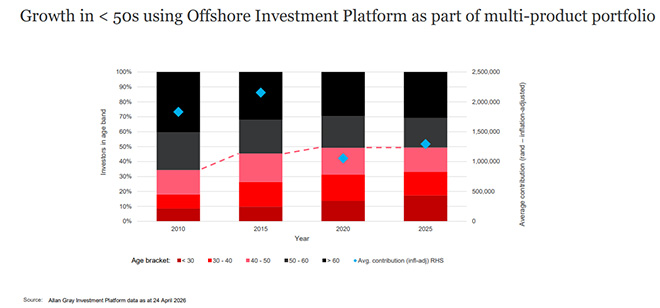
Allan Gray’s data shows the proportion of offshore platform investors under the age of 50 has increased markedly since 2010, while the average inflation-adjusted contribution has fallen. According to Duddy, this points to offshore investing becoming accessible to investors earlier in their wealth-creation journeys.
Many investors in the R5m-to-R15m wealth segment are likely to be in higher tax brackets, thinking about intergenerational wealth transfer and estate-planning considerations, while also seeking greater global diversification. Yet many are not using dedicated offshore structures.
What is holding adoption back?
To better understand the barriers to adoption, Allan Gray asked advisers attending the presentation what they believed were preventing the wider use of offshore platforms.
Administration and complexity featured prominently, alongside minimum investment requirements, familiarity, and investor inertia.
Duddy said these were among the issues on which Allan Gray continues to focus as it seeks to make offshore investing more accessible and easier to use.
Adoption remains relatively low
The findings are particularly notable given the broader growth in offshore investing.
In April 2026, Allan Gray’s offshore discretionary platform administered R103.3 billion on behalf of 28 462 clients and 2 208 advisers. Its offshore endowment and sinking-fund offering administered a further R5.63bn for 1 601 clients and 538 advisers. Despite this growth, only about 6% of platform clients currently use offshore platform solutions.
The gap between adviser adoption and client adoption suggests that even among advisers who have incorporated offshore platforms into their advice processes, the solutions are still being used selectively rather than broadly across client bases.
For Duddy, the data points to a clear opportunity. Although offshore investing has become increasingly mainstream, many investors in the R5m-to-R15m wealth segment are still not making use of dedicated offshore platform solutions.
Given the role these structures can play in diversification, tax planning, and estate planning, Allan Gray believes this remains one of the most under-served segments of the offshore investment market. The firm’s data suggests that although South Africans have become significantly more global in their investment outlook, offshore platform adoption has yet to catch up.

