When a house catches fire, the difference between a room that can be repaired and a home that must be rebuilt may be measured in minutes.
That reality is changing the way some insurers approach fire risk. Alongside paying claims after a fire, they are investing more heavily in technology, emergency response, and risk management aimed at limiting damage before a small incident becomes a catastrophic loss.
Fire remains one of the world’s leading insurance risks. The Allianz Risk Barometer 2026 ranks fire and explosion among the world’s 10 biggest business risks, describing it as one of the most destructive and disruptive events companies can face. The report says that increasingly complex risks are prompting businesses to complement traditional risk transfer with more integrated resilience strategies.
Santam’s 2024/25 Insurance Barometer suggests the same shift in insurers’ thinking. It says insurers are operating in a “new normal” of more frequent and severe catastrophes, citing the January 2025 California wildfires, which resulted in an estimated US$38 billion to US$42 billion in insured losses, as an example of how inadequate fire resilience can magnify losses. It says insurers are increasingly investing in smarter technology, targeted risk mitigation, and more responsive claims handling.
For Discovery Insure, the changing risk landscape prompted a closer examination of its own claims experience. The insurer began asking whether reducing the time between a fire starting and emergency responders arriving could significantly limit the extent of a claim.
That question led the insurer to build a national fire-response capability using specialist private firefighting companies, one of which is Fire Ops SA.
A system under pressure
Firefighting in South Africa has long been regarded as a municipal responsibility. That has not changed. What has changed, according to Fire Ops SA, is the environment in which those services operate.
Fire Ops was established in 2017 to develop a private-sector model for firefighting. Chief executive De Wet Engelbrecht says the idea grew from watching private security, healthcare, and other services expand alongside their public-sector counterparts, prompting him to ask why firefighting had not followed a similar path.
Engelbrecht says demand for private firefighting has grown as communities have expanded and municipal fire services have come under increasing pressure in parts of the country. He points to Johannesburg, where he says the city has 31 fire stations but only six operational fire engines.
He says manufacturing a single fire engine costs about R14 million, with a further R20m required to equip it for frontline service.
“As a private sector, you need to get these dual fundings,” he says, adding that insurers value the model because it helps reduce claims costs while providing policyholders with greater peace of mind.
Today, Fire Ops employs 130 full-time firefighters, operates a fleet of 72 emergency vehicles, and has 11 stations across Gauteng, two in KwaZulu-Natal, and one in Bloemfontein. The company also provides dedicated firefighting standby services at Cape Town’s V&A Waterfront following the heliport’s upgrade.
Through partnerships with insurers and other organisations, Engelbrecht says Fire Ops provides fire-response cover to more than 560 000 policyholders served by its insurance partners.
Its firefighters work alongside municipal brigades every day. Engelbrecht says municipalities remain the authority with jurisdiction at incidents. Where Fire Ops arrives first, it establishes incident command but hands it over if the municipality chooses to assume control when its crews arrive. If municipal firefighters are already on scene, Fire Ops reports to the municipal incident commander and provides support where needed. Although there are no formal agreements between Fire Ops and municipalities, he says the working relationship has developed naturally over the past seven years.
Fire Ops can be activated through several channels. Engelbrecht says incidents are reported via various apps, direct phone calls, WhatsApp community groups, social media, and other public reporting channels.
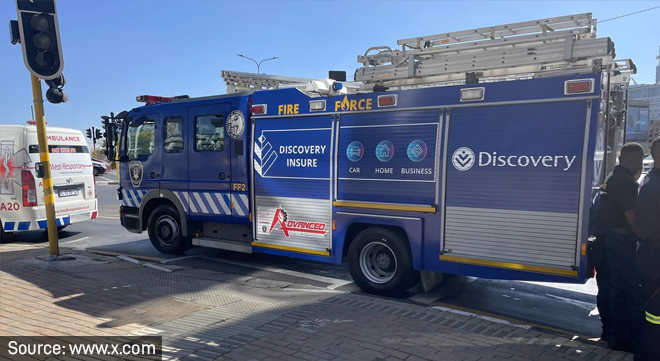
Discovery Insure clients access that response through Fire Force, the insurer’s national fire-response network. Launched in June 2022, the platform’s aim is to shorten the time between a fire starting and firefighters arriving on scene.
Clients can request assistance through the Discovery Insure app or Discovery Bank app using the virtual panic button or emergency assist features, or by calling Discovery Insure Emergency Services on 0860 999 911. Discovery has since expanded those access channels with the launch of its Discovery 911 connected smoke detector, which can automatically alert the insurer’s Insure24 emergency call centre when smoke is detected.
From claims to prevention
After years of using data to understand and manage motor risk, Discovery Insure turned its attention to the biggest risks on the non-motor side of its business. Fire stood out above the rest.
“We’ve looked at our data and tried to understand what are some of the most important risks on the non-motor side, and fire then was by far the one that stuck out the most,” Discovery Insure Deputy CEO Francois Theron says.
The review began as Discovery Insure helped clients affected by the Knysna fires. Then load shedding and the rapid uptake of solar energy systems started reshaping the insurer’s fire claims.
“We started seeing a different trend developing,” Theron says. “Things like lithium batteries, people that installed solar that maybe didn’t install them as compliant as they should have, or then as lithium batteries are getting older, they start creating these fires.”
As Discovery analysed what was driving those losses, it began asking whether reaching a fire sooner could prevent it from becoming a total loss.
“That’s when we partnered with these fire prevention experts to say… just how quickly can we actually get a response when there’s smoke in a house?” Theron says.
Today, about 94% of Discovery’s residential fire claims involve partial damage rather than total losses, Theron says. For the insurer, that reinforces the value of intervening early, before a fire spreads through an entire home.
‘Protect, not just pay’
The idea that insurers should help to prevent losses rather than simply pay for them is becoming increasingly visible across the industry. Advances in data analytics, connected devices, and real-time monitoring are allowing insurers to intervene before a claim occurs, whether through telematics that encourage safer driving, sensors that detect water leaks, or smoke alarms that trigger an emergency response.
For Discovery Insure, that philosophy is embodied in Fire Force. CEO Robert Attwell says insurance should “protect, not just pay”.
Fire Force now responds to almost two residential fire incidents a day, reaching affected properties in an average of less than 10 minutes. Since its launch, the network has attended more than 3 000 fire incidents. Collectively, Fire Force response teams have travelled more than 200 000 kilometres while responding to those incidents.
“The Fire Force initiative has been absolutely incredible, not just from the standpoint of potentially preventing a house from burning down, but critically, you’re most likely preventing a loss of life,” says Attwell.