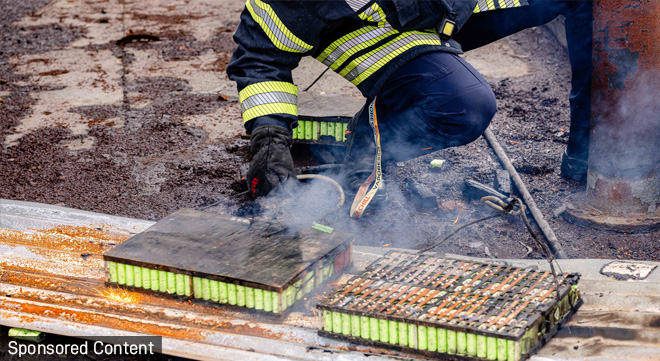

Data from Fire Ops SA supplied by Discovery Insure shows that 48 of 197 structural-fire calls recorded since January 2026 were confirmed as related to solar, battery, or backup-power equipment, a proportion of about 24%.
A further 10 calls were suspected to be related to this equipment but were not confirmed and were not included in the 48 confirmed cases.
The figure is not a national estimate. According to Discovery, the data covers residential and commercial incidents attended by Fire Ops SA, largely in Gauteng, with additional incidents in Bloemfontein and Durban.
Discovery said the finding was based on Fire Ops SA’s response data and could not yet be compared directly with national fire data because fires linked to solar systems have historically been recorded simply as structural fires.
Discovery clarified that the classification included incidents involving batteries, inverters, and associated switchgear, distribution boards, and wiring on both the AC and DC sides of solar and backup-power installations.
Fires involving a distribution board or switchgear were included only where the equipment was directly associated with the inverter, battery, or solar installation. Fires that started elsewhere and subsequently spread to the equipment were excluded.
Discovery said that, in most cases, the probable source of the fire was determined through an assessment by fire investigators and recorded in the subsequent incident report. Fire Ops SA’s first responders also made an initial assessment based on the conditions they observed when they arrived at the scene.
The finding comes after a rapid increase in household solar installations. Citing Statistics South Africa’s 2025 General Household Survey, Discovery said about 675 000 homes had solar systems, an increase of 86% in three years.
“A solar system isn’t something that you install and forget about,” said Saqib Hossain, the head of technical marketing at Discovery Insure.
“Many of these were installed at the height of loadshedding, and as these systems age, components need to be maintained and replaced where necessary to reduce fire risk.”
Fire Ops SA said it had attended far fewer fires linked to solar and backup-power installations in previous years, largely because fewer systems were installed. It said South Africans began installing solar at a much faster rate from about 2021 in response to problems with the electricity grid.
However, comparable historical percentages are unavailable because these fires were not consistently recorded as a separate category before 2025. Discovery also confirmed that Fire Ops SA’s operational coverage and client base grew over this period.
The data therefore does not establish how the incidence of fires linked to solar, battery, and backup-power equipment has changed over time.
No single component identified
Discovery said no single component accounted for the confirmed incidents. Fire Ops SA had encountered fires involving batteries, inverters, wiring and electrical connections, installation-related problems, and deterioration as systems aged.
Fire Ops SA did not have a breakdown showing the proportion of incidents attributed to each component or category.
One particular concern is the behaviour of lithium-ion batteries when they enter thermal runaway, a rapid, self-sustaining rise in temperature that can result in an intense fire.
At a live demonstration, Fire Ops SA showed what happens when a lithium-ion battery enters thermal runaway.
De Wet Engelbrecht, chief executive and deputy fire chief of Fire Ops SA, said lithium-ion battery fires behaved differently from conventional household fires.
“Thermal runaway can cause intense heat, toxic gases and the potential for fire to reignite even after it appears to have been contained,” he said.
Engelbrecht warned homeowners not to attempt to deal with a lithium-ion battery fire themselves.
“These fires require specialist knowledge and equipment. The priority should be getting to safety and getting professional help as quickly as possible,” he said.
“The first 15 to 20 minutes are critical. They can determine whether a fire is contained or spreads into other parts of the home, including the roof, where additional combustible materials can cause the fire to escalate rapidly.”
Connected smoke detector triggers emergency response
Discovery Insure described the experience of a client whose solar installation had a valid Certificate of Compliance but later suffered a fire.
The client, identified only as David, was at home with his family when his daughter heard the smoke alarm. An inverter fault had caused a fire involving the distribution board, and the flames were almost reaching the ceiling.
David used a fire extinguisher on the distribution board but was unsure whether he had stopped the spread of the fire or whether the flames might reignite.
At the same time, the connected smoke detector alerted Discovery Insure’s 24/7 call centre. When the emergency service could not contact David, Fire Force was dispatched automatically.
Fire Force is a private firefighting project launched by Discovery Insure and Fire Ops SA in 2022. Discovery said its monitored smoke detector is available nationally to the public, not only to Discovery Insure clients.
“They arrived within five minutes of the alarm sounding. I didn’t have to worry about calling for help during a highly stressful situation,” David said.
He said the solar system had been installed several years earlier. According to Discovery, a post-fire inspection identified serious faults.
The information provided did not indicate when the faults developed or whether they were present when the Certificate of Compliance was issued.
Engelbrecht said homeowners should think differently about the equipment powering their homes.
“A home solar system is effectively a small power station on your property. It needs to be installed properly, but it also needs to be inspected and maintained throughout its life,” he said.
“A Certificate of Compliance at installation doesn’t mean you can forget about the system for the next five or 10 years.”
Reducing the likelihood of a fire
Engelbrecht said homeowners should focus on reducing the likelihood of a fire starting and ensuring it was detected as quickly as possible if something went wrong.
Fire Ops SA recommends using reputable solar specialists with recognised industry credentials and a registered electrician authorised to inspect, test, and certify electrical installations.
Homeowners should obtain a valid electrical Certificate of Compliance when an installation is completed, rather than a certificate of completion.
Fire Ops SA also recommends that solar systems be inspected and serviced at least once a year. This should include the batteries, inverter, wiring, and electrical connections.
Batteries, inverters, and other components have finite lifespans. Fire Ops SA advises homeowners to follow manufacturers’ maintenance and replacement guidance instead of waiting for equipment to fail.
Potential warning signs include swelling batteries, excessive heat, unusual smells or noises, error messages, and unexplained system faults. Fire Ops SA said these should be investigated by a qualified professional. It advises homeowners to replace a battery immediately if it begins to swell.
Fire Ops SA also advises homeowners to consider where the equipment is installed. Batteries and inverters require adequate ventilation and should, where possible, be kept away from vehicles, fuel, and other combustible materials. A qualified installer should advise on the safest location for the particular system.
Smoke detectors installed near solar and backup-power equipment can provide early warning of a fire, giving occupants more time to get to safety. Fire Ops SA also recommends automated detection linked to professional emergency response, particularly when nobody is at home.
People should prioritise getting to safety and obtaining professional assistance rather than attempting to fight a lithium-ion battery fire themselves, Engelbrecht said.
“South Africans moved incredibly quickly to make their homes more energy resilient. Now we need to make sure that those systems remain safe as they age,” Hossain said.