


Where are we in the global bond bear market?
Alpine Macro’s summary of the state of the US bond market last week said it all: “The ongoing Treasury bear market morphed into a ‘disorderly liquidation’ over the past two weeks, involving panic selling, trade unwinds, convexity hedging, and global contagion.” This is typical behaviour at the final stage of a bear market when the weak holders capitulate.
But what is the smart money doing?
The combined net long positions of asset managers in US 2-, 5-, and 10-year Treasury Note derivatives (futures and options) on the Chicago Board of Trade (CBOT) amounts to about US$1 trillion.
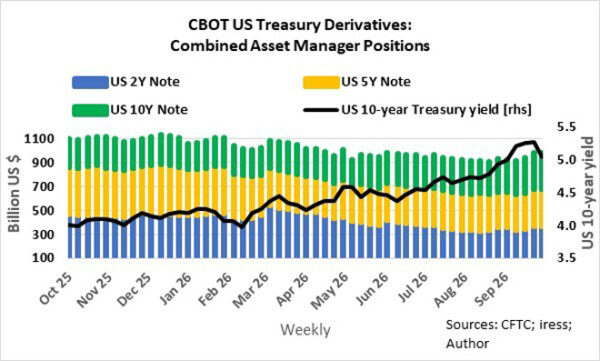
My analysis indicates that when bond yields surged in March this year, asset managers cut their risk (lowering the weighted effective duration of the total exposure) by increasing the exposure to the US 2Y Note and decreasing exposure to the US 5Y Note. From March to early September, total exposure fell by approximately US$180 billion because of a cut in positions, specifically at the short end of the market, and price drawdowns because of an upward shift in the overall yield curve. Since then, the net long positions of asset managers increased by about US$78bn, with the focus on US 2Y and US 10Y Notes.
It is interesting to note that in the case of the combined net long position of asset managers, the potential income yield (measured by the weighted yield to maturity) before March fell short of the weighted effective duration of the net long position, roughly speaking meaning that income over the next 12 months will be insufficient to cover capital losses if interest rates increased by 100 basis points over 12 months. As an example, the S&P US Government Bond Index total return from 31 December last year to date was -0.9% despite a near 100-basis-point jump in the US 10-year Government Bond yield to 5.09% over the same period.
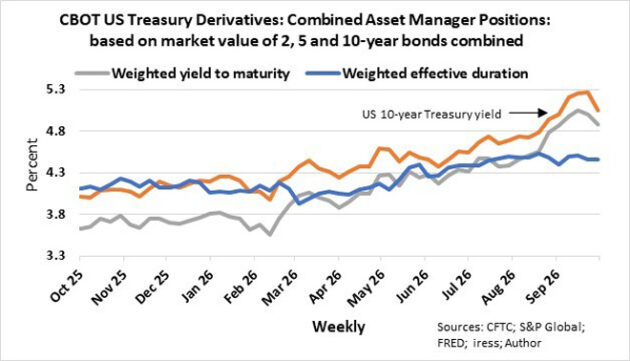
Since mid-September, however, income over the next 12 months will be sufficient to cover capital losses if interest rates increase by 100 basis points over 12 months because the combined net long position is on a weighted yield to maturity of 4.8% and a weighted effective duration of 4.46. That, together with a near all-time high real yield of about 3% on 10-year US inflation-protected bonds (TIPS), will certainly give asset managers comfort staying long or increasing holdings of longer-term bonds.
The upward shift in the overall yield curve that saw the US 10-year Treasury yield increase to 5.09% from 4.15% since the end of December last year had a severe impact on certain sectors of the US stock market. In the accompanying graph, the operating earnings (TTM) yields (or inverse of the price-to-earnings ratios) of selected S&P 500 sectors are depicted as of 31 December 2025 and the close on Friday and compared to the US 10-year Treasury yield on the same days.
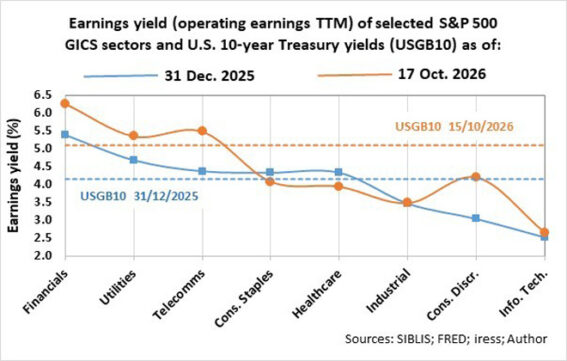
The fallout of the upward shift in the US 10-year Treasury yield over the period is reflected in the derating (increase in earnings yield) of the Financials, Utilities, Telecommunications, and Consumer Discretionary sectors, whereas the Consumer Staples, Healthcare, Industrials, and Information Technology sectors were relatively immune to the shift.
This has important consequences for investment strategy.
Further significant increases in US long bond yields will probably result in further deratings of the Financials, Utilities, Telecommunications, and Consumer Discretionary sectors, while lower bond yields are likely to lead to their re-ratings (lower earnings yield and capital appreciation).
The resilience of the Consumer Staples, Healthcare, Industrials, and Information Technology sectors in a rising and/or declining long-term interest rate environment is likely to be severely tested, specifically Information Technology, which is heavily biased towards technology and semiconductor companies, where there is increasing doubt over AI expansion and future profitability.
The bond yield spread of Information Technology companies, specifically the Magnificent Five (Nvidia, Apple, Microsoft, Alphabet, and Amazon) to US 20-year Treasuries has already contracted significantly over the past two weeks, perhaps indicating lower bond issues in coming quarters and therefore lower AI capex spend over the next year or two. Earnings growth prospects are probably toned down by the market, resulting in the spike in the CBOE Volatility Index (VIX) on Friday as investors in the Magnificent Five are hedging specific company risks. Yes, from an investment strategy point of view, it comes down to the survival of the fittest in the AI sphere.
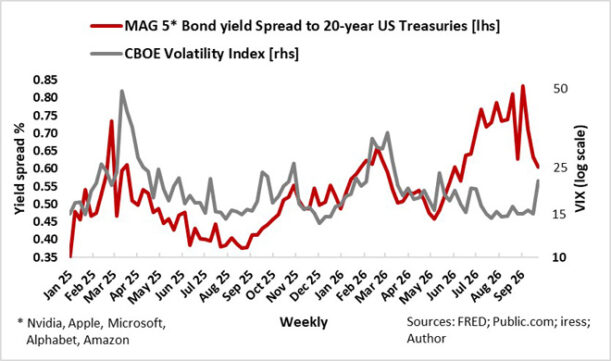
Lower AI capex forecasts are likely to lead to lower forecasts for US GDP growth, which are likely to lead to less pressure on the Federal Reserve to increase rates – an environment conducive to lower US long bond rates. That is why I follow the money.
Ryk de Klerk is an independent investment analyst.
Disclaimer: The views expressed in this article are those of the writer and are not necessarily shared by Moonstone Information Refinery or its sister companies. The information in this article does not constitute investment or financial planning advice that is appropriate for every individual’s needs and circumstances.