
A locomotive is not quite like any other commercial asset.
It may be worth millions of rand, spend years in service, cross several borders, be financed by a bank in one country, owned by a company in another and operated by a third.
If it is written off, its value may be difficult to establish. If the operator fails, the financier needs to know whether it can recover the asset. If it derails, the liability may extend well beyond the value of the train itself.
For years, much of South Africa’s rail infrastructure sat within a state-owned system. That is changing.
Eleven private train-operating companies have now been allocated capacity on the national freight rail network. The allocations are expected to add 24 million tonnes of freight capacity, with the potential to scale to 52 million tonnes over the next five years.
Transnet is also establishing a rolling-stock leasing company, LeaseCo, as a public-private partnership. The company will acquire, manage, and lease rolling stock to domestic and regional markets, helping to address shortages of reliable rail equipment.
The change is not simply a matter of more assets requiring cover. Private operators, lessors, and the financial institutions funding them bring a different set of requirements around asset protection, liability, business interruption, financing, and cross-border risk.
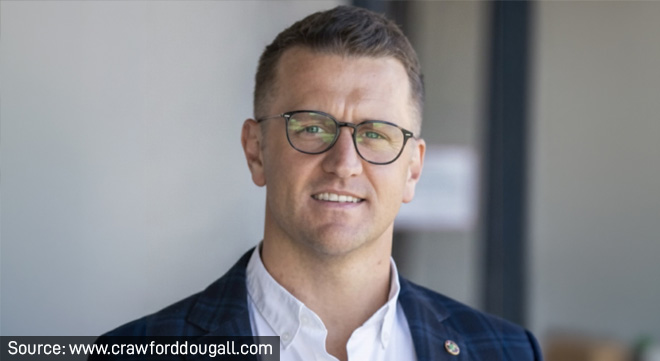
That is the market in which Simon Dougall (pictured), chief executive of Crawford Dougall Insurance Brokers, has spent almost a decade working in specialist rail insurance, developing policies for assets that operate across multiple jurisdictions and financial markets.
On 31 August 2026, Dougall will take that experience to Geneva, where he has been invited to present the insurer’s perspective at a United Nations Economic Commission for Europe (UNECE) workshop on the Luxembourg Rail Protocol and the UN Model Rules for the permanent identification of railway rolling stock.
From one operator to a market
The opening of South Africa’s freight rail network forms part of the government’s wider logistics reform programme.
Operation Vulindlela’s freight logistics reform is aimed at modernising the sector, reducing transport costs and supporting export growth. The programme includes the restructuring of Transnet, opening the rail network to multiple operators, private-sector participation in rail and ports, the establishment of a Transport Economic Regulator and a new legislative framework for the sector. The government says the reforms are intended to mobilise private investment while retaining state ownership of the rail infrastructure.
The shift from a single operator to an open-access model is already under way.
Transnet Rail Infrastructure Manager has concluded access arrangements with the 11 private train operating companies allocated capacity on the network. The operators cover coal, manganese, containers, fuel, and general freight. The government has said operations are expected to commence from April 2027.
The rolling-stock question is being addressed in parallel.
LeaseCo is intended to acquire, manage, and lease locomotives and wagons to train operators, allowing companies to access rolling stock without having to fund the entire fleet themselves. In June, Transnet issued a request for proposals to two shortlisted bidders for the public-private partnership.
Private capital is already entering the market. Traxtion, for example, has committed R3.4 billion to a rolling-stock programme involving 46 locomotives and 920 wagons.
Each privately financed locomotive or wagon brings an insurance requirement with it.
“Every single locomotive and freight wagon placed on the tracks represents millions of rands in capital that requires robust physical asset damage (hull) cover, third-party liability, and business interruption insurance,” Dougall says.
The banks and other institutions financing those assets have their own requirements.
“Private operators, lessors, and the commercial banks funding them cannot – and will not – operate uninsured.”
That relationship between the asset, the financier, and the insurance policy is where specialist rail insurance begins to differ from more familiar commercial cover.
Why market value can be a problem on rail
Dougall’s experience in rail insurance began almost a decade ago, when a small African operator approached his business with locomotives operating across borders.
The standard commercial policies available at the time did not adequately address the combination of mobile assets, different legal jurisdictions, and difficulties in establishing the value of specialised rolling stock.
The valuation problem was exposed when a locomotive insured for $2 million suffered a catastrophic loss.
The loss adjusters found a vaguely comparable locomotive in Sweden and used it to arrive at a proposed settlement of about $600 000.
A bank carrying $1.5m of debt on the locomotive faced a substantial shortfall.
Dougall says the experience led Crawford Dougall to work with local and international underwriters to develop agreed-value policies for rolling stock.
Under an agreed-value structure, the amount specified in the policy schedule is the amount payable following a total loss, subject to the terms of the policy.
The approach avoids relying on a conventional market-value assessment for an asset that may have no active second-hand market in Africa. It is an example of where a standard commercial policy can leave a financing structure exposed even though the underlying asset is insured.
“Locomotives are long-lived, highly specialised, and do not trade frequently,” Dougall says. “There is no active, liquid second-hand market in Africa to establish an accurate ‘market value’.”
The policy must reflect the way the asset is financed and used.
A train carries more than its own value
Physical damage is only one part of the exposure.
A freight train can be involved in a derailment, collision, environmental incident, or cargo loss. The operator may face liability claims while the train itself is damaged. If the incident interrupts a commercial operation, there may also be business interruption losses.
Then there is the geography.
A locomotive financed in South Africa might operate into Mozambique, Zimbabwe or the Democratic Republic of the Congo. The asset crosses borders, while the laws governing insurance, taxation, liability, and enforcement may change from one jurisdiction to the next.
Dougall describes cross-border jurisdictional risk as one of the industry’s biggest historical challenges.
Among the issues are non-admitted insurance rules, where a country may restrict the placement of insurance directly with an insurer outside its borders, as well as different premium-tax regimes.
A broker may consequently have to structure a programme that works across several jurisdictions rather than simply extending a South African policy over a wider geographic area.
The physical operating environment also enters the underwriting equation.
Track condition, route reliability, theft of railway infrastructure, vandalism, and security incidents can affect the probability and severity of claims.
For an underwriter, the questions extend beyond the value of the locomotive: where will it operate, what infrastructure will it use, what liabilities could arise, and what happens to the asset if its owner or operator becomes insolvent?
That is where the legal framework supporting rail finance comes in.
The size of the assets also brings reinsurance into the equation. Dougall says South African insurance capacity is relatively small compared with the requirements of international rail financing, meaning substantial portions of these risks may need to be placed with global reinsurers. The credit strength of the parties involved can add another layer of complexity: local insurers may face ratings constrained by the sovereign environment, while international financiers can require highly rated security behind the insurance.
The legal infrastructure behind the physical infrastructure
The Luxembourg Rail Protocol is designed to provide greater legal certainty for financing railway rolling stock across borders.
It establishes an international framework for recognising and registering security interests in railway rolling stock, including an international registry through which interests in specific assets can be registered and given internationally recognised priority.
For a bank financing a locomotive, that provides a mechanism for protecting its interest in the specific asset and establishes rules around enforcement if the borrower defaults or becomes insolvent.
South Africa deposited its instrument of ratification on 27 January 2025, and the Protocol entered into force for the country on 1 May 2025.
South Africa declared that it would apply Alternative C of the Protocol’s insolvency provisions to all types of insolvency proceedings. Its declaration specifies a 30-calendar-day period for Article IX(5) and a 30-calendar-day cure period under Article IX(15).
Alternative C allows the insolvency administrator or debtor, during the cure period, either to remedy defaults and continue performing the agreement or to give the creditor the opportunity to take possession of the rolling stock under applicable law. An application can also be made to court for a suspension period, subject to the Protocol’s conditions.
That choice is something financiers and insurers need to consider when assessing a transaction.
South Africa is not the only country in the region moving towards the Protocol. The DRC acceded to the Protocol on 4 June 2026, with its accession due to come into force on 1 October 2026. Other critical transit nations such as Mozambique, Namibia, and Zimbabwe have signed but not yet ratified or are still considering accession.
Dougall gives the example of a locomotive travelling from Gauteng to the port of Beira. Once it crosses into Mozambique, where the Protocol has not yet been ratified, the legal framework provided by the treaty does not extend to that part of the journey.
Wider adoption along the region’s freight corridors would give financiers and insurers a more consistent legal framework as rolling stock moves between jurisdictions.
The number on the locomotive
Another part of the system is the Unique Rail Vehicle Identification System, or URVIS.
The UN Model Rules provide for a permanent 16-digit identifier for railway rolling stock. The identifier is intended to provide a unique reference for the asset throughout its life.
That gives a financier a clear link between its security interest and the particular locomotive or wagon being financed.
An insurer, meanwhile, gains another source of information about the asset.
Dougall compares it with the vehicle identification number used in the motor industry.
“If you must register a legal claim, you must be able to uniquely and permanently identify the asset,” he says.
The revised UN Model Rules also provide for digital solutions that can make information about rolling stock available to creditors through the URVIS identifier.
The system also opens the possibility of more detailed underwriting based on verified asset information, including maintenance and operational data.
Dougall sees the potential for usage-based insurance models for rail, similar in principle to telematics in motor insurance.
The practical use of that data still depends on what information operators and lessors are prepared and legally able to share. Data-protection requirements, including South Africa’s Protection of Personal Information Act and the European data-protection rules where international markets are involved, form part of that discussion.
There is already one concrete example of the financial effect of the Protocol.
A 20% insurance signal
South Africa’s Export Credit Insurance Corporation (ECIC) announced in 2025 that, where the Luxembourg Rail Protocol is in force in the state of the debtor or lessee, it would apply a discount of up to 20% to its risk premium when underwriting qualifying rolling-stock financings.
The discount is subject to ECIC’s South African-content requirements, compliance with the Protocol and other underwriting conditions.
It is not a 20% reduction in commercial rail-insurance premiums across the market. It is a specific pricing measure by an export credit insurer for qualifying transactions.
Dougall sees the development of pricing and insurance products as the next part of the process.
“The legal and technical foundation is now live and working,” he says. “But the pricing and product benefits are still catching up.”
Where Operation Vulindlela fits
The rail changes form part of a much broader reform of South Africa’s freight logistics system.
Operation Vulindlela Phase II identifies freight logistics as a priority reform area, with the objective of modernising the sector to enable export growth and reduce transport costs. The government has linked the programme to the opening of the rail network to competition and private-sector participation in port terminals.
The reform is now moving through several parallel tracks.
The 11 private operators have received access to the freight rail network. LeaseCo is being developed to provide rolling stock. The Transport Economic Regulator has entered its initial phase of operations. The government has also advanced the National Rail Master Plan and the process of establishing an independent National Ports Authority.
At the ports, the Durban Container Terminal Pier 2 partnership with International Container Terminal Services Inc. has reached financial close, with R11bn in private investment associated with the concession.
The rail and port reforms meet at the freight corridor.
The cargo must reach the port, the port must handle it, and the rolling stock must be available to move it. Private capital is increasingly being brought into those different parts of the system.
From the African rail market to Geneva
Dougall’s experience in that market is what has taken him to the UN workshop.
The invitation came from Francesco Dionori, chief of transport networks at UNECE, following a recommendation from Howard Rosen, chairman of the Rail Working Group.
On 31 August, he will join international credit and political-risk underwriters, commercial and development banks, rail operators and transport policymakers in Geneva for a workshop on using the UN Model Rules and Luxembourg Rail Protocol from an insurer’s perspective.
Dougall says he wants the discussion to move beyond the treaty itself and towards how it can be applied in actual transactions.
That means understanding the insolvency options selected by individual countries rather than assuming the Protocol produces identical remedies everywhere.
He also wants policymakers, particularly in the Southern African Development Community, to address the interaction between national data-protection rules and the information insurers and financiers need to assess mobile assets.
He expects rail operators to see permanent asset identification through URVIS become increasingly important as rolling stock moves into private financing and commercial insurance.
“My objective is to highlight that a treaty is only as good as the policy structured around it.”
And his ambition for the discussion goes beyond the insurance transaction itself:
“Ultimately, I want to show that by aligning legal frameworks, tracking technology, and specialised insurance, we can safely unlock the capital needed to revitalise Africa’s railways.”

