
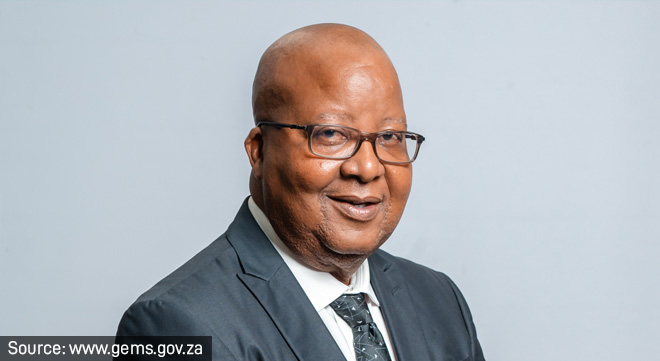

The Democratic Nursing Organisation of South Africa (DENOSA) has slammed the lack of transparency around the precautionary suspension of Government Employees Medical Scheme (GEMS) principal officer Dr Stan Moloabi (pictured), saying the entire GEMS board and executive management should go.
DENOSA president Simon Hlungwani said the union was concerned that GEMS had not disclosed the reasons for Moloabi’s suspension or informed stakeholders before the board took the decision.
His comments came as GEMS appeared before Parliament’s Portfolio Committee on Public Service and Administration on 26 August 2026, for a briefing on its performance from January to June, as well as its strategies to address fraud and waste.
Moloabi confirmed his suspension on 25 August but declined to provide the reason, saying the conditions of his suspension prevent him from discussing the matter.
GEMS board chairperson Dr Nomzamo Tutu said the suspension was an interim measure and should not be construed as a finding of misconduct or wrongdoing.
“The board has a fiduciary responsibility to ensure that the scheme’s governance processes are applied consistently, fairly, and without prejudice,” Tutu said.
GEMS said the suspension was not related to the scheme’s financial position, reserves, or solvency, nor was it related to any stakeholder or union demands.
Chief operating officer Dr Vuyo Gqola has been appointed acting principal officer with immediate effect.
“The scheme continues to operate normally and remains fully committed to delivering quality healthcare benefits and services to its members and stakeholders,” GEMS said.
GEMS provides medical cover to more than 2.4 million beneficiaries and has more than 890 000 principal members.
DENOSA questions what lies behind Moloabi suspension
Speaking to SAfm’s First Take SA, Hlungwani said DENOSA viewed the suspension as a serious development but questioned why GEMS had acted only now and why it had not explained the reasons for the decision.
“We feel it is serious because they have acted very late, but also they are not transparent on what are the reasons,” he said.
Hlungwani said DENOSA represented members who were effectively the owners of the scheme and had not even been given the courtesy of being informed that the board had taken the decision.
He questioned whether the board was properly exercising its responsibilities and said DENOSA was concerned that the suspension could divert attention from what it regarded as the more serious problems facing GEMS.
Hlungwani said DENOSA wanted GEMS to fast-track the process.
He said the suspension should not take attention away from the concerns of public servants, particularly the 9.5% contribution increase and what he described as the financial difficulties facing GEMS.
DENOSA’s position is that the solution should extend beyond Moloabi.
“The better thing could be if all of them can go, including the same plan and the entire executive management, and a better, cleaner, and transparent leadership can be installed,” Hlungwani said.
He said the board and executive management had failed to safeguard the interests of GEMS members and called for the process to be dealt with quickly.
Hlungwani also said DENOSA had asked GEMS to explain the reasons for the suspension directly to stakeholders and that the minister should play a role in addressing the issues at the scheme.
GEMS faces parliamentary scrutiny
GEMS briefed the Portfolio Committee on Public Service and Administration on its performance from January to June 2026 and its strategies to address fraud and waste.
The committee’s chairperson, Jan de Villiers, said the meeting was important because GEMS is funded through member and employer contributions and, as a scheme established through an Act of Parliament, falls under the committee’s oversight.
The committee raised concerns about the payment of public servants acting as GEMS trustees, including whether the necessary approvals were in place for paid work outside the public service.
Members also questioned GEMS’s strategies to prevent, detect, and recover losses from fraud and waste. The scheme reported that 3 062 instances were detected in 2025, with remediation and recoveries amounting to R257 million.
The committee also discussed GEMS’s contribution increases, hospital-centred benefit design, and claims management.
Members welcomed a proposal from Deputy Minister of Public Service and Administration Pinky Kekana for a joint meeting involving the Portfolio Committee on Public Service and Administration, the Portfolio Committee on Health, and the Standing Committee on Finance to interrogate governance matters at GEMS.
The committee supported the proposal and said organised labour and the Council for Medical Schemes (CMS) should also be invited.
Unions had called for Moloabi’s removal
Several public-sector unions called for Moloabi and GEMS’s executive leadership to be removed earlier this year, following a dispute over the scheme’s 2026 contribution increases.
GEMS initially announced a weighted average contribution increase of 9.8% for 2026. It subsequently reduced this to 9.5%, effective from February.
On 21 February, unions handed a memorandum of demands to GEMS during nationwide protests over the increases.
The memorandum called for the immediate withdrawal of the 9.5% increase and the development of a revised contribution structure in consultation with organised labour.
It also called for the immediate removal of Moloabi and the scheme’s executive leadership.
The unions said the principal officer and executive leadership were responsible for advising the board on contribution increases, benefit options, governance, and the administration of the scheme. They described the continued implementation of decisions affecting members as a failure of leadership and oversight.
The memorandum also called for disclosure of GEMS’s operational budgets, administrative expenditure, managed-care and outsourcing contracts, executive and board remuneration, and procurement contracts.
The unions sought an independent forensic audit of governance, procurement, administrative and outsourcing expenditure, fraud and leakage controls, and executive accountability.
The unions involved included the Public Servants Association (PSA), Health and Other Service Personnel Trade Union of South Africa, National Professional Teachers’ Organisation of South Africa, National Teachers’ Union, National Union of Public Service and Allied Workers, Professional Educators’ Union, Suid-Afrikaanse Onderwysersunie, and South African Policing Union.
The Federation of Unions of South Africa (FEDUSA), which represents several of the unions involved, said in February that the 9.5% increase should be withdrawn and called for greater financial transparency and a review of GEMS’s funding and reserve model.
From 9.5% to 7.5%
GEMS subsequently agreed to seek a further reduction in the 2026 contribution increase.
In a media statement issued on 7 May, GEMS said its board had approved a reduction in the weighted average increase from 9.5% to 7.5%, effective from 1 July, subject to approval by the CMS.
The scheme attributed the proposed reduction to savings generated through measures to contain costs, manage claims and improve operational efficiency. Moloabi said GEMS was aware of the pressure that rising costs placed on members and their families.
The Congress of South African Trade Unions and FEDUSA welcomed the proposed reduction, saying it followed months of organised-labour pressure.
In a joint statement on 7 May, they said GEMS had confirmed that its board had considered their submissions and approved the move from 9.5% to 7.5%, subject to CMS approval.
The CMS subsequently rejected the application, leaving the 9.5% contribution adjustment in effect.
In July, Moloabi told Moonstone that GEMS would not pursue another application to reduce the 2026 increase. Instead, the scheme would continue implementing its cost-containment measures and use the resulting savings to influence future contribution adjustments, beginning with the 2027 cycle.
Read: GEMS targets future contribution relief after CMS setback
He said GEMS’s application for the 7.5% increase had been based partly on claims-management interventions that were projected to generate about R1.7 billion in savings during 2026.
The CMS assessed the application using established actuarial models and historical claims trends. According to Moloabi, the regulator was not persuaded that projected savings that had not yet been fully demonstrated over time provided a sufficient basis for the lower contribution increase.
GEMS accepted the regulator’s decision.
GEMS separates suspension from contribution dispute
GEMS has specifically said that Moloabi’s suspension is not connected to the scheme’s financial position, reserves or solvency, or to demands made by stakeholders or unions.
FEDUSA said it was not aware of the reason for the suspension.
“At this stage we cannot comment on the matter until the GEMS board provides further details,” acting general secretary Ashley Benjamin told News24.
He said FEDUSA believed the reasons and basis for the suspension should be made public, given the importance of GEMS to public servants and their families.
The PSA also declined to comment, telling News24 that it had no information beyond the GEMS statement.
Business Day reported that COSATU’s chief negotiator in the public-sector bargaining council, Itumeleng Molatlhegi, said the federation would raise the suspension in the Public Service Co-ordinating Bargaining Council.
GEMS’s financial position
In July, Moloabi told Moonstone that GEMS’s solvency ratio was 24.72% at the end of 2025, slightly below the statutory 25% requirement.
He said GEMS expected to begin rebuilding its reserve ratio during 2026 and projected that it would return above the statutory 25% requirement within two to three years.
The CMS’s rejection of the 7.5% application was based in part on concerns that a lower contribution increase could put additional pressure on the scheme’s reserves.
Moloabi told Moonstone that GEMS’s position was that affordability and financial sustainability had to be considered together.
The scheme is now operating with Gqola as acting principal officer while the internal administrative process involving Moloabi proceeds.
GEMS has not disclosed what the process concerns or when it is expected to conclude.


