


A client asks whether adding another balanced fund would make their retirement investments more diversified. Both funds are marketed or reported as complying with Regulation 28. Their fact sheets show different allocations to shares, bonds, and offshore assets. Useful information, certainly. But it does not tell the adviser how much the two funds own in common.
For funds designed for retirement investing, compliance is an expected part of the offering. Advisers should be able to draw on the manager’s compliance reporting. The more useful question in a client conversation is what that reporting, together with the fact sheet, actually establishes about the investment being recommended.
An allocation summary can help to explain broad exposures and the consequences of changing them. Questions about individual holdings, legal issuers, overlapping exposures, and some regulatory restrictions require more detail. Knowing when to ask for that detail is part of making a recommendation the client can understand.
Headroom depends on what is being changed
Consider a client who wants more invested outside South Africa. Perhaps they are concerned about the rand or expect to spend money abroad. The adviser needs to establish what the change would involve, including what would be sold to fund it.
Take a hypothetical portfolio with 70% in equities and 30% offshore. These figures overlap because some equities are foreign. They describe the same portfolio from different angles; they should not be added together.
Against the headline ceilings of 75% for equities and 45% offshore, the apparent headroom is five and 15 percentage points respectively. The equity ceiling comes from Regulation 28. The offshore ceiling is set separately under the exchange-control framework: SARB Circular 10/2022 consolidated the previous allowances into a single 45% limit for qualifying institutional investors.
Suppose 15 percentage points move from domestic bonds into foreign equities. Offshore exposure rises to 45%, but equities rise to 85%. The offshore calculation works; the equity calculation does not. If the same amount moves from domestic equities into foreign equities, total equities remain at 70%.
Both changes increase offshore exposure by the same amount. Their consequences are different because the money comes from different investments.
These are illustrative changes, not transactions a client invested in a pooled balanced fund can necessarily instruct the manager to make. Someone invested in a pooled balanced fund cannot ask its manager to alter the underlying allocation just for their account. Available options, mandates, and the retirement arrangement matter.
Nor does unused headroom mean the allocation should be increased. A manager may hold less offshore because of its mandate or investment views. Before discussing the percentage, the adviser needs to understand what the client wants to achieve. Broader diversification, future foreign expenses, and a reaction to recent market performance are different reasons for asking the same question.
More funds do not necessarily mean greater diversification
The limits become less informative when the question concerns what sits inside several funds.
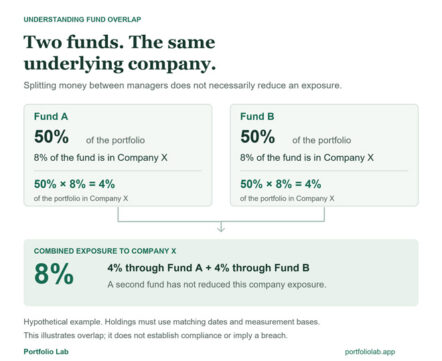
Suppose a client’s retirement allocation is divided equally between two balanced funds. Each holds 8% in the same company. That company still represents 8% of the combined allocation: 4% through each fund, assuming matching dates and measurement bases. A second manager has not reduced that exposure.
There is no suggestion of a breach in this example. It shows why counting fund names is an unreliable way to assess diversification. Managers with different investment processes may still hold many of the same companies.
To investigate, the adviser needs underlying holdings or a consolidated exposure report. Security names alone may not be enough. Different bonds can have the same legal issuer, while companies in the same group can be separate legal entities. The fund manager, issuer, parent company, and guarantor should not be treated as interchangeable.
Regulation 28 contains issuer limits and other restrictions that broad allocation totals cannot establish. Infrastructure exposure crosses asset categories, and the look-through provisions contain specific treatment for hedge funds and private equity funds. Applying the rules requires the relevant evidence and any applicable exceptions.
What advisers should ask fund managers for
The practical starting point is to ask managers for their existing holdings exports, preferably complete, with a field guide and a common valuation date. Any omissions, restrictions, or unavailable look-through information should be identified. There is little benefit in making every manager produce a new format. Ask for security and legal issuer identifiers, position weights or values, and the information needed to understand any underlying pooled funds.
A list of the ten largest holdings will not describe the rest of the fund. Missing information should remain visible. Scaling a partial list to 100% creates an apparently complete answer from incomplete evidence. Likewise, comparing June holdings with September holdings can give a misleading impression of overlap.
Tools can support, but not settle, the analysis
Advisers do not have to build all the supporting arithmetic themselves. Portfolio Lab’s free Regulation 28 allocation calculator compares entered percentages with selected headline asset-class limits and separately checks offshore exposure. Changing the inputs helps to explain why an adjustment affects more than one total. The calculator does not establish full compliance; foreign exposure entered under its unsplit residual “other assets” category needs separate reconciliation.
For the holdings question, the separate issuer-exposure tool provides a ready-to-send manager request and an optional CSV template. Advisers can import Excel or CSV holdings, map the columns, and enter their allocation across funds. Matching legal issuer identifiers are combined, with underlying funds expanded where the necessary links and holdings have been supplied. Missing information is reported separately.
Both tools are free and require no account. The issuer tool processes files in the browser rather than uploading them. It relies on the supplied data and the user’s checks of issuer identities, dates, and exposure definitions. It does not calculate Regulation 28 limits or resolve the legal treatment of derivatives, guarantees, or netting. Those questions still need the appropriate reports and expertise.
The result should therefore be described as carefully as the calculation. “Within the headline limits checked, based on the supplied allocation” is a defensible description of an initial screen. An exposure analysis can identify concentrations and unanswered questions. Neither establishes full regulatory compliance or, by itself, the suitability of a recommendation.
For the adviser, the value is practical. Explain what the allocation shows, ask for the evidence needed to investigate a concern, and record what remains unresolved. The client should come away understanding why an investment has been recommended and what it adds to the rest of their retirement money. A compliance label is important, but it cannot do that job on its own.
Glenn Cameron, CFA, is the founder of Portfolio Lab, which developed and provides the tools discussed in this article.
Disclaimer: The views expressed in this article are those of the writer and are not necessarily shared by Moonstone Information Refinery or its sister companies. The article is intended for general educational purposes and does not constitute financial advice, investment advice, legal advice, or a regulatory compliance opinion.


