

The Financial Intelligence Centre (FIC) has called on specified accountable institutions urgently to submit their 2026 Risk and Compliance Return (RCR) as the first of two deadlines is rapidly approaching.
The submission rates since the 2026 RCR platform was launched at the beginning of May 2026 have been extremely low, with fewer than 12% of specified accountable institutions responding to a directive by the FIC to file their returns.
Businesses and professions specified in Directive 11, published on 31 March, must submit their RCR questionnaires to the FIC electronically by Tuesday, 30 June 2026, or Friday, 31 July 2026.
Directive 11 applies to the following accountable institutions listed in Schedule 1 to the Financial Intelligence Centre Act (FICA):
- Item 1 – Legal practitioners
- Item 2 – Trust and company service providers
- Item 3 – Estate agents
- Item 9 – Gambling institutions
- Item 11 – Credit providers (excluding banks, mutual banks, and co-operative banks acting as credit providers)
- Item 14 – South African Postbank Limited
- Item 20 – Dealers in high-value goods
- Item 21 – South African Mint Company (limited scope)
- Item 22 – Crypto asset service providers (CASPs)
Trust and company service providers, casinos, credit providers, the Post Bank, the South African Mint, and CASPs must file their RCRs between 4 May and 30 June 2026.
Legal practitioners, estate agents, high-value goods dealers – including dealers in precious metals, precious stones, and Krugerrands – and non-casino gambling institutions are required to submit their RCRs between 4 May and 31 July 2026.
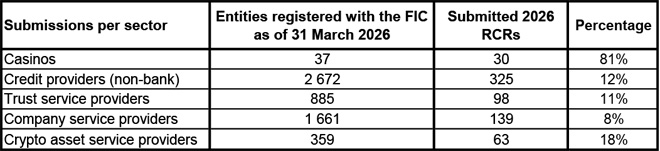
The FIC said the current rate of RCR submissions for trust and company service providers, casinos, credit providers, and CASPs is low, with 655 of 5 614 (11.66%) registered entities submitting their RCRs by 17 June.
“The FIC commends the prompt response from some accountable institutions that have filed their 2026 risk and compliance returns, making their contribution to strengthening South Africa’s regime for anti-money laundering and combating of terrorist financing,” said Christopher Malan, the FIC’s executive manager for compliance and prevention.
“We urge accountable institutions not to leave their submissions until the last minute, and risk non-compliance should they miss the deadline.”
The RCR questionnaires gauge the specified accountable institutions’ understanding of the money laundering (ML), terrorist financing (TF), and proliferation financing (PF) risks they face and the implementation of risk-based control measures.
The FIC uses the information from these questionnaires to gain a better understanding of the ML, TF and PF risk exposure at an institutional and sector-wide level. This, in turn, informs the FIC’s risk-based supervision approach.
The FIC introduced the RCR mechanism in May 2023 in support of its risk-based supervision framework and to assist South Africa’s work towards exiting the Financial Action Task Force’s grey list. The FATF required the country, and by extension the FIC as the supervisor, to implement assessment tools to identify higher-risk businesses and professions as a basis for risk-based supervision.
Through analysis of information in the submitted RCRs, the FIC can identify accountable institutions at higher risk of being abused for ML/TF/PF, resulting in a tailored approach to supervision and compliance monitoring.
Accountable institutions that do not submit their RCRs within the set deadlines may face administrative sanctions, including financial penalties.
The FIC has published Public Compliance Communication 60 of 2026 to provide practical guidance to the specified accountable institutions on how to submit their 2026 RCR.
Read: FIC finalises guidance on how to complete 2026 RCR
Specified accountable institutions can only submit their RCR on the online platform and can find more information, including sample questionnaires, on the FIC website.


