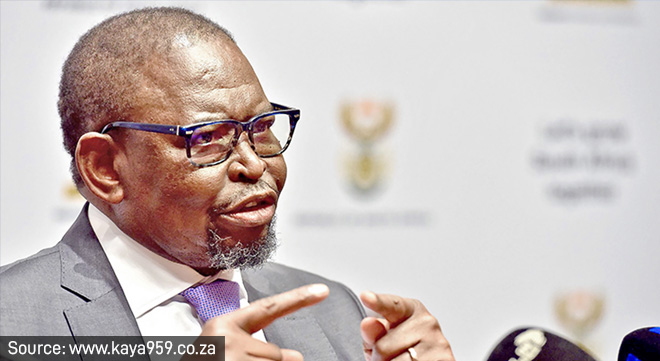
Municipalities that deduct contributions from employees’ salaries but fail to pay them over to retirement funds could face criminal prosecution, Finance Minister Enoch Godongwana has warned, signalling that National Treasury is prepared to escalate its enforcement against persistent financial misconduct.
Asked whether criminal charges were now on the table, Godongwana said the government had until now been “lenient” in pursuing that route but warned that failure to pay deducted contributions to retirement funds amounted to criminal conduct.
“We have been lenient in not taking that route. In certain circumstances, we may be forced to go that route,” he said.
The warning came as National Treasury announced it would release the remaining R7.1 billion in equitable share allocations withheld from 49 municipalities from 31 July, despite acknowledging that many still fall short of the financial management and governance standards that triggered the intervention earlier this month.
Treasury’s original debt schedule shared three weeks ago showed that the 69 municipalities targeted by the intervention collectively owed retirement funds about R1.43bn in unpaid contributions – money deducted from employees’ salaries but not paid over to retirement funds.
Read: Treasury intervention lays bare concentrated municipal debt
Earlier this month, Treasury argued that withholding equitable share allocations was necessary to force municipalities to meet their legal obligations. It now says continuing to withhold the funds risks harming the very communities the intervention was intended to protect.
Godongwana emphasised that releasing the funds “does not mean that the affected municipalities have satisfied the requirements of the Municipal Finance Management Act (MFMA)” or the regulations governing financial misconduct in municipalities. Treasury’s assessments, he said, identified “material and continuing weaknesses” in financial governance, misconduct investigations, disciplinary processes, and consequence management.
Treasury said the section 216(2) process also exposed broader weaknesses than isolated cases of unauthorised, irregular, fruitless, and wasteful expenditure (UIFWE). The assessments pointed to shortcomings in municipal budgeting, cash-flow management, financial oversight, accountability, and consequence management, raising questions about whether some municipal budgets accurately reflect their true financial position.
The broader accountability drive announced earlier this month has now been incorporated into Treasury’s compliance programme.
Read: Treasury’s crackdown spreads beyond municipalities
As part of the next phase, premiers, provincial finance MECs, and MECs responsible for co-operative governance will receive formal conditions linked to December’s equitable share assessment.
Godongwana said each affected municipality would also receive a detailed letter setting out what had to be achieved between now and December, with the same instructions going to provincial governments so that all three spheres could monitor progress together through quarterly reporting. Provincial governments and national departments will also continue reporting on plans to settle overdue municipal accounts.
But will this time be different?
The government has spent years introducing recovery plans, debt-relief programmes, oversight frameworks, and financial interventions to restore municipal finances. Despite those efforts, municipal debt has continued to grow.
Read: Municipalities are owed R218bn. So why are they running out of money?
Godongwana believes the difference this time will be consistency. Treasury, he said, will monitor every affected municipality through quarterly reporting, while provincial governments will be expected to work alongside municipalities to ensure corrective measures are implemented.
“We are confident because we are going to be consistent this time,” he said.
Treasury has now replaced an immediate financial sanction with a compliance programme. Over the next four months, it will have to show that this approach delivers results where previous ones did not.
Why release the funds now?
Treasury says continuing to withhold the equitable share would ultimately affect the delivery of basic services, particularly to poor households. Although many of the affected municipalities remain non-compliant, it argues that extending the withholding beyond the initial 30-day period would ultimately punish communities rather than those responsible for the failures.
As Godongwana put it, Treasury must “balance its constitutional responsibility to enforce financial management requirements” with the need to avoid “communities carrying the immediate consequences of failures by municipal institutions and officials”.
The release does not end the enforcement process. Treasury describes it as a conditional release and says municipalities must now comply with a structured programme of reporting, investigations and consequence management. Those that fail to demonstrate measurable progress could face another withholding when the next equitable share allocation is considered in December.
Provincial governments and national departments have also been instructed to verify and settle overdue municipal accounts after the Financial and Fiscal Commission (FFC) criticised the government for expecting payment discipline from municipalities while failing to pay its own bills on time. They must report regularly on their progress alongside the affected municipalities.
Godongwana said Treasury had already issued warning letters to several provinces and national departments ahead of their September transfer cycle.
Illustrating why Treasury intends to take a tougher approach, he said one province had acknowledged owing municipalities more than R700 million but proposed settling the debt over seven years.
“It’s unacceptable,” he said, adding that departments failing to comply by the end of September could face the same section 216(2) enforcement process.
What happens next?
The next four months will determine whether municipalities have made enough progress to avoid another withholding of equitable share allocations.
The first deadline is 30 September. By then, affected municipalities must submit quarterly reports and supporting evidence showing that they have started processing cases of UIFWE and are meeting Treasury’s requirements.
By 31 October, municipalities must show that outstanding UIFWE matters have moved through the required legal processes. A month later, by 30 November, Treasury expects to see measurable progress in disciplinary proceedings, investigations, recoveries, and, where appropriate, criminal referrals.
Treasury says it will not measure progress solely by reductions in UIFWE balances.
It will also assess whether municipalities have implemented consequence management and whether cases have progressed through the required investigation, disciplinary, recovery, and criminal processes.
The Minister said Treasury would place greater emphasis on the conduct of officials and structures responsible for investigating and acting on financial misconduct, rather than focusing only on those responsible for the original expenditure. Those assessments will determine whether Treasury again considers withholding equitable share allocations in December.
Godongwana said Treasury “remains committed to support municipalities during this period on their road to compliance and to assist municipalities in avoiding another withholding of the equitable share in December 2026 and March 2027”. But that support is tied to measurable progress under the compliance programme.
Parliament: Support must not replace accountability
Parliament’s joint oversight committees backed Treasury’s decision to release the remaining equitable share allocations, saying they were encouraged that basic services would be protected while municipalities continue working towards compliance. The committees said communities, particularly indigent households, should not bear the consequences of municipal governance failures.
The committees also made it clear that releasing the funds should not weaken accountability.
“Releasing the funds must, however, not suspend accountability or allow responsible officials and office-bearers to escape accountability for their role in governance failures,” said the chairperson of the Portfolio Committee on Co-operative Governance and Traditional Affairs (COGTA), Dr Zweli Mkhize.
Parliament said it was encouraged that the release would be accompanied by a structured compliance programme requiring municipalities to meet strict reporting deadlines, complete investigations, pursue disciplinary action, recover losses, and, where necessary, institute criminal proceedings. It also welcomed the decision to broaden the programme to include the South African Local Government Association, premiers, provincial governments, provincial treasuries, and municipalities.
The committees also supported plans to strengthen early-warning systems for municipalities in financial distress and provide targeted support to struggling municipalities.
Among the structural problems Parliament said needed to be addressed was the continued adoption of unfunded municipal budgets. Songezo Zibi, chairperson of the Standing Committee on Public Accounts (SCOPA), said ending the practice, together with support from National Treasury, COGTA, and provincial institutions to eliminate unaffordable and non-essential expenditure, would help to arrest persistent municipal dysfunction.
Under the MFMA, municipalities are required to adopt budgets that are backed by realistic revenue and financing assumptions. An unfunded budget, by contrast, commits a municipality to spending it cannot realistically afford, increasing the risk of financial distress and service delivery failures.
Treasury identified the credibility of municipal budgets as one of the key concerns arising from its section 216(2) assessment, raising questions about whether some budgets accurately reflect municipalities’ true financial position.
Zibi also welcomed Co-operative Governance Minister Velenkosini Hlabisa’s announcement during the media briefing on Tuesday that the number of municipalities with unfunded budgets had fallen from 113 to about 76. He backed the government’s goal of eliminating unfunded budgets altogether within two years.
The committees further welcomed plans to apply similar enforcement measures to national and provincial departments that owe money to municipalities, reiterating that accountability must extend across all three spheres of government.
They also said Treasury and COGTA would be expected to demonstrate that the new joint approach protects services, supports distressed municipalities and holds those responsible for governance failures to account.
Mkhize said the approach reflected Parliament’s earlier directive that fiscal enforcement should be “lawful, transparent and accompanied by support rather than treated as the sole municipal recovery mechanism”.
Treasury’s legal position
Treasury’s decision to withhold July’s equitable share allocations also raised legal questions.
During Parliament’s joint oversight meeting earlier this month on Treasury’s withholding of equitable share allocations, the FFC questioned whether the intervention complied with section 216(2) of the Constitution, prompting the committees to request a report from Treasury on the implementation of the constitutional provision.
Parliament confirmed this week that it had received the report and said Treasury and COGTA would now be expected to demonstrate that the new approach protects basic services, supports distressed municipalities and holds responsible individuals accountable.
The report has not yet been made public. However, Business Day, which obtained a copy, reported that Treasury concluded the withholding complied with both the Constitution and the MFMA.
It said the required consultation process had been followed before the funds were withheld and rejected the FFC’s contention that Parliament’s approval was required before the decision could take effect. Instead, Treasury argued that the Constitution allows it to act immediately, provided Parliament is notified and the prescribed approval process is completed within 30 days.