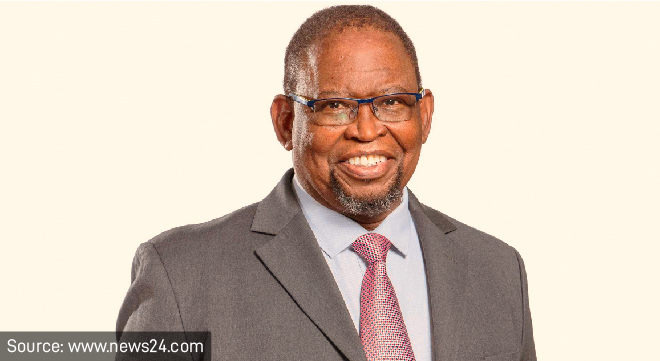

Municipalities could begin receiving their withheld equitable share allocations this week as National Treasury broadens its financial accountability drive beyond local government to the provinces and national departments.
Last week, Treasury withheld R13.5 billion in July 2026 Local Government Equitable Share (LGES) allocations from 69 municipalities that had failed to meet a range of financial and governance obligations, including debts owed to Eskom, water boards, retirement funds, and the South African Revenue Service.
The decision followed warnings that continued non-compliance was increasingly posing a risk to essential public institutions and municipal finances.
Read: Treasury intervention lays bare concentrated municipal debt
Two media briefings held after the announcement – one by Treasury officials and another led by Finance Minister Enoch Godongwana (pictured) – provided more detail about how the intervention will be implemented.
Officials explained why the number of affected municipalities was reduced before the sanctions took effect, how municipalities can regain access to withheld funding, and why the intervention forms part of a broader effort to strengthen financial discipline across all three spheres of the government.
The briefings also addressed difficult questions about accountability. Journalists challenged Treasury on whether withholding funds ultimately penalises residents rather than the officials responsible for financial mismanagement, and why individuals implicated in governance failures often remain in office. While defending the intervention as a necessary enforcement measure, Godongwana acknowledged that some municipalities face genuine capacity constraints that require support alongside accountability.
The intervention was more targeted than first appeared
The decision to withhold the July 2026 LGES allocations did not begin with a list of 69 municipalities. Treasury first wrote to 99 municipalities, warning that their allocations could be withheld and giving them an opportunity either to address the identified shortcomings or to explain why the funds should not be withheld.
Twenty-nine municipalities responded satisfactorily. Some demonstrated that they had already addressed Treasury’s concerns, while others provided information that changed Treasury’s assessment. After considering those responses, Treasury reduced the list to 69 municipalities.
Godongwana rejected suggestions that the intervention came without warning.
“We don’t simply jump up and say today we are withdrawing. We give you some time, send you letters, and tell you, ‘Please comply.’ It’s only after then that we take decisive action,” he said.
The process, Treasury officials explained, is intended to give municipalities an opportunity to comply before enforcement measures are applied.
How municipalities can regain their funding
Treasury said that withholding the July LGES allocations is intended to be temporary. Municipalities that move quickly to address the identified shortcomings could regain access to their allocations within a matter of weeks.
“It could be a week, it could be two weeks, it could be a month, depending on how fast the municipality acts,” said deputy director-general: intergovernmental relations Ogalaletseng Gaarekwe.
Municipalities must first conclude repayment arrangements with creditors such as Eskom, water boards, or retirement funds and submit the agreements to Treasury. Once Treasury is satisfied that appropriate arrangements are in place, it can release enough of the withheld allocation to settle those debts. After proof of payment has been submitted, the balance of the allocation can be released.
As Gaarekwe explained: “Once they give us that, we’ll release a portion of the money… once they’ve done that, they give us proof, we release the money.”
The process is already under way. Godongwana said about 29 municipalities have responded satisfactorily and could begin receiving funding during the week. Gaarekwe later confirmed that 11 municipalities would receive their full allocations, while a further 18 would initially receive enough funding to settle outstanding obligations before the balance was released.
Treasury also confirmed that municipalities will not have to wait until the next quarterly payment cycle for relief.
“We’re doing this thing on a weekly basis. Money will be transferred to the relevant municipalities,” Godongwana said, adding that allocations would be restored as soon as Treasury was satisfied that the required conditions had been met.
Governance or funding?
One of the clearest differences to emerge from the briefings was Treasury’s view of the underlying problem. Municipalities and some local government organisations have argued for changes to the local government funding model and increases in the equitable share. But Godongwana maintained that many of the most serious failures stem from governance rather than inadequate funding.
He pointed to municipalities deducting retirement contributions from employees’ salaries but failing to pay over the money to pension funds, as well as councils that fail to deal with unauthorised, irregular, fruitless, and wasteful expenditure (UIFWE).
“If you deduct pension contributions from employees’ salaries and don’t pay them over, that has nothing to do with the equitable share,” the Minister said. “If a council doesn’t process UIFWE resolutions, that has nothing to do with the equitable share.”
He argued that municipalities must first demonstrate sound financial management, comply with existing legislation, and strengthen governance before attention turns to whether the funding model itself requires adjustment.
Treasury applied the same reasoning when asked whether withholding funds would affect service delivery.
Gaarekwe said municipalities collectively receive less than R200bn a year through national transfers but raise about R750bn from their own revenue sources. Treasury’s view is that withholding part of a single LGES allocation should not, on its own, prevent municipalities from continuing to provide basic services, although officials acknowledged that municipalities differ significantly in their financial position.
Enforcement backed by support
Treasury also rejected suggestions that withholding equitable share allocations was its first response to municipalities’ financial difficulties. Officials said the intervention followed years of technical support aimed at helping municipalities improve financial management and comply with the Municipal Finance Management Act (MFMA).
Jan Hattingh, chief director: local government budget analysis, said Treasury’s work extended well beyond monitoring municipal finances.
“The preparation work to guide municipalities has been extensive,” he said, referring to MFMA circulars, guidance documents, and frameworks to strengthen financial management and consequence management.
Khensani Makaneta, a Treasury official specialising in MFMA implementation and local government financial management, also highlighted roadshows, Municipal Public Accounts Committee training, financial recovery plans, standardised templates, and technical assistance provided to municipalities in financial distress.
Godongwana acknowledged, however, that poor governance is not the only reason some municipalities continue to struggle. Referring to Lekwa Local Municipality, he said some repeat offenders face genuine capacity constraints that make it difficult to meet their legal and financial obligations.
The Minister said that requires a balanced approach. Treasury will continue to enforce compliance where municipalities fail to meet their obligations, but some municipalities also need practical support if financial management is to improve.
Accountability beyond municipalities
The intervention is no longer focused only on municipalities. During the briefings, Godongwana confirmed that Treasury has written to provincial governments that owe money to municipalities and is extending the same process to national departments.
Gaarekwe said provinces have been asked to verify the amounts they owe municipalities, distinguish between disputed and undisputed debts, and submit repayment plans. Treasury is assessing those responses, but some proposals were rejected because they would have spread repayments over several years instead of settling them during the current financial year.
She said provinces and national departments collectively owe municipalities about R27.9bn, although that figure is still being verified because some amounts remain in dispute.
Godongwana made it clear that Treasury’s expectations apply across government.
“No sphere of government is exempt,” he said.
Beyond the current intervention
The briefings also showed that Treasury views the withholding of equitable share allocations as only one element of a broader effort to improve municipal finances.
Hattingh linked the intervention to Treasury’s Metro Trading Services Reform programme, which aims to strengthen the financial sustainability of municipalities by improving the management of essential services. The initiative includes ring-fencing trading-service revenue, rebuilding infrastructure, strengthening management accountability, re-organising municipal operations, and improving revenue collection through better use of data and technology.
Hattingh argued there were already signs that the intervention was having an impact.
“Two water boards were on the brink of being closed… This process has helped to facilitate that those two water boards are still operational now. If a water board cannot proceed and provide services, the impact of that is much more negative because that means communities won’t get water.”
Will residents pay the price?
One question kept resurfacing during both briefings: who ultimately pays the price when municipalities fail to meet their financial obligations?
Journalists questioned whether withholding equitable share allocations would ultimately leave residents with poorer services while the officials responsible remained in office.
Responding to a question about whether Treasury was “correcting municipalities or correcting the people”, Gaarekwe said: “In our view, we are correcting the behaviour in municipalities… we need to get into a habit of paying our creditors.”
The discussion then turned to another question: if poor governance is at the heart of the problem, why do officials linked to repeated financial failures often remain in office?
Godongwana drew a distinction between holding institutions accountable and acting against individual office-bearers.
“I’m dealing with institutions. I’m not dealing with individuals. Individuals come and go, and the institutions are going to remain… The rules are going to apply. It’s not about the individuals. It’s about the institutions.”
Treasury officials made the same distinction. Asked why officials associated with repeated failures often remain in their posts, Hattingh said decisions about consequence management ultimately rest with municipal councils.
“Ultimately… the council make the final decisions, and therefore they make the final choices.”