
That’s the question hanging over three chapters of SCOPA’s draft report into the Road Accident Fund.
From the appointment of hand-picked specialists and an expanding close-protection operation to years of costly labour disputes, the evidence points to a recurring pattern: governance safeguards were repeatedly bypassed while the RAF board failed to exercise effective oversight.
Then again, there may be an explanation.
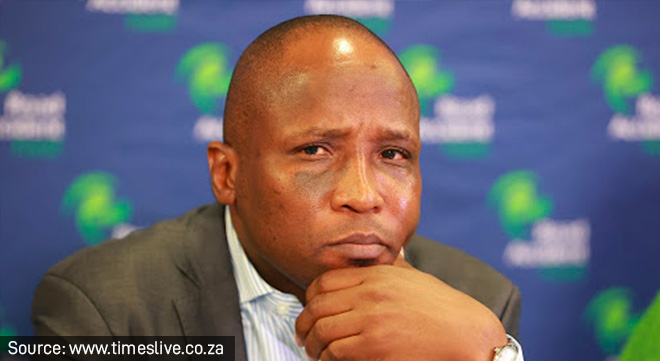
As SCOPA chairperson Songezo Zibi reminded members during Wednesday’s deliberations, the committee never heard Collins Letsoalo’s (pictured) side of the story. Despite being summoned to appear before Parliament, he refused to testify. That left the committee to reconstruct events from documents and months of testimony by board members, executives, whistleblowers, and former employees, without hearing from the man at the centre of it all.
This week, the Standing Committee on Public Accounts continued working through its draft report, turning its attention to media contracts, close-protection services, and governance and human resources. The chapters form part of Parliament’s inquiry into governance failures and operational shortcomings at the RAF. Earlier sections examined the Fund’s controversial change in accounting policy, the RAF 1 Form, Sunshine Hospital, unpaid claims litigation, allegations of collusion involving RAF officials, and the RAF’s panel of medico-legal experts.
The findings also come as SCOPA presses ahead with criminal charges against Letsoalo for failing to comply with a parliamentary summons. Although legal advice warned that questions over how the summons had been served could complicate a prosecution, the committee decided the matter should proceed.
Read: SCOPA presses ahead with Letsoalo charge despite legal risk
Last month, Zibi told Moneyweb that SCOPA had since handed evidentiary documents to the South African Police Service, which is preparing a docket for referral to the National Prosecuting Authority.
Letsoalo arrived at the RAF on secondment from the Department of Transport as acting CEO in April 2020 before being appointed permanently four months later. Five years later, after being suspended and unsuccessfully challenging that decision in court, his contract expired without renewal.
The chapters considered this week tell the story of what happened in between. And if SCOPA’s findings are anything to go by, the deeper the committee dug, the more skeletons emerged.
The rise of a parallel management structure
Soon after Letsoalo arrived at the RAF, specialist advisers began appearing in the CEO’s office. On paper, they were there to help address capability gaps in areas such as finance, supply chain management, and ICT. In practice, many ended up exercising influence well beyond an advisory role. By the end of the inquiry, one former executive summed it up in two words: “a parallel structure”.
The committee accepted that the RAF needed specialist expertise. Its concern was how those specialists were appointed and how quickly they became embedded in the organisation’s leadership.
The former head of the CEO’s office, Mpho Manyasha, testified that Letsoalo had wanted to headhunt people he knew and trusted. Because RAF policy did not allow for headhunting, the posts were advertised instead.
“But this was a headhunting process essentially,” she said.
According to Manyasha, Letsoalo had already identified Sefotle Modiba, Peter Malele, and Boitumelo (“Beauty”) Mabusela before recruitment even started. All three were eventually appointed. Other witnesses also told SCOPA that several of the specialists had existing personal or professional relationships with Letsoalo before joining the RAF.
Within weeks of joining the RAF, Mabusela was appointed acting chief financial officer and later led the controversial accounting policy review that features elsewhere in the inquiry.
Modiba moved from treasury specialist into an acting executive position that did not yet exist on the approved organisational structure before later becoming acting chief investment officer, despite telling SCOPA the RAF had no investment portfolio.
Stephens Msiza, who had previously worked with Letsoalo and was also a director alongside him in a poultry company that never became operational, eventually took charge of the CEO’s close-protection arrangements.
According to SCOPA, advisers had gradually become decision-makers, blurring reporting lines and weakening accountability across the organisation.
As specialists moved into influential positions, permanent leadership posts remained vacant.
SCOPA found that critical executive and senior management positions were left unfilled for years, with acting appointments becoming the norm rather than a temporary stopgap. Some executives simultaneously occupied two senior portfolios. Letsoalo himself assumed responsibility for the chief claims officer portfolio, while key positions, including legal services, people management, and enterprise risk management, remained vacant.
The committee concluded that the arrangement weakened accountability and left critical functions without permanent leadership. Even former board members acknowledged that acting appointments had dragged on for far too long, with one remarking that if someone had been acting for years, the organisation should either appoint them permanently or recruit someone who could.
The committee also examined the cost of the RAF’s labour disputes.
Documents subpoenaed by SCOPA showed that between April 2020 and June 2025, the RAF suspended 188 employees. Thirty-five were still on suspension when the information was compiled, some dating back almost four years. Another 136 employees had their employment terminated after lengthy disciplinary processes. In several cases, the CCMA and Labour Court ruled in the employees’ favour, yet the RAF continued litigating instead of reinstating them.
The cost to the Fund mounted quickly.
Employees remained on full pay while suspended. Acting officials received allowances to fill their positions. The RAF also relied heavily on external law firms to manage disciplinary hearings and defend labour disputes, spending R121.26 million on labour-related legal fees between 2020 and 2025. Acting allowances added another R5.57m.
Some individual cases were particularly costly. One suspended employee earned R6.95m before their employment was terminated, while two others spent almost five years on suspension at a combined salary cost of more than R15m before the Labour Court ultimately ruled in their favour.
Prolonged suspensions, vacant leadership positions, and years of costly litigation pointed to a human resources environment that had become both financially unsustainable and operationally dysfunctional.
From a fringe benefit to a R27 million security operation
Nobody questioned whether the RAF’s chief executive should be protected if he faced genuine security risks.
SCOPA certainly didn’t.
The board approved close protection as part of Letsoalo’s employment package. But it came with a limit: R480 000 a year, escalating by 10% annually, for what officials described as a basic security arrangement.
That is not what happened.
According to SCOPA, management could not procure the level of VIP protection Letsoalo wanted within that budget. After several procurement attempts failed, the matter should have gone back to the board for a new decision.
Instead, management invoked the RAF’s security policy and treated the close-protection arrangements as separate from the board-approved fringe benefit. In doing so, it bypassed the board, which was never asked to approve the additional expenditure. SCOPA concluded that this was done “purposely and surreptitiously” because it was unlikely the board would have approved the escalating costs.
The arrival of security specialist Stephens Msiza marked another shift. Witnesses told SCOPA that once he joined the RAF, he effectively took over the CEO’s security arrangements. The original procurement process fell away, and an existing security contract was used instead. According to the committee, the new arrangement was procured through a deviation process and immediately exceeded the board-approved limit. Instead of costing R480 000 a year, the service provider alone cost about R1.74m annually.
The operation continued to grow.
What started as one driver and two close-protection officers expanded into a protection team of nine officers, three vehicles – including an armoured BMW X5 – and an escort detail for Letsoalo’s wife, despite no separate threat assessment having been conducted for her.
RAF records showed that between 2021 and 2025, operational spending on vehicles, fuel, equipment, and security contractors reached R20.3m, while salaries for close-protection officers added another R7.18m. Nearly R5.8m was spent on vehicles alone, including about R4.4m for the armoured BMW X5.
SCOPA also questioned the evidence used to justify the expanding security arrangements.
The first assessment by the SAPS found no direct threat to Letsoalo at either his office or home. Later assessments identified security vulnerabilities rather than verified threats. Claims that the taxi industry wanted to assassinate him were never substantiated, with Msiza conceding that he could not explain why taxi operators would target the RAF CEO.
The committee was careful not to conclude that no threat existed. Its concern was that management relied on unverified claims to justify an increasingly expensive security operation without returning to the board for approval.
The inquiry also heard evidence that some close-protection officers were routinely used for work that had little to do with protecting the CEO.
Msiza testified that officers worked on Letsoalo’s farm, ran personal errands using state vehicles and fuel, and spent hours waiting outside his home before he was due to leave. Some reportedly remained at locations without proper ablution facilities.
SCOPA said the evidence, supported by photographs published in the media and accounts from anonymous close-protection officers, pointed not only to an abuse of public resources but also to “a flagrant violation of the human dignity” of the officers themselves.
The CEO who was never vetted
Perhaps the most extraordinary finding in the report concerns something that never happened.
Throughout his five years as CEO, Letsoalo was never vetted by the State Security Agency.
Yet during those same five years, he reshaped the RAF’s organisational structure, appointed trusted specialists to key positions, presided over procurement worth billions of rand, and approved decisions that now form the subject of several chapters of SCOPA’s draft report.
The committee heard that the security vetting of several other executives also remained incomplete, despite earlier assurances that the process was under way.
For SCOPA, the obvious question was how this was allowed to continue for five years.
Former board chairperson Lorraine Francois testified that directors relied on management’s assurances that governance requirements had been met. Looking back, she acknowledged that the board should have done more to verify those assurances independently instead of accepting them at face value. Former director Thembelihle Msibi similarly conceded that important information had not always reached the board.
Where was the board?
Time and again, the committee found that the board accepted management’s assurances instead of independently testing them, allowing governance failures to become entrenched before stepping in.
In July 2025, Transport Minister Barbara Creecy dissolved the board, saying it had acted recklessly, failed to hold executive management to account and had not acted in the best interests of the Fund. An interim board was appointed after Letsoalo’s departure the following month to begin restoring governance at the RAF.
Whether the public will ever know why many of the decisions taken during Letsoalo’s tenure were made remains uncertain. But the evidence before SCOPA suggests this is no longer just a story about the decisions made by one chief executive. It is also about what happens when the systems designed to challenge those decisions stop working.