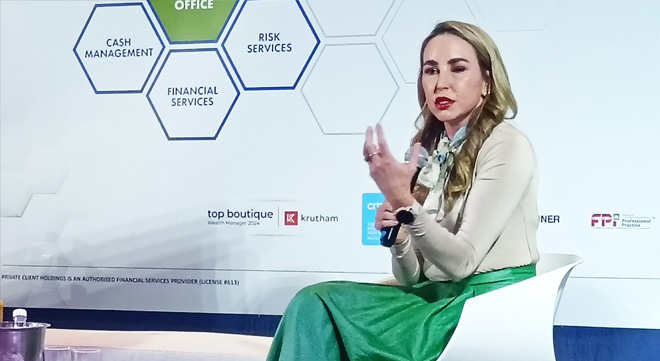
Every week brings another geopolitical shock. Conflict in the Middle East. New trade tariffs. Supply chains under pressure. Investors naturally focus on the latest headline. But Fairtree Capital’s Chantelle Baptiste (pictured) says they’re looking in the wrong direction. The real story is that many of the assumptions on which investors have relied for decades no longer apply.
At a recent Private Client Holdings client event, Baptiste, equity portfolio manager and head of South African equity research at Fairtree Capital, said many of the assumptions on which investors have relied for more than three decades no longer hold true. The result is a world that is less predictable and more fragmented and one that is likely to remain volatile.
“We’re living in a world right now that is deglobalising… the world’s breaking up,” she said.
To Baptiste, that means far more than countries introducing tariffs or companies rethinking supply chains. It marks the end of the post-Cold War era, when investors grew accustomed to a relatively stable global order and assumed that, when conflict erupted, the world’s dominant powers would step in.
“That fundamentally broke down when Russia invaded Ukraine, and nobody came to their aid. Not NATO, not the US. People felt sorry for them, but no one actually intervened,” she said.
For much of the past three decades, the world’s major powers avoided sustained conflict, even though regional wars continued. That period of relative stability brought integrated supply chains, lower inflation, and efficiencies that investors came to take for granted.
As that stability gives way to a more fragmented world, uncertainty increases, Baptiste argues. Countries become more focused on securing strategic resources and reducing their dependence on others, while strategic competition between the US and China continues to accelerate the shift.
China, she added, isn’t trying to replace the US as the world’s dominant power. Its goal is to become increasingly self-sufficient and less reliant on the rest of the world.
For investors, that changes the way risk should be viewed.
“With conflict comes a lot of volatility because it comes with uncertainty,” Baptiste said.
Deglobalisation, in her view, isn’t just a geopolitical story. It’s an inflation story. As countries become less willing to rely on one another, supply chains become less efficient, governments compete for strategic resources, and costs rise.
That helps to explain why investors have increasingly turned to precious metals such as gold and, more recently platinum, as uncertainty has grown.
Waiting for the wave
Imagine an earthquake beneath the ocean. Everyone notices the tremor, but no one immediately knows how large the wave will be when it eventually reaches the shore.
Baptiste believes that’s exactly how investors should think about today’s geopolitical shocks.
The immediate impact is usually obvious. A conflict erupts, oil prices spike, and markets react. The harder question is what comes next.
She used the Strait of Hormuz as an example. During the escalation of the conflict between Iran, Israel, and the US earlier this year, Iran threatened to close the narrow shipping lane through which about a fifth of the world’s crude oil and a significant share of global liquefied natural gas exports pass. Although markets initially focused on the immediate impact on oil prices, Baptiste argued that the greater investment risk lay in the ripple effects that would follow.
Subsequent developments have reinforced that point. Since the outbreak of the wider conflict, Iran has imposed tight control over shipping through the strait, commercial traffic has fallen sharply, insurance costs have surged, and global energy markets have remained volatile, despite periodic pauses in direct military action.
But Baptiste says investors should pay closer attention to the second-, third- and even fourth-order consequences.
Higher energy costs ripple through the economy, making goods more expensive to produce and transport. Fertilisers, chemicals, and industrial gases such as helium – an essential component in semiconductor manufacturing – are all linked, directly or indirectly, to energy production. Disruptions in those supply chains can create inflationary pressures that extend well beyond the oil market.
“The world’s trying to stand back and say, well, what are the first-round impact, which would be fuel. Second-, third-, fourth-round impact will be other by-products,” she said.
The real investment implications often emerge long after the initial market reaction.
The AI gold rush
If deglobalisation is reshaping geopolitics, artificial intelligence is reshaping the investment landscape.
Baptiste believes AI will transform industries, but she sees the bigger investment opportunity in the businesses that use the technology rather than those racing to build it.
She compares today’s AI boom with America’s railway expansion in the 1800s. Investors poured vast sums into building the rail network, convinced the infrastructure itself would generate enormous profits. Many of those companies eventually failed. The real winners were those that came later, acquiring the infrastructure at a fraction of the cost and building profitable businesses on top of it.
She argues the same dynamic is likely to play out with AI.
The world’s largest technology companies are investing hundreds of billions of dollars in data centres and advanced chips, much of it financed through debt. Many of the specialised chips that power AI have an effective lifespan of about three years, creating a continual replacement cycle as operators refresh around half their installed chips.
That raises an important question about how long the current pace of spending can be sustained.
Once that infrastructure is in place, businesses across the economy will be able to use AI to improve productivity, reduce costs, and develop new products, much as companies such as Apple and Microsoft ultimately capitalised on the infrastructure built during the dot-com era.
China’s long game
A recent trip to China left Baptiste convinced that many investors still underestimate how quickly the country is changing.
She believes part of the reason is that many people try to understand China through a Western lens. Democracies tend to think in election cycles, with governments and priorities changing every few years. China operates differently. Long-term national goals are set centrally and pursued over decades, allowing government and industry to work towards the same objective.
Electric vehicles are a case in point.
In 2015, China’s leadership declared its ambition to become the world’s leading producer of electric vehicles. Today, Chinese manufacturers are exporting those vehicles around the world. Baptiste points to BYD, which exported one million vehicles in 2025. This year, that figure is expected to reach 1.6 million, with exports projected to climb to between four and five million vehicles over the next few years as the company expands across Europe, Latin America, and Africa. It is already the best-selling electric vehicle brand in Germany – the home market of manufacturers such as Volkswagen, BMW, and Mercedes-Benz.
What stayed with Baptiste, though, was less the scale of China’s manufacturing than the mindset behind it.
As she toured Chinese manufacturers, she noticed reception areas lined with plaques commemorating production milestones and export achievements. Then she looked at when many of those companies had been founded.
Most dated back only to around 2014.
“Cast your mind back to 2014,” she said. “Where were you? What were you doing? … They were already starting that journey.”
But it wasn’t only electric vehicles that demonstrated China’s long-term ambitions.
She travelled in driverless taxis, describing them as among the best taxi rides that she had experienced. At Xpeng, she saw the company’s flagship humanoid robot, IRON, which forms part of its expansion beyond electric vehicles into what it calls “physical AI”. The first 1 000 robots are expected to be rolled out within months for trial use in factories and retail stores before wider commercial deployment. For now, they are expected to take on repetitive factory tasks.
She could already see the appeal for manufacturers.
“They don’t sleep, they don’t eat, they don’t take leave, they don’t feel offended, they’re not part of the union,” Baptiste said.
Perhaps the question that stayed with her most was a simple one: What is China building today that the rest of the world will only recognise a decade from now?
For investors, that’s the question worth asking.
Closer to home
Baptiste ended on a subject closer to home: South Africa.
“I’m an optimist at heart, especially about my own country,” she said.
“I think that South Africans are probably the most resilient nation, honestly, in the world. The worst stuff in the whole world happens, and the first thing we do is we make a meme about it, it goes viral, and we laugh about it.”
Optimism, however, doesn’t mean ignoring the country’s challenges.
Baptiste points to three structural constraints on growth: energy, logistics, and water.
She says the electricity outlook has improved, not only because of government intervention, but because the private sector has been given greater scope to invest in generation. She sees the same approach as part of the solution for logistics, where Transnet remains under pressure, but signs of improvement are beginning to emerge.
Water worries her most.
Outside the Western Cape, she believes many parts of the country face a growing water and sanitation crisis.
“It’s super, super tough when you don’t have energy at home and you can’t watch your Netflix and roast chicken,” she said. “But when you can’t flush your toilets, that becomes a big, big problem.”
Ultimately, she argues that South Africa’s biggest challenge is creating jobs. That means rebuilding the country’s manufacturing base, attracting investment, and creating opportunities for the roughly 15 million South Africans who have been failed by the education system.
“We need manufacturing, we need industrialisation, we need jobs to be created,” she said.