
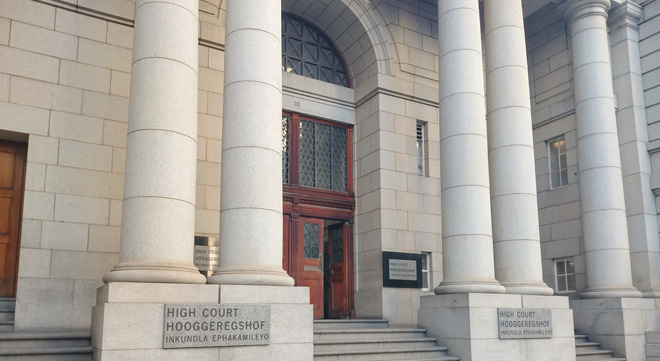

A businessman who faced restrictions on his bank account after Santam reported an insurance claim it regarded as fraudulent has failed to secure the interim removal of the resulting listing on the Southern African Fraud Prevention Service (SAFPS) database.
The Western Cape High Court accepted that the listing threatened Allan Geldenhuys’s banking and business interests and that the balance of convenience substantially favoured him. But it found that he had not shown any prospect of proving in contemplated proceedings for final relief that the misrepresentation underlying Santam’s report was made in good faith.
The court was not called upon to decide finally whether Geldenhuys had committed fraud. It had to determine whether he had established the requirements for an interim interdict pending an action challenging the listing.
The judgment, delivered on 22 September 2026, highlights the consequences that an SAFPS listing may have for access to financial services, while also considering the National Credit Act (NCA) mechanism for challenging the accuracy of information held by a credit bureau.
How the listing arose
In January 2021, Geldenhuys lodged a claim with Santam for R48 930 for damage to a vehicle insured in the name of Somarigal Property Investments, a company of which he was a director. The claim was based on the assertion that bricks had fallen on the vehicle at his business premises in Paarl in December 2020.
Santam’s investigation found that the damage was identical to damage for which it had paid an earlier claim in 2019. At the time of the first claim, the vehicle was insured in the name of Siyaba Electrical, another company of which Geldenhuys was a director. Santam had paid R45 930.79 after deducting the excess from the assessed loss of R48 930.79.
It was common cause in the court proceedings that the incident described in the second claim had not occurred. Geldenhuys did not dispute that the claim was based on a misrepresentation. His case was that the misrepresentation was made in good faith because he did not know the damage he saw in December 2020 was the unrepaired damage from the 2019 incident.
Santam repudiated the second claim, opened a criminal case against Geldenhuys, and reported him to SAFPS. In a letter dated 1 May 2022, SAFPS advised Geldenhuys that information he had provided in financial transactions with Santam might have contained inaccuracies. He denied receiving the letter and, according to the judgment, appears to have been listed for fraud on the same date.
Geldenhuys said he became aware of the listing only in January or February 2023, when he tried to apply for pay points for one of his other companies. In April 2024, his private banker at First National Bank informed him that his identity number was listed on the SAFPS database and that a restraint had been placed on his account. He was told he had 30 days to clear his name.
After attempts to resolve the matter through correspondence, Geldenhuys applied for an interim interdict directing Santam to take the necessary steps to have the listing removed and directing SAFPS to remove it from its database. The interim relief was sought pending an action for a final interdict directing the removal of the listing.
The application was dismissed in December 2024 because Geldenhuys had failed to establish a prima facie right to the relief. He appealed to a Full Bench with leave granted by the Supreme Court of Appeal.
Consequences of the listing
The Full Bench accepted that the potential harm extended beyond inconvenience to Geldenhuys’s businesses if he could not operate a bank account.
Acting Judge ML Norton said a fraud listing impugns a person’s creditworthiness and potentially implicates the constitutional rights to dignity and reputation and the right to pursue an occupation. These considerations had to be considered when weighing the prejudice Geldenhuys would suffer if the listing remained in place pending the action for final relief.
The court also recognised the interests served by Santam’s insurance-fraud listing practices. These included safeguarding the pooled funds from which valid claims are paid, protecting the integrity of the insurance industry, and serving the public interest in information about instances of dishonesty or fraud.
Nevertheless, the Full Bench found that the balance of convenience substantially favoured Geldenhuys. It also agreed that he had established a well-grounded apprehension of irreparable harm.
These findings were not sufficient to obtain an interim interdict. Geldenhuys still had to establish at least some prospect of obtaining a final interdict directing the removal of the listing.
Challenging information held by SAFPS
In considering whether Geldenhuys had another satisfactory remedy, the court examined the mechanism in the NCA for challenging information held by a credit bureau.
SAFPS is a credit bureau as defined in the Act. Section 72 entitles a person to challenge the accuracy of information concerning them that is held by a credit bureau. Once a challenge is lodged, the bureau must take reasonable steps to obtain evidence supporting the disputed information.
Within the prescribed period, it must either provide the person with a copy of credible evidence supporting the information or remove the information, and all record of it, if it cannot find such evidence.
A person who receives supporting evidence may, within 20 business days, ask the National Credit Regulator to investigate the disputed information as a complaint under section 136 of the Act. The regulator may issue a compliance notice setting out the steps required to address non-compliance by the credit bureau.
The Full Bench referred to the 2025 decision in Naidoo v South African Fraud Prevention Service and Others. In that case, the KwaZulu-Natal High Court held that an applicant in a similar position to Geldenhuys could not establish the absence of an adequate alternative remedy, because section 72 provided a statutory framework for challenging an adverse listing. It said that although a fraud listing could affect dignity, reputation, and fair administrative action, those rights were given practical effect by a statutory mechanism that had to be exhausted before judicial relief could be considered.
The Full Bench did not decide that the same conclusion applied to Geldenhuys.
Although section 72 appeared to provide an ordinary statutory remedy for challenging an SAFPS listing, the court said it was not apparent from the provision that the process would provide sufficiently swift relief comparable to an interim interdict in the circumstances of this case.
The court therefore found it unnecessary to decide whether it could consider the section 72 remedy when the issue had not previously been raised, or whether the remedy applied in Geldenhuys’s circumstances. For the purposes of the appeal, it accepted that he did not have a suitable alternative remedy.
What an applicant must establish
The Full Bench then considered whether Geldenhuys had established a prima facie right, although open to some doubt, to the removal of the listing.
It applied the flexible approach associated with Olympic Passenger Service (Pty) Ltd v Ramlagan. Under this approach, the requirements for an interim interdict are considered together. An applicant need show only some prospect of obtaining final relief, even if those prospects are weak.
The strength of the applicant’s prospects of success is weighed against the other requirements: the weaker the prospects, the more the other factors must favour the applicant. But the applicant must still have some prospect of establishing the right relied upon. Where the prospects are non-existent, there is no prima facie right to weigh against the other requirements.
Geldenhuys therefore did not have to prove at the interim stage that he would probably secure a final interdict. He did, however, have to place sufficient evidence before the court to demonstrate some prospect of establishing that the misrepresentation underlying Santam’s report was made in good faith.
Why the evidence was insufficient
The court recognised that it was assessing evidence that was incomplete, disputed, and untested. But the existence of factual disputes did not prevent it from considering whether Geldenhuys had shown some prospect of success.
Applying the Olympic approach, it assessed the affidavits holistically, examining and balancing the facts and reaching such conclusions as it could about the probabilities where disputes existed, without finally deciding between conflicting versions.
Geldenhuys’s explanation rested on two principal assertions. The first was that he had not seen the vehicle after the original incident and did not know the damage had not been repaired. The second was that an employee told him in December 2020 that bricks had fallen on the vehicle, leading him to assume that the damage had occurred during construction work at his premises.
The court found that the first assertion was undermined by inconsistencies and evidence Geldenhuys could not dispute. A director of Siyaba had sent him 20 photographs and a video via WhatsApp in January 2019 showing the vehicle, the collapsed wall, and the damage. Geldenhuys accepted in his replying affidavit that the blue ticks showed he had opened the messages and that he “must have seen” the material, although he said he could not remember it.
There was also evidence that the unrepaired vehicle had been returned to his business premises before the second claim and was regularly parked outside. Geldenhuys disputed evidence that he had seen the vehicle and commented on the original damage.
His account of the alleged December 2020 incident was not corroborated. He identified the employee who allegedly told him that bricks had fallen on the vehicle only as “Samuel” and said the employee had since died. He provided no supporting evidence that construction work was taking place on the relevant date and did not explain what steps he took to verify the cause of the damage before lodging the claim.
The court also considered his admitted statements to Santam’s assessor, including that the vehicle had not sustained prior damage and that he was unaware of the earlier claim. In addition, he did not satisfactorily explain why the second claim was almost identical to the first. His account that the second amount resulted from a separate assessment was not supported by confirmatory evidence.
The court held that an applicant could not advance a “bland, unsubstantiated and inherently improbable version” and rely on the contention that the evidence would be fully tested in later proceedings.
Considered holistically, Geldenhuys’s evidence did not establish any prospect of proving that the misrepresentation was made in good faith. There was therefore no prima facie right to weigh against the irreparable harm, favourable balance of convenience, and absence of a suitable alternative remedy he had established.
The Full Bench dismissed the appeal with costs.
Click here to download the judgment.


