


The tsunami in the issuance of artificial intelligence-related bonds is playing havoc with global bond markets. Investors in AI-related bonds are demanding higher yields, pushing up long-term government bond yields as governments compete with AI-related issuers for funding in financial markets.
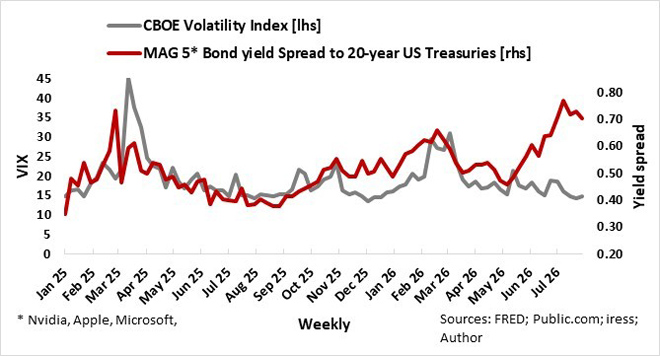
The average long-bond yield spread of the Magnificent Five (Nvidia [2050], Microsoft [2045], Apple [2046], Alphabet [2050], and Amazon [2044]) to 20-year US Treasuries jumped to 70 basis points from 55 in June this year. The yield spread tends to indicate the risk premium that market players require to compensate for uncertainty.
But the increased risk is yet to be reflected in the CBOE S&P 500 Volatility Index (VIX), also known as the Fear Index.
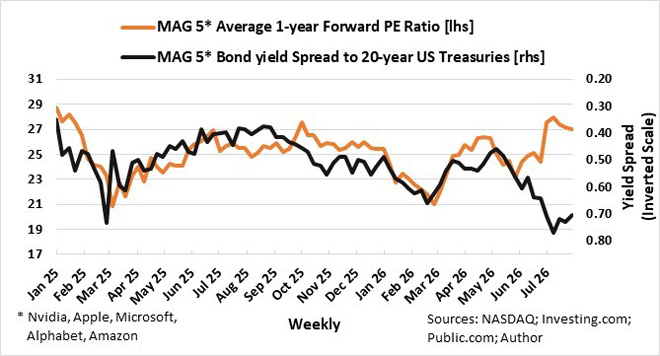
It also appears that the increased risk is not reflected in the valuations of AI-related stocks, specifically the MAG 5. The accompanying graph shows a major divergence since June this year between the MAG 5 long-bond yield spread and the market valuation of the MAG 5 (measured by the average one-year forward PE ratio of the MAG 5 and calculated by using consensus earnings forecasts through to July 2027 and actual historical earnings based on data from the NASDAQ and Investing.com).
The upside potential of the MAG 5 collectively is limited.
The following chart compares the weekly average upside potential of the MAG 5 with the average one-year forward PE ratio since January last year. The average upside potential of the MAG 5 collectively was calculated using the average analyst 12-month price target for the MAG 5 stocks compared with the individual stock prices on the relevant dates.
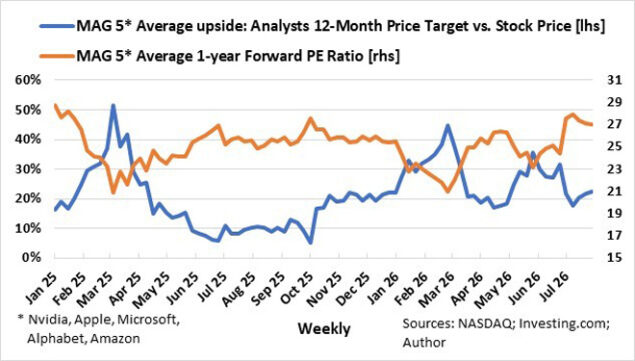
With the MAG 5’s price-to-one-year-forward-earnings ratio at the top end of the range since January last year and upside potential of 22% at the bottom of the range since November last year, it is evident that the collective upside potential for the MAG 5, given the analysts’ 12-month price targets for the five stocks, is limited. Obviously, the upside potential of some of the stocks may be significantly greater than that of the others.
From this fundamental overbought/oversold indicator, it is evident that for the MAG 5 to return to value territory again, an upside potential of about 30% could be required. For that to happen, the analysts’ 12-month price targets would need to be raised by about 8% to 10%, driven by positive earnings surprises and an improved outlook resulting in analyst rating upgrades, or MAG 5 stock prices would need to experience an average drawdown of 8% to 10%.
The upward thrust in long-term government bond yields is such that the market yield on US 20-year Treasuries is approaching previous highs reached in June 2007 and October 2023. The high in 2007 was followed by the 2008 Global Financial Crisis, while the high in 2023 coincided with the VIX increasing to anxiety levels above 22, resulting in a sell-off in emerging-market and developed-market stocks.
As things stand, it seems that this is a repeat of what happened in the first quarter, when the MAG 5 bond yield spread began to widen before volatility in the stock market increased. Any drawdowns could become extremely uncomfortable.
This is why I am bracing for a surge in stock market volatility.
Ryk de Klerk is an independent investment analyst.
Disclaimer: The views expressed in this article are those of the writer and are not necessarily shared by Moonstone Information Refinery or its sister companies. The information in this article does not constitute investment or financial planning advice that is appropriate for every individual’s needs and circumstances.



What factors could contribute to a significant increase in stock market volatility, and how might investors prepare for it?