
When insurers first started covering motor vehicles, they had a fairly obvious problem: nobody knew what the risk looked like.
In 1904, one of the early motor policies written through Lloyd’s of London reportedly borrowed from marine insurance, describing the car as a “ship on land”. Insurers were dealing with unfamiliar risks, from collisions with horses to engine fires and leaking petrol tanks. There was no long claims history to tell them what those risks would eventually cost.
More than a century later, insurers are back in that position with another technology that is developing faster than the insurance models around it.
Artificial intelligence is moving into business processes where it can make decisions, recommend actions, and, increasingly, act without someone checking every output. When an AI system fails to perform as expected, the resulting loss does not necessarily fit neatly into existing insurance categories.
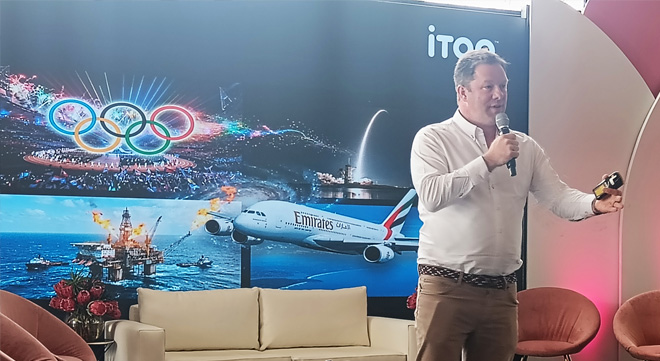
Moonstone caught up with iTOO managing director Justin Naylor (pictured) at the inaugural The Insurance Conference 2026, held at Plaisir Wine Estate in the Cape Winelands last week, after his presentation on the role insurance has played in enabling major technological advances.
In March, iTOO launched aiSure, in partnership with Munich Re, as Africa’s first AI performance insurance solution. The product was launched in South Africa and is designed to respond when an AI system fails to meet agreed performance benchmarks, rather than a malicious cyber event or an error by a human professional.
The product is now live, and Naylor says more than 100 prospective clients have already approached iTOO.
“We’re analysing and assessing these risks,” he said. “And we’re learning as we go.”
So how do you price it?
So where does the data come from when there is no established South African claims history?
iTOO is drawing on several sources. Brokers provide information about the risks their clients are looking to insure, while iTOO brings its specialist underwriting experience. Munich Re brings international experience and data from its work insuring AI risks.
Munich Re’s experience with AI insurance predates the aiSure launch in South Africa. The reinsurer says it issued its first AI policy in 2018 and has since built experience underwriting AI risks across several industries.
That gives iTOO something to work with, but the international experience cannot simply be transplanted into South Africa.
“We have access to some of their data and their experiences,” Naylor said. “But the challenge is how do we bring it into a South African or African context, where the risks can be different and the regulations are different?”
The individual AI system is central to the underwriting.
The product starts by agreeing measurable performance indicators – for example, an accuracy rate or an acceptable error threshold. Underwriters then assess the model’s data, training, and historical performance before setting the policy triggers.
Naylor gave the example of a bank using AI to detect fraud.
The bank and the developer could agree that the model should identify 98% of fraudulent transactions. That 98% becomes a measurable performance target. If the model subsequently fails to achieve the agreed level, the insurance can respond on the agreed basis.
It turns a question about how reliable an AI system is into something that can be tested, underwritten, and attached to a financial consequence.
The trust gap
That performance guarantee is also aimed at one of the practical obstacles facing AI developers.
A small developer might have built a capable AI system, but convincing a large corporate to put that system into an important business process can be another matter. The buyer’s risk and procurement teams want some assurance about what happens if the promised performance is not achieved.
The aiSure product describes this as the “trust gap” – the gap between wanting to use AI and being comfortable putting it into a business-critical environment.
For AI providers, the insurance can support a performance guarantee to the customer. For companies using AI themselves, it can provide financial protection if the system fails against the agreed performance measures.
And the performance measure does not have to be theoretical.
The product material gives examples including a fraud-detection model missing fraudulent transactions, an automated logistics system causing delivery delays and contractual penalties, an AI document-review system missing critical clauses, and an agricultural AI system putting lower-grade fruit into an AA export assortment.
Naylor offered another example from the market: an airline using AI to sell discounted tickets. The system hallucinated, sold too many tickets and resulted in overbooking, leaving passengers who had planned holidays around those bookings with potential claims.
For the insurer, the question is what that particular AI system has been designed to do, how well it has performed, what happens when it fails, and what the resulting financial exposure looks like.
Starting small
iTOO is deliberately keeping the book small.
“We know we can have losses. We don’t know what they’ll be,” Naylor said.
For a new line of business, iTOO can take a relatively small share of the risk and use its reinsurance relationships to carry more of the exposure.
Naylor said a new product might start with the insurer taking about 5% of the risk. As the business builds up knowledge, experience, and data, that could increase to 20%, 30%, or 50%.
“So, we take a small amount of risk, and we pretty much figure it out as we go.
The more than 100 approaches to iTOO are not simply potential sales. They are also giving the insurer an early view of how South African businesses are deploying AI and what risks they are looking to transfer.
AI is not all the same
One of the early lessons has been that “AI risk” is not a single thing.
Naylor said much of the international AI insurance market is focused on large language models, which he considers somewhat more predictable.
In South Africa, however, iTOO is seeing considerable activity around agentic AI – systems that can make decisions and take actions with less human intervention.
That is where the underwriting conversations become particularly detailed.
The product is built around a particular model, its training and data, its historical performance, its intended use, and measurable outcomes.
The data is developing alongside the market.
The cyber lesson
iTOO has been here before.
When the company launched its cyber insurance proposition in South Africa in 2015, cyber cover was already developing internationally but was still unfamiliar to many local businesses.
Naylor said the first two or three years were largely spent training brokers, explaining the cover and talking to clients about the risk. The company initially sold only two or three policies a year.
That eventually grew to two or three policies a month, and cyber is now one of iTOO’s largest lines of business.
He expects AI insurance to follow a similar path.
“We’re not expecting to write hundreds of policies in the first year,” he said. “We’re expecting to write some, but mostly we’re engaging with brokers, with clients. We understand the risks, and we’re slowly building.”
The opportunity beyond the risk
There is plenty of anxiety about what AI will do to insurance – from underwriting and claims to jobs, client relationships, and the way insurers operate.
Naylor is looking at the other side of that equation.
If AI becomes embedded across business, the risks it creates become part of the insurance market too. There will be models to insure, performance to guarantee, liabilities to assess, and financial losses to transfer.
That could extend well beyond the type of performance cover iTOO is writing today.
Naylor is enthusiastic about where it could lead.
“I think it’s hugely exciting,” he said. “I hope that one day, when AI is as prevalent as motor cars, people in Africa will look back and say: ‘iTOO Special Risks was the first company to insure Africa.’”


yeah right