


South African salary earners started 2026 on relatively stable footing, but market commentators warn that rising fuel costs, higher inflation, and growing business uncertainty could put pressure on wages and employment prospects in the months ahead.
The PayInc Net Salary Index, which tracks the average nominal net salaries of about 2.1 million South African salary earners, edged up to R21 508 in March 2026 – a modest 0.1% increase from February and 2.3% higher than a year earlier.
The index replaced the long-running BankservAfrica Take-home Pay Index and now tracks monthly net salaries for about 2.1 million salary earners earning between R5 000 and R100 000 a month. PayInc says the revised methodology excludes weekly and bi-monthly salary payments and adjusts for inflation and seasonal effects to provide a more consistent view of salary trends over time.
But once inflation is considered, the picture looks less encouraging.
The index declined by 1% in real terms year-on-year in the first quarter of 2026, suggesting that despite marginal salary gains, many households may already be experiencing reduced purchasing power.
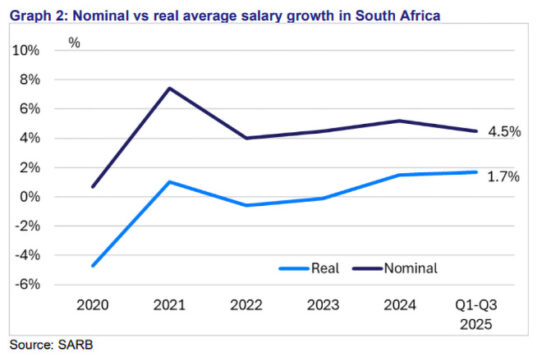
In practice, this means salary earners may not necessarily feel better off despite earning more on paper. Although the average nominal net salary reached R21 508 in March – meaning take-home pay before adjusting for inflation – the real net salary index, which reflects purchasing power after inflation, remained materially lower. The gap suggests higher living costs are absorbing much of the increase in earnings.
According to PayInc, salary growth has largely stabilised after stronger gains in previous periods. However, the outlook has become 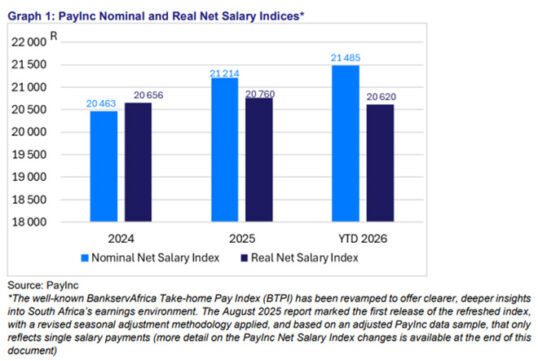
Independent economist Elize Kruger said inflation remained well contained through March and broadly aligned with the South African Reserve Bank’s recently adopted inflation target.
That outlook changed in April.
Fuel price increases and the broader economic effects of the Middle East conflict have significantly altered inflation expectations for the rest of the year, she said.
The government introduced temporary relief through a temporary reduction in the general fuel levy running from April to June 2026, at a cost of R17.2 billion in forgone tax revenue.
Read: South Africa’s new inflation target gets its first big test
According to National Treasury, the measure was designed to remain revenue neutral and funded through stronger-than-expected tax collections and underspending elsewhere in the fiscus. Economists had previously noted that revenue projections for the year to March 2027 appeared conservative, particularly given the possibility of stronger corporate tax collections linked to elevated commodity prices in 2025.
Kruger said lowering the fuel levy would “moderate the direct impact of the fuel price increases on consumer inflation”, which would be helpful from a monetary policy perspective and could reduce the likelihood of pre-emptive interest-rate increases in response to higher short-term inflation.
She added: “The government’s ability to act to protect the economy in a period of unexpected hardship is firmly in the spotlight in the current crisis.”
However, Kruger cautioned that the broader economic consequences remain significant, saying: “This remains a notable shock to the economy and the probability that it could trigger a widespread upward adjustment in prices across the economy remains very high, but also dependent on how long fuel prices remain at these levels.”
The fuel shock has already become visible in consumer prices.
Fuel prices rose sharply over March, April, and May as oil markets reacted to escalating conflict in the Middle East. Petrol prices increased by 20 cents a litre in March, followed by R3.06/litre on 1 April and a further R3.27/litre on 6 May. Diesel prices rose by between 62 cents and 65 cents in March, followed by increases of between R7.37 and R7.51/litre in April and a further R5.27/litre in May.
Taken together, petrol prices have risen by about R6.53/litre since March, while diesel prices have increased by between R13.26 and R13.43/litre over the same period.
Although the government introduced temporary fuel levy relief to soften the impact, the increases remain substantial and have added to concerns about broader inflation pressures. Treasury initially reduced the general fuel levy by R3/litre for petrol and diesel before extending support into May and June, although at lower levels over time.
Against that backdrop, Kruger said consumer inflation could now average about 4.4% in 2026, compared with a pre-conflict baseline expectation of about 3.4%.
Similar concerns have emerged elsewhere in the market. Adam Furlan, portfolio manager at Ninety One, said the larger risk may not be the initial supply shock itself, but whether inflation expectations begin filtering through into “wage settlements, pricing decisions, and the broader behavioural fabric of the economy”.
He said inflation at current levels was not necessarily the central concern – the bigger question was whether second-round effects become embedded more broadly.
That would complicate the outlook for salary earners.
PayInc expects the deterioration in inflation conditions to weigh further on purchasing power, increasing the likelihood of negative real net salary growth during 2026.
Adriaan Pask, chief investment officer at PSG Wealth, similarly warned that inflation expectations becoming embedded in wage demands and price-setting behaviour could prove more damaging over time than the initial fuel shock itself.
The labour market could also respond unevenly.
Kruger said unionised sectors are likely to place greater pressure on employers for stronger annual wage increases to offset rising transport and living costs.
The report points to the recent agreement by members of the National Union of Mineworkers to accept Eskom’s offer of a 7% wage increase over the next three years as one example of this trend.
Private sector employers, however, may react differently.
Pask noted that South Africa is not facing an overheating economy and cautioned that higher borrowing costs would place additional pressure on households and businesses already dealing with weak income growth and elevated costs.
According to PayInc, businesses tend to respond more directly to changing economic conditions and could moderate wage offers, to preserve employment and remain financially sustainable.
The latest Bureau for Economic Research Inflation Expectations Survey reflects this divergence: analysts forecast nominal salary growth of 4.1% for 2026, business respondents expect 4.7%, while trade union officials expect 5.1%.
Kruger said uncertainty about the longer-term impact of the conflict on both the global and local economy is likely to remain for some time.
That uncertainty may push companies into a more cautious operating mode – delaying investment decisions, slowing expansion plans, and becoming more conservative about hiring and salary growth.
Furlan said the longer-term risk is not necessarily a single inflation shock, but whether higher costs become embedded more broadly in wages and pricing decisions.


