
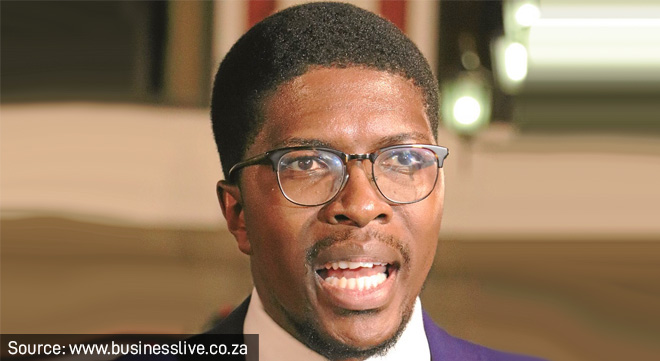
Despite intensifying criticism from political and industry stakeholders, the Department of Transport says work on reviving the controversial Road Accident Benefit Scheme (RABS) Bill is nearing completion.
Briefing the media ahead of last week’s Transport Budget Vote, Deputy Transport Minister Mkhuleko Hlengwa (pictured) said the government was in the final stages of updating the long-contested legislation.
“The work of the legislative amendments on RAF is currently under way, but we need to make sure that the ecosystem, which has fundamentally changed from when RABS was initially introduced, we need to be able to update it correctly, and we’re at the tail end of the process,” he said.
Hlengwa’s comments come nearly six years after Parliament rejected the RABS Bill following opposition from legal professionals, civil society organisations, and opposition parties.
The long-stalled legislation returned to the policy agenda in June last year when Hlengwa confirmed that the government had abandoned the separate Road Accident Fund Amendment Bill and would instead revive the RABS framework as part of broader reform of the Road Accident Fund.
Read: Government revives rejected Bill to fix Road Accident Fund
First introduced in 2017, the RABS Bill proposes replacing the RAF’s fault-based compensation model with a no-fault social insurance system built around structured and defined benefits. Under the proposed framework, claimants would no longer need to prove negligence to qualify for compensation.
The proposal has remained contentious because it would also remove the right to sue negligent drivers and eliminate compensation for pain, suffering, and disfigurement. Critics have also raised concerns about capped benefits, exclusions affecting informal workers, and constitutional implications linked to limiting common-law rights.
The Department of Transport has nevertheless continued to argue that the current RAF model is financially and administratively unsustainable.
That debate intensified further during a recent Standing Committee on Public Accounts (SCOPA) meeting linked to Sunshine Hospital, where Democratic Alliance MP Patrick Atkinson argued that fuel levy income could not sustain the scale of liabilities created under the current system.
Atkinson warned that the proposed RABS framework could worsen the financial position instead of resolving it.
He said running “two parallel schemes”, as envisaged under the RABS transition model, could cost between R70 billion and R80bn annually, while the RAF currently receives about R48bn from the fuel levy.
“I don’t think that the people should be living in a world of mystery, believing that the RABS Bill will actually resolve the problem; it won’t,” he said.
Atkinson further argued that the government should delay further legislative changes until the completion of SCOPA’s inquiry into the RAF, which he described as the most comprehensive investigation into the institution conducted in recent years.
SCOPA’s inquiry into the RAF – initiated after concerns about governance failures, misleading information provided to Parliament, and the Fund’s long-standing financial instability – concluded its public hearing phase in early 2026 after months of testimony from the RAF, government departments, regulators, and industry bodies.
The committee is now considering the report section by section, beginning with claims-related matters. So far, it has dealt with the RAF’s accounting policy changes, the RAF 1 Form dispute, and the Sunshine Hospital matter.
Read: RAF faces claims surge if form falls
Once deliberations are complete, relevant sections will be circulated to affected parties for comment before the report is finalised and tabled in the National Assembly.
Separate debate emerging over RAF funding model
Alongside the proposed RABS reforms, the government is examining changes to the RAF’s funding structure – a process increasingly moving towards some form of hybrid funding model.
In her budget speech last week, Transport Minister Barbara Creecy said the department was researching “options for a hybrid funding model that will include both private and public contributions, to lessen the burden on the fiscus going forward”.
Hlengwa said the department was conducting a gap analysis and case study “to ensure we cross our t’s and dot our i’s”.
He also linked the funding debate to broader structural pressures facing the RAF, including road safety and the gradual shift towards electric vehicles, which could erode fuel levy revenue over time.
“So, part of what we are doing with the gap analysis, therefore, is to say, how do we deal with that particular problem? So, for us, the whole ecosystem of integration around RAF is critical,” he said.
The comments align with findings published last month in a study commissioned by the Actuarial Society of South Africa, which concluded that no single compensation model – including RABS – could fully resolve the RAF’s financial, legal, and administrative challenges on its own.
Read: Actuarial study finds no single model resolves RAF challenges
The study evaluated the current RAF system, the proposed RABS model, and compulsory third-party insurance provided by private insurers. It found that each model addressed some weaknesses while creating new trade-offs around affordability, sustainability, and legal rights.
The research instead pointed to a hybrid structure combining elements of public compensation and private insurance.
Sunshine Hospital dispute sharpens focus on RAF litigation strategy
The Sunshine Hospital matter has meanwhile become another flashpoint in the broader debate over governance, litigation costs, and financial pressure at the RAF.
The issue formed part of SCOPA’s ongoing inquiry on 15 May, where committee members considered a draft section of the committee’s report dealing with Sunshine Hospital, litigation linked to unpaid claims, and allegations of collusion involving RAF staff.
According to the draft report, Sunshine Hospital claimed that by July 2025 the RAF owed it more than R300 million, while several former RAF employees alleged they had been unfairly dismissed in matters linked to the hospital.
The report notes that Sunshine Hospital, a private facility in Ekurhuleni that primarily treated motor vehicle accident victims, worked closely with the RAF for years under a co-operation arrangement aimed at assisting overflow patients from overburdened state hospitals.
The relationship deteriorated after the RAF imposed a moratorium on payments to Sunshine Hospital in 2020 while forensic investigations into alleged overbilling, overservicing, and collusion were underway.
SCOPA’s draft findings state that the RAF’s own Forensic Investigation Department report, completed in September 2021, “could not establish evidence of collusion between RAF employees and Sunshine Hospital”. The report also found no evidence of duplicated payments or overservicing and recommended that the payment moratorium be reconsidered.
Despite this, the RAF continued withholding payments and launched multiple legal challenges against Sunshine Hospital while facing hundreds of court judgments ordering it to settle outstanding claims.
The draft report states that by September 2025, Sunshine Hospital had issued more than 6 000 summonses against the RAF and obtained 647 judgments totalling about R180.4m.
Several courts sharply criticised the RAF’s handling of the matter.
In one judgment cited by SCOPA, the Supreme Court of Appeal found there was no evidence of fraud linked to the claims and criticised the RAF for repeatedly attempting to avoid complying with court orders.
Another judgment described the RAF’s allegations against Sunshine Hospital as “unconvincing”, stating that the Fund had “simply thrown mud at Sunshine in the hope that some of it sticks”.
SCOPA’s draft findings also raised concerns about the RAF’s litigation strategy and the financial consequences flowing from repeated court defeats.
The committee found that the RAF appeared to rely on “vague and generalised allegations of impropriety” despite failing to produce substantive evidence in court, while legal costs and interest linked to the litigation had already reached nearly R24m by September 2025.
The committee concluded that these costs amounted to fruitless and wasteful expenditure.
The handling of RAF staff linked to the Sunshine matter also came under scrutiny.
The draft report states that about 13 RAF employees were dismissed over allegations of collusion with Sunshine Hospital despite the RAF’s forensic report finding no evidence of collusion between staff and the hospital.
SCOPA warned that if the dismissals and suspensions were not legally justified, the RAF may have incurred further unnecessary costs through disciplinary proceedings, legal fees, and salaries paid during suspensions.
During last week’s meeting, SCOPA chairperson Songezo Zibi questioned why the RAF had failed to link its allegations to specific claims despite years of investigations and litigation.
He also questioned the basis on which RAF employees had been suspended or dismissed when the Fund had repeatedly failed to prove collusion allegations in court or through its own investigations.
Zibi further suggested that some of the RAF’s conduct could reflect deeper financial pressure inside the institution, with delays in payments to claimants, medical providers and attorneys potentially linked to broader liquidity constraints.

