
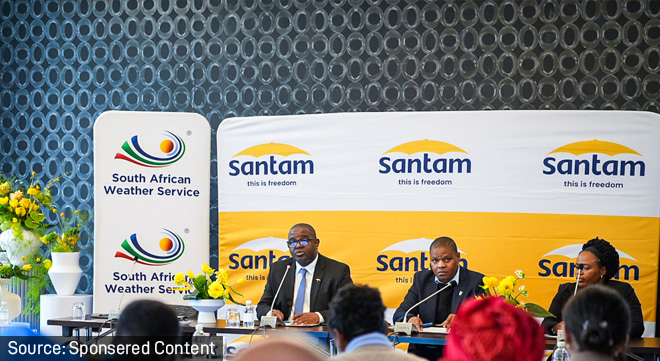

Santam and the South African Weather Service (SAWS) have launched a partnership to strengthen the country’s early warning and forecasting capabilities, with nine new automatic weather stations now installed across the country.
The stations are already operational and integrated into the SAWS observation network, supplying real-time data to improve weather monitoring and forecasting.
Four of the AWS units were piloted in Limpopo and Mpumalanga between 2021 and 2022, with five additional stations recently commissioned in KwaZulu-Natal, Eastern Cape, Western Cape, and Gauteng.
Site selection was driven by identified gaps in weather observation, particularly in regions exposed to severe rainfall, flooding, and other disruptive weather events. These include parts of the eastern seaboard – from the Eastern Cape through KwaZulu-Natal and into Mpumalanga and Limpopo – as well as areas in the Western Cape and Gauteng.
The initiative forms part of a broader collaboration aimed at expanding observation infrastructure, improving public awareness, and supporting the SAWS’s mandate to issue severe weather warnings.
Santam said the partnership is intended to strengthen disaster risk management by improving the accuracy, reach, and timeliness of early warnings.
Santam group chief executive Tavaziva Madzinga said enhancing the SAWS’s capabilities would help ensure that warnings are “accessible, credible, and localised so that South Africans can act before weather hazards escalate into disasters”.
He added: “Simply put, early warning enables early action. If people delay travel, secure property, move vehicles, or protect agricultural assets based on credible early warnings, exposure is reduced and losses are minimised.”
The SAWS described the partnership as a practical example of public-private collaboration to strengthen the country’s weather infrastructure.
SAWS acting chief executive Jonas Mphepya said the additional stations would reinforce the agency’s observation network at a time when severe weather events are becoming more frequent and intense.
Rising risks, growing costs
The partnership comes amid increasing climate-related risks and mounting economic losses.
Data cited by Santam shows that global disaster costs have risen sharply, with annual losses increasing from about US$70 billion to US$80 billion between 1970 and 2000 to roughly US$180bn to US$200bn between 2001 and 2020. More recent estimates suggest total losses now exceed US$2 trillion annually when broader impacts are included.
In South Africa, the financial impact is also significant. The 2022 floods in KwaZulu-Natal alone caused more than R50bn in damage.
In this context, early warning systems are increasingly seen as a critical – and cost-effective – tool for reducing risk.
Despite this, gaps remain in South Africa’s weather observation network, limiting the ability to provide accurate, localised warnings in some regions.
From infrastructure to awareness
Beyond expanding infrastructure, the partnership includes a focus on public awareness and education.
Santam said it works with municipalities, schools, and community organisations to improve understanding of weather warnings and how people should respond. This includes targeted campaigns, school-based programmes, and community radio initiatives in high-risk areas.
The collaboration also aligns with South Africa’s commitments under the Sendai Framework for Disaster Risk Reduction and the United Nations’ Early Warnings for All initiative, which aims to ensure universal access to early warning systems by 2027.
Santam and the SAWS are now formalising the partnership to support further investment in weather observation systems and capacity-building initiatives.
Madzinga said the objective is to build resilience to increasingly severe weather events, adding that strengthening early warning systems ultimately benefits communities, businesses, and the broader economy.

