
The South African Revenue Service has moved into enforcement in the campaign against the illicit economy, executing search-and-seizure and preservation orders against six current and former officials and associated taxpayers and traders linked to a customs corruption probe.
The action, announced on 17 March, follows commitments in President Cyril Ramaphosa’s February State of the Nation Address to intensify efforts against organised crime and illicit trade. The intervention comes after years of warnings about the scale of the problem.
Customs corruption case moves into enforcement phase
SARS said it has been investigating allegations that customs inspection teams colluded with clearing agents and importers to manipulate inspections in exchange for cash bribes.
Financial analysis identified more than R45 million in under-declared taxable income, resulting in estimated income tax losses of about R18m.
Search-and-seizure and preservation orders were obtained to secure evidence and assets linked to the scheme. SARS said those involved are suspected of breaching their statutory obligations and prejudicing compliant taxpayers, legitimate traders, and the fiscus.
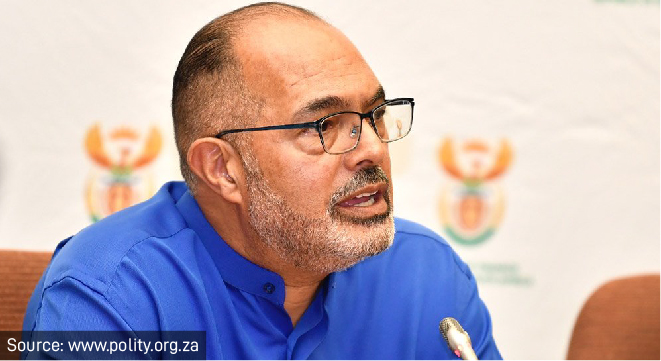
SARS Commissioner Edward Kieswetter (pictured) said the operation forms part of efforts to protect the fiscus, secure borders and enforce compliance “without fear, favour or prejudice”.
“Those who choose to abuse this mandate, whether from within SARS or from outside, have committed a crime and must face the consequences,” he said.
Illicit economy entrenched across sectors
The illicit economy is estimated at roughly 10% of GDP and spans multiple sectors:
- Excise goods (alcohol and tobacco): Duty-not-paid products dominate, with illicit share rising from about 37.6% in 2019 to more than 66% by 2024.
- Customs fraud and trade mis invoicing: Including under-declaration and tariff manipulation at ports of entry.
- Illegal mining: Linked to organised criminal networks and infrastructure damage.
- Fuel smuggling and adulteration: Undermining regulated markets and tax collection.
- Counterfeit goods and smuggling: Affecting retail, manufacturing and imports.
- Construction-sector extortion: Disrupting infrastructure delivery and inflating costs.
Parliament’s finance committees have called for stronger enforcement, coordinated SARS–SAPS operations and improved customs systems – a position set out in committee recommendations accompanying the 2026 Budget Review.
Years of warnings, limited enforcement
Illicit trade has expanded rapidly in recent years. It now accounts for a significant share of economic activity, with billions of rand in lost tax revenue annually.
Research from the Transnational Alliance to Combat Illicit Trade points to weak enforcement, organised crime networks and economic pressure – including unemployment and inflation – as key drivers.
Regulatory shocks, including the 2020–2021 tobacco sales ban, accelerated the shift towards entrenched illicit supply chains.
Coordinated response now taking shape
After years of warnings from industry and researchers, it seems that the government is starting to shift towards a more co-ordinated response to illicit trade.
In his 2026 Budget Speech, Finance Minister Enoch Godongwana described illicit trade as a “major threat” that “robs the fiscus of billions in revenue” and requires intensified enforcement.
He indicated that funding in the latest Budget would be channelled through enforcement capacity rather than a single dedicated allocation. This includes about R990m over the medium term for the Border Management Authority to expand frontline capacity, alongside additional funding for police and defence operations targeting organised crime.
Operational measures include joint SARS operations with the Border Management Authority, SAPS and the defence force, as well as continued focus on customs enforcement and illicit tobacco trade.
SARS said its strategy targets corruption and fraud within government systems and across tax and customs processes. SARS confirmed it will work with the South African Police Service and the National Prosecuting Authority (NPA) to pursue prosecutions.
Fiscal and economic impact
Illicit trade reduces revenue, distorts competition, and places additional strain on already constrained public finances.
Parliament’s finance committees, in recommendations accompanying the 2026 Budget Review, link weak enforcement and tax leakage directly to fiscal pressure. They note that lost revenue limits the government’s ability to stabilise debt, fund social services, and avoid further spending compression.
The committees highlight that non-interest expenditure is projected to decline as a share of GDP over the medium term, warning of risks to frontline services such as health, education, and policing if revenue shortfalls persist.
They recommend that SARS be further resourced to strengthen enforcement, recover outstanding and evaded taxes, and reduce disputed amounts. This is coupled with calls for improved co-ordination between SARS, SAPS, and the NPA, as well as a clearer medium-term tax policy roadmap.
In excise sectors, the committees call for a structured approach to curb illicit trade, including a multi-year roadmap for alcohol and tobacco taxes, stronger customs enforcement, and the implementation of an effective tobacco track-and-trace system.
Enforcement likely to intensify
SARS indicated that further actions can be expected.
Kieswetter said enforcement is aimed at protecting compliant taxpayers and ensuring that revenue intended for the public good is not lost to corruption.
SARS has called on the public and industry to report suspected bribery, fraud, and customs irregularities.

