
South Africa’s economic growth remains stuck at about 1%, despite years of structural reforms intended to make the economy more competitive.
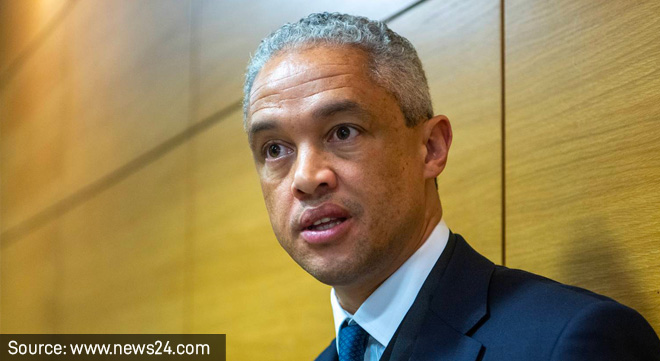
“OV [Operation Vulindlela] is now six years old. It clearly has made gains. Yet economic growth still seems to be stuck at around 1%,” said National Treasury Director-General Duncan Pieterse (pictured), describing what he called the “apparent paradox of reform”.
At the Old Mutual Investment Group’s Tomorrow Investment Summit on 11 November 2026, Pieterse outlined the next phase of the reform programme, which he said must focus on accelerating implementation and attracting private investment, particularly in infrastructure.
The question the government is regularly asked, he noted, is when South Africa will grow at 3%. In Pieterse’s view, the answer lies in reforms that open network industries, improve competitiveness, and allow businesses to invest and expand.
Structural reforms take time because they involve changes to policy, regulation, and institutions. In sectors such as electricity and logistics, the government is seeking to dismantle longstanding monopolies and establish new institutions and markets.
He also acknowledged that these changes could meet resistance.
“Change inevitably causes discomfort, even resistance, which must be carefully navigated and co-ordinated across government,” he said.
Pieterse said the government has spent the past three years rebuilding fiscal credibility and stabilising debt.
“Now that the macro-economic conditions have been created for faster growth, our energy and effort can shift to accelerating the work of Operation Vulindlela,” he said.
Opening electricity, rail, and ports
Electricity, freight logistics, and water are key areas where reforms are intended to remove constraints on investment and economic activity.
In electricity, the removal of licensing requirements in 2022 opened the market to private renewable energy generators. This prompted a surge in investment and brought substantial new capacity onto the national grid, while helping to end the electricity crisis.
The next constraint is the grid itself, which needs more than R100 billion in investment to expand and modernise, according to Pieterse.
“Most of that investment will have to come from private investors,” he said.
Attracting that investment will require a level playing field for private generators, including equal access to the grid and “a transmission and system operator that dispatches private power on competitive terms with Eskom power – so that prices come down over time”.
The National Transmission Company of South Africa has been established as an Eskom subsidiary. The next step is to establish it as “a fully independent, state-owned Transmission System Operator that owns and controls the transmission assets and provides open, non-discriminatory access to the grid”, he said. This would allow generators to compete on equal terms.
In freight rail, the market has been opened to private operators, and the first privately owned trains have started testing the lines. But an independent Rail Infrastructure Manager is still needed to ensure a level playing field.
“There too, we need a Rail Infrastructure Manager that is fully independent to ensure a level playing field between Transnet and privately owned operators,” he said.
At the ports, Cabinet has approved an approach to unbundling the ports authority from Transnet. The separation is intended to create greater scope for competition between terminal operators, but the restructuring has yet to be completed.
Opening the market and creating a level playing field for terminal operators, Pieterse argued, would help “reduce the cost of trading with the rest of the world and improve South Africa’s global competitiveness”.
Water, skills, and tourism also feature in the reform agenda
Beyond electricity and freight logistics, Operation Vulindlela covers water, immigration, digital infrastructure, and local government. But the initiatives Pieterse outlined are at different stages, and several have yet to move beyond policy changes, pilot projects or plans.
In water, the revised Raw Water Pricing Strategy is in place, new raw water use charges have been approved, and work is continuing on the National Water Action Plan and the establishment of the National Water Resources Infrastructure Agency.
Immigration reform is intended to make it easier for tourists and skilled workers to enter South Africa. The Electronic Travel Authorisation (ETA), an online system, through which eligible foreign visitors can apply for authorisation to travel to the country, was officially launched in August.
The system, he said, “will improve tourist visa processing and ultimately also work and study visas”. The extension to work and study visa categories is still planned.
The second phase of the Trusted Employer Scheme is also intended to simplify the recruitment of highly skilled foreign workers by allowing qualifying employers to use a streamlined visa process. How much difference it makes will depend on how effectively the scheme operates and how widely employers can access it.
Other projects are a search for a strategic partner for Transnet’s multi-billion-rand Manganese Export Corridor, which transports manganese for export. Transnet has issued a request for qualifications, but a partner has yet to be selected.
Digital public infrastructure is also on the agenda. The Department of Home Affairs has unveiled a digital identity prototype, while MzansiXchange data sharing is being piloted within government. Both initiatives remain at an early stage.
Municipal finances and service delivery are also part of the reform programme. And this could prove to be the toughest challenge of them all.
Read: Treasury calls July municipal intervention a success – but the bigger fix is still ahead
The reform programme includes a revised White Paper on Local Government, approved by Cabinet in September, the Municipal Finance Management Amendment Bill published for public comment alongside the Medium-Term Budget Policy Statement, and measures to ensure municipalities reinvest revenue from essential services in the infrastructure needed to provide them.
Under the municipal trading services reforms, large cities are being encouraged to ring-fence revenue from water, electricity, and waste services and reinvest it in the infrastructure needed to provide them.
He said the changes would “open the way for private investment in municipal infrastructure”, alongside new public-private partnership regulations for municipalities. Whether this leads to better infrastructure will depend on how well municipalities manage the money and services for which they are responsible.
The expansion of Operation Vulindlela in 2025 added local government, digital infrastructure, and spatial inequality – particularly housing reform and public transport – to its original priorities of electricity, freight logistics, water, visas, and broadband spectrum.
The wider growth strategy also includes lowering barriers to competition and small businesses, supporting labour-intensive sectors such as agriculture and tourism, and improving export competitiveness.
Reform progress is uneven
The latest Operation Vulindlela Phase II report, covering the second quarter of 2026/27, shows that 47% of reforms were on track. A further 30% were delayed or off track but work was under way, while 10% faced significant challenges requiring intervention. Another 10% had been completed but required further work, and 3% were classified as complete, with no further work required.
The report records decisions to introduce competition in electricity and ports, progress towards allowing private operators into freight rail, and changes to the visa system. Business Leadership South Africa’s independent second-quarter tracker also recorded progress, with its reform completion index reaching 72.5% – its highest reading since tracking began in March 2024.
However, several major reforms are taking longer than expected. Electricity distribution is one example. Progress has been slow, and the roadmap that was due in June had still not been published when Pieterse delivered his speech.
He acknowledged that several reforms in the current phase of Operation Vulindlela are complex and contested and are taking longer than expected.
“They need to be accelerated; this will require political will and cohesive action across the whole of government,” he said.
Opening a market is one thing; making it work is another. Private operators still need fair access to infrastructure, independent institutions must be established, and the regulatory frameworks governing competition must be put in place. Until these conditions are met, the expected gains in investment, efficiency, and lower costs remain just that – expected.
Faster reform is essential to lifting growth, in Pieterse’s view.
“There can be no question that growth will not lift without reform,” he said. He added that faster progress could boost confidence and investment, creating a cycle of higher growth, job creation, and poverty reduction.
Government wants to shift more spending towards infrastructure
Pieterse also discussed how fiscal policy can support growth, with a greater focus on the quality of government spending and directing more resources towards infrastructure.
The government stabilised debt as a share of GDP in the 2025/26 financial year, meeting a target set three years earlier. This was achieved through a primary surplus, where revenue exceeds spending excluding interest payments. The government has maintained a growing primary surplus for three consecutive years and projects that debt will fall below 70% of GDP within five years.
Read: Holding the line: fiscal discipline takes centre stage
Rebuilding fiscal credibility had helped to narrow South Africa’s risk premium, improve credit ratings, and lower borrowing costs for the government. These improvements also benefit businesses and households.
With the public finances on a more stable footing, Treasury wants to shift more spending towards capital investment. Payments for capital assets are projected to grow by 5.3% over the medium term, faster than spending on the public-sector wage bill and goods and services.
The government has also set aside R20bn from stronger-than-expected revenue collection for infrastructure investment through the Budget Facility for Infrastructure (BFI).
Since 2021, the BFI has approved 41 projects with R96bn in direct fiscal allocations. The facility is intended to help bring additional private investment into projects that meet its assessment requirements.
The facility was reconfigured last year, with the government aiming to route all infrastructure proposals through its evaluation process. An infrastructure bond programme is also under way to finance projects approved by the BFI.
The government wants to attract more private investment into infrastructure projects. But that will depend on whether it can identify viable projects, prepare them properly, and see them through to completion.
“The turnaround may not be instant, but over the next few years we have an opportunity to create a much stronger economy if we put our collective energy behind the government’s reform efforts.”