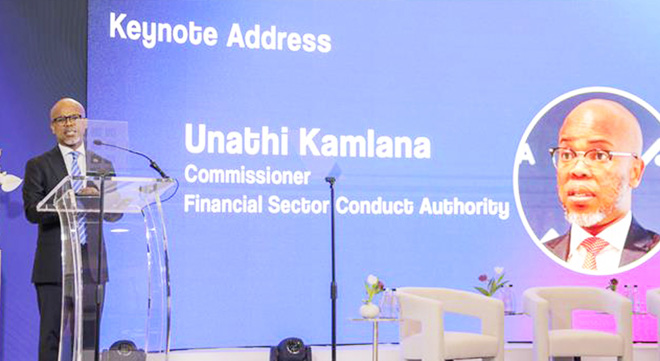
What will define the next phase of development for the financial sector – and how must both regulators and the industry evolve to respond to it? That was the central question posed by FSCA Commissioner Unathi Kamlana (pictured) in his keynote address at the regulator’s third annual Industry Conference on 18 March.
He said a more complex, uncertain, and rapidly changing environment will require a corresponding shift in regulatory approach – away from detailed rule-setting and towards a stronger focus on outcomes, accountability, and adaptability.
Kamlana situated the financial sector within a changing global backdrop marked by rising geopolitical tensions, including conflict in the Middle East, increasing economic fragmentation, and a gradual weakening of multilateral institutions.
Although noting signs of domestic improvement – including South Africa’s exit from grey listing and an upgrade by S&P Global from BB- to BB – he cautioned that global developments are likely to weigh on economic prospects, with businesses facing more difficult operating conditions and investment decisions becoming more cautious.
Structural changes reshaping the sector
Kamlana said the financial sector is also being reshaped by deeper structural changes.
Technology, particularly artificial intelligence, is already widely adopted across the sector. Although it offers clear benefits, it also introduces new responsibilities.
“If automated systems are used in areas such as credit decisions, investment advice, or risk management, institutions must be able to explain how those decisions are made and ensure they remain fair and transparent.”
He added that, “technology does not remove responsibility from institutions; if anything, it increases it”.
Changes in market structure are also evident. Although new exchanges and trading venues are increasing competition, the number of listed companies has been declining.
A recent study by the Development Policy Research Unit at the University of Cape shows that smaller and less profitable firms are significantly more likely to exit public markets, with delistings disproportionately concentrated among smaller companies. Over time, this can lead to a concentration of market capitalisation among a smaller number of larger firms, raising questions about the depth, diversity, and ability of public markets to support firms at different stages of growth.
Climate-related risks are also increasingly influencing how capital is allocated and how financial risks are assessed, alongside the growing demand for consistent and comparable sustainability disclosures.
At the same time, customers are more informed, more digitally connected, and more able to compare financial products and services. Social media has amplified this dynamic, with negative experiences able to spread quickly and increase reputational risks for institutions.
Regulation must evolve
Kamlana said that as the financial system changes, regulation must also evolve.
“Effective regulation is not about prescribing detailed rules for every possible situation. It is about ensuring that the right outcomes are achieved in practice.”
He noted that financial markets and business models evolve more quickly than regulatory frameworks can be rewritten, and regulation should therefore focus on clear principles such as fair customer outcomes, transparency, market integrity, and sound governance.
He also highlighted the importance of proportionality, noting that regulation must be calibrated to the risks it seeks to address, balancing the need to support innovation with the need to maintain trust and stability.
Kamlana said these ideas sit at the heart of the Conduct of Financial Institutions (COFI) framework.
Although the legislative process is still under way, he said the philosophy behind COFI is already shaping how the FSCA approaches regulation and supervision.
COFI represents a shift away from a narrow focus on compliance towards greater accountability for outcomes, requiring institutions to consider whether the products they design, the advice they provide, and the services they deliver genuinely serve the interests of financial customers.
He said this shift “does not begin only when the legislation formally comes into effect” and should already be shaping how institutions think about conduct.
Governance and ‘social capital’
Kamlana said trust in the financial sector is shaped by governance and organisational culture.
He referred to the concept of “social capital” – the trust placed in financial institutions – noting that it is built over time through responsible leadership and ethical conduct, but it can be lost quickly when misconduct occurs.
In this context, he said that “in the face of the global and local challenges confronting us, these good values and good conduct have never been more urgent”.
Looking ahead
Kamlana said the future of the financial sector will depend on how effectively regulators and industry work together to respond to ongoing changes.
He said the environment is becoming more complex, more interconnected, and more technologically driven, and institutions that are unable to adapt to this reality will increasingly struggle to remain relevant.