
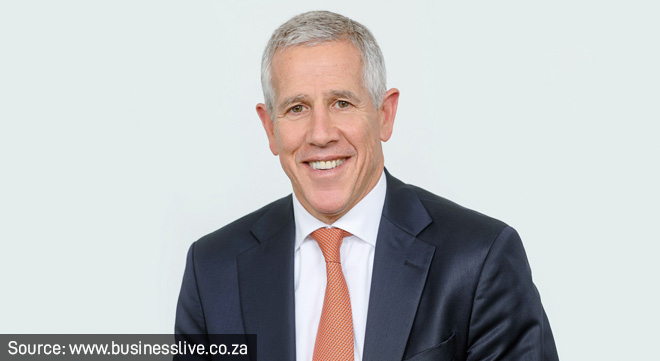
“This is a humbling profession, and very few houses and teams get it right all the time,” says Hendrik du Toit (pictured), founder and chief executive of Ninety One.
His observation comes against a mixed set of interim results. The asset manager increased adjusted operating profit by 19% to £117.8 million in the six months to 30 September 2026, but it recorded net investment outflows of £4.2 billion. Assets under management (AUM) grew by 19% year on year to £181.4bn, helped by £13.8bn in positive market and foreign exchange movements.
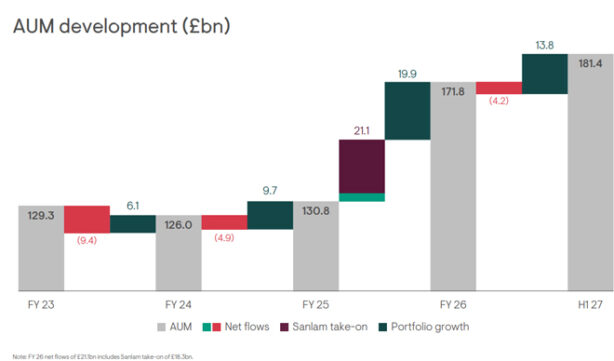
The outflows were a reversal from the £4.3bn in net inflows recorded in the comparable period. However, that previous figure included £1.9bn in assets brought across through the Sanlam UK take-on. Excluding that transaction, Ninety One recorded net inflows of £2.4bn in the first half of the previous financial year.
Du Toit acknowledged that the latest flow performance was disappointing and fell short of management’s expectations.
Equity strategies bear the brunt of outflows
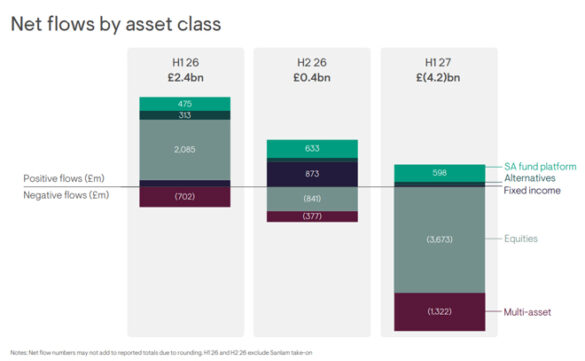
The outflows were concentrated in equities and multi-asset strategies. Equities recorded net outflows of £3.67bn, while multi-asset strategies lost £1.32bn. These were partly offset by inflows into the South African fund platform (£598m), alternatives (£124m), and fixed income (£53m).
Ninety One attracted money into Asian and emerging-market equity strategies, but these inflows were outweighed by withdrawals from global, South African, and international equities, as well as income and sustainable equity strategies. Multi-asset outflows were driven by South African strategies.
Du Toit attributed the withdrawals to investment-performance challenges in two broad areas: global and international equities, and South African equities.
In global and international equities, one factor was the prolonged underperformance of the quality investment style relative to growth stocks, particularly in a market dominated by large US technology companies.
“Our team has done what they promised clients, but after many years of outperformance, the quality style will remain in a tough place while markets remain obsessed with growth stocks,” he said.
He explained that this type of underperformance can affect client allocations, even when a strategy is sticking to its longer-term investment approach.
“[The quality style] wasn’t supposed to stay with the market but doesn’t generate inflows if you don’t stay with the market, and sometimes gets weights against it because the clients feel the regime has changed,” he said.
He also distinguished this from stock-selection errors in some global strategies, which had affected performance.
“On the global side, [we] made a few stock selection errors, and stock selection errors can be quite expensive because the market moves stocks far, and therefore your alpha gets slightly depleted, and that makes clients either down weight or not buy.”
In South Africa, he acknowledged that the group should have performed better in domestic equities and said it was working to improve its position. Fixed income, by contrast, had performed well.
“Our fixed income platform was done very, very well,” he said.
Du Toit also cautioned against reading too much into the overall outflow figure without considering how flows work across an active asset manager’s business.
“Remember an active manager, you have quite a significant inflow and a significant outflow all the time. If the ratio between them changes, suddenly your number looks kind of big, and it may not be that big because you have to close the jaws from two sides.”
Second-half flows: better, but no promises
When setting its budget for the current financial year, Ninety One had expected substantial net inflows. Du Toit acknowledged that the actual flow performance had fallen well short of those expectations.
“We were budgeting for pretty big inflows, and I didn’t think I was just hoping. I think it was real,” he said.
Although he believes the flow picture could improve in the second half, he was reluctant to make firm predictions.
“I’m very cautious to promise anything, but I think it could be better than that.”
He said the South African business could recover more quickly, while the global business would depend on whether investment performance improved and whether the group secured additional fixed-income and infrastructure mandates.
A recovery in performance could help to stem withdrawals, but persuading clients to put new money into the strategies would take longer.
“Once you start clawing back, as we have done, you hold the outflows,” he said, adding that the group would then need to win substantially more business in emerging markets.
Du Toit was careful not to promise a return to substantial inflows in the second half.
“I would be cautious. I wouldn’t just go back with a massive inflow in the second half,” he said. “But I’m pretty confident that what we’re doing is right.”
The group had also expected some mandates to fund before the end of the reporting period. Du Toit said the pipeline of signed but unfunded UK mandates stood at well over £2.5bn. Some had since funded, although not all would necessarily do so within the current financial year.
“We were a bit unlucky that some of that could have come in and made the outflow experience look a bit better,” he said.
He declined to comment on developments after the reporting period, including whether further redemptions had been notified, but said the pipeline was in a better position than the first-half flow result might suggest.
Emerging-market interest has yet to translate into a wave of inflows
Ninety One continues to see emerging markets as a key growth area, but Du Toit said the expected shift in investor allocations towards the asset class was taking longer than anticipated.
Despite emerging markets’ relative performance, global investors remained heavily focused on the US, buoyed by the strength of its technology sector and enthusiasm around artificial intelligence.
“The bulk of the active flows haven’t moved,” he said. “I think it will in due course but given the fact that the outperformance of the US was so much, and given the geopolitical uncertainties, capital tends to stay home for longer.”
He also pointed to China’s underperformance, which he attributed largely to geopolitical factors rather than a lack of innovation.
Despite the slower pace of allocations, Du Toit said the group would not change its strategy.
“There is evidence that diversification benefits are building up in this world, which is slightly more, I wouldn’t say decoupled, but less integrated,” he said.
Europe was the only client region to record net inflows during the half year, with £2.62bn. Africa recorded outflows of £1.74bn, the Americas £1.77bn, Asia Pacific £2.17bn, and the UK £1.17bn.
Longer-term investment performance remains competitive
Although some strategies struggled during the period, Ninety One pointed to its longer-term investment performance as evidence that its investment approach continued to deliver over time.
Across the firm’s assets under management, 68% of portfolios outperformed their benchmarks over three years, 64% over five years, and 76% over 10 years. The one-year figure was 43%, down from 56% at the end of March 2026.
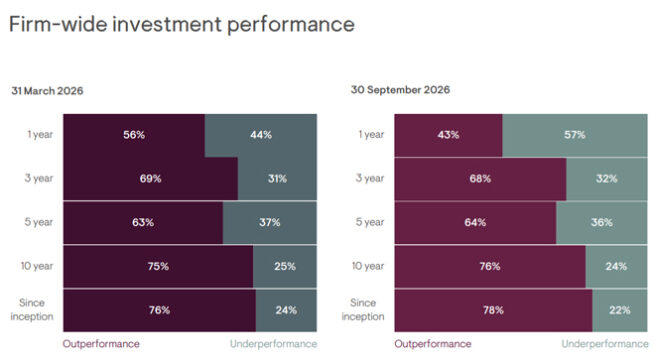
The figures measure the proportion of current AUM in portfolios with positive active returns, on a gross basis. They do not include terminated funds.
Du Toit said the group was addressing stock-selection issues through changes to investment processes and, where necessary, personnel and leadership.
“Where stock selection has been the issue, we are working hard to improve ourselves. This includes process improvements, personnel, and leadership changes where necessary,” he said.
He also cautioned that the commercial outcome would depend on market conditions as much as on the group’s own efforts.
Higher average assets support earnings growth
The increase in average AUM, which rose by 29% to £179.6bn, supported growth in revenue and earnings.
Adjusted operating revenue increased by 18% to £362.1m, while management fees rose by 21% to £351m. Adjusted operating expenses increased by 17% to £244.3m.
Adjusted earnings per share rose by 5% to 8.8 pence, while basic earnings per share declined by 8% to 8.2p, partly reflecting the accounting treatment of the Sanlam transaction. The interim dividend increased by 5% to 6.3p a share.
The average management fee rate was 39 basis points, compared with 41.5 basis points in the previous comparable period. Ninety One said the reduction was mainly due to the Sanlam South Africa take-on, which predominantly consisted of fixed-income mandates.
Du Toit said the fee outcome was in line with the group’s expectations. He also explained that some of the equity outflows came from large institutional clients reducing their allocations. These withdrawals did not necessarily have the same impact on fee income as money leaving smaller, higher-fee mandates.
He said the fee debate was increasingly shifting towards private markets, where clients were seeking larger co-investment allocations that can reduce the average fee earned.
Sanlam integration completed as group expands its reach
Ninety One completed the integration of Sanlam Investment Management on schedule. Du Toit said the transaction had shifted the group’s asset mix further towards emerging markets and increased the proportion of revenue generated from fixed income.
The group is also pursuing a proposed combination of its Namibian business with Sanlam and Allianz. Competition Commission approval had been received, with final regulatory approval from Namibia’s financial regulator, Namfisa, still required at the time of the results presentation. The transaction is expected to add about N$40bn, or approximately £2bn, to AUM.
Ninety One’s Asian joint venture has also made a positive start, recording net inflows. The group is developing its presence in the Middle East and launched its first domestic strategy in Saudi Arabia, with local funding received after the reporting period.
In private markets, the group is focusing its private credit efforts on emerging markets and expects the first closes of two infrastructure vehicles in the final quarter of the financial year.
AI adoption accelerates, but productivity gains are still to come
Ninety One reported increased use of AI across the business. Du Toit said about 90% of employees were active users of Claude by September, compared with 50% six months earlier. About a quarter of users were using Claude Code.
The group has a number of AI initiatives under way in its investment teams, operations, and client-facing functions. However, Du Toit acknowledged that it had not yet achieved tangible productivity gains, partly because work was still needed to organise and improve the firm’s data.
“The test is whether AI is changing and improving what we provide our clients in investment outcomes, experience, and service internally,” he said.
He added: “Yes, AI is helping us deal with greater volumes. That is useful, but not necessarily transformational.”
Investment performance remains the priority
Du Toit said the group’s immediate priorities were to improve investment performance and make Ninety One fit for the future through investment in talent and technology.
The results show a business that has grown its assets and profits, but where performance in several important strategies has not yet translated into the flows management expected. The second half will test whether the improvements Du Toit described are enough to restore client confidence and turn the group’s longer-term emerging-market ambitions into stronger net inflows.
“We’ve been here many times before, and you’ve got to be able to bat from the back foot as well as the front foot,” he said.