

South Africa has substantial pension assets, an established private retirement industry and a strong regulatory framework. Yet it ranks 51st out of 55 systems in the 2026 Marsh CFA Institute Global Pension Index, placing it last among the four African countries assessed.
The country’s score fell from 51.0 to 50.4, leaving it with a C grade. The Index describes a C-grade system as having some good features, but also significant risks and shortcomings. For South Africa, these include inadequate support for the poorest older people, limited occupational pension coverage and the absence of mandatory minimum retirement contributions. The Index also points to the need for higher household savings and greater workforce participation at older ages as life expectancy rises.
The decline underlines a persistent problem: a mature retirement industry does not necessarily translate into adequate retirement income across the population.
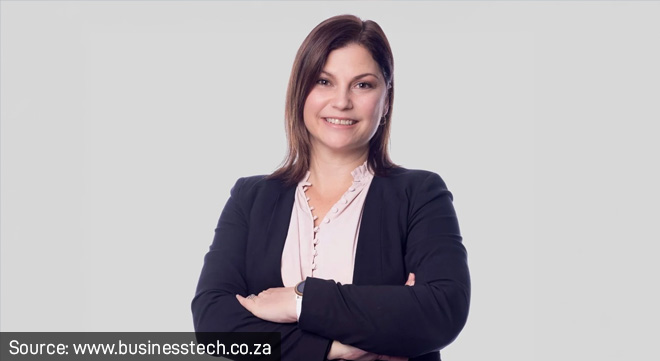
Belinda Sullivan (pictured), head of corporate consulting strategy at Alexforbes, said that although South Africa has a well-governed retirement industry, access remains uneven and too few people are saving through occupational funds.
During a media briefing unpacking the Index, Sullivan said the real measure of success was not simply the size of the country’s retirement asset pool, but whether those assets translated into adequate and sustainable retirement incomes for more people across the population.
What the Index measures
The 18th edition of the Index, published by Marsh in collaboration with CFA Institute and the Monash Centre for Financial Studies, assesses 55 retirement income systems covering about 66% of the world’s population.
It scores each system across three pillars. Adequacy, weighted at 40%, considers the benefits people can expect and whether these are sufficient to provide a meaningful retirement income. Sustainability, weighted at 35%, looks at whether a system can continue delivering benefits as populations age and economic conditions change. Integrity, weighted at 25%, examines governance, regulation, communication and other factors that support confidence in the system.
The global results show a wide gap between the strongest and weakest retirement income systems. The Netherlands tops the 2026 Index with 85.8, while Argentina ranks last with 43.7. The overall average is 65.3.
Six systems received an A grade, indicating that they deliver good benefits, are sustainable and have a high level of integrity. Australia joined this group for the first time in 2026. Four other systems completed the top ten, each receiving a B+ grade.
The Netherlands tops the Index with a score of 85.8, combining a near-universal state pension with broad occupational pension coverage, voluntary private saving, strong governance and substantial funded assets. Denmark follows on 84.1, performing strongly across all three pillars, while Iceland ranks third on 84.0, with A grades for adequacy, sustainability and integrity. Singapore takes fourth place with 82.0, supported by its strong integrity score, followed by Israel on 81.9, which also performs well on sustainability and integrity. Australia rounds out the six A-grade systems with a score of 80.6, having improved its overall grade to A for the first time in 2026.
The pillar results also show that no single system leads in every aspect of retirement provision. South Africa’s strongest result was integrity, at 75, although this was down from 75.7. Its adequacy score fell from 38.0 to 37.3, while sustainability declined from 48.2 to 47.8.
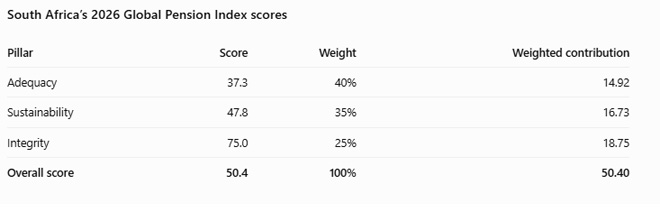
Its overall score of 50.4 was well below the Index average of 65.3.
The Index changed some of its measures this year. Its adequacy assessment now considers pension replacement rates at age 80 as well as at retirement. The integrity pillar includes a measure of pension-plan mobile-app availability, with greater weight given to cybersecurity guidance and data-breach reporting. Some defined-benefit funding measures receive less emphasis.
The Dominican Republic, Kenya and Qatar also joined the Index.
Sullivan cautioned that the lower score did not necessarily mean South Africa’s retirement system had deteriorated. She said changes to the Index’s methodology, including the assessment of retirement income adequacy at age 80, had affected the result. The inclusion of additional countries and changes other systems had made to their national savings and social security arrangements also influenced the comparison.
South Africa trails its African peers
All four African systems in the 2026 Index received a C grade, but South Africa recorded the lowest score. Namibia scored 57.5 and Botswana 57.0, while Kenya, a new entrant to the Index, scored 53.1.
The differences reflect how countries combine private retirement saving with public support for older people.
“Historically, South Africa has a very mature private retirement system, and we still need to work on that foundational accessibility and inclusivity for all South Africans,” she said.
South Africa’s public provision relies on a means-tested older persons grant, alongside private retirement saving. Namibia and Botswana have broader old-age support that is not means-tested in the same way, combined with their own arrangements for retirement provision. Sullivan linked these national differences to the countries’ stronger sustainability results.
Kenya has a mandatory national contributory pension arrangement, with contributions set as a percentage, alongside private-sector retirement provision. Its result puts it ahead of South Africa, although the systems differ in design and cannot be compared on a single policy feature alone.
The countries also have different rules for accessing retirement savings before retirement. Botswana and Namibia have distinct cash-access arrangements and related reform trade-offs, while Kenya has its own preservation rules.
The limits of voluntary retirement saving
South Africa combines a means-tested older persons grant with private retirement saving, much of which is accumulated through occupational pension and provident funds. The private system has substantial assets and established governance arrangements, but access to workplace saving is not universal.
Unlike systems where employers are required to provide retirement funding, South Africa’s workplace provision remains largely voluntary. Employees’ access to a fund often depends on whether their employer offers one, while self-employed and informal workers may have no equivalent route into occupational saving.
“Voluntary is key because there is no obligation on an employer in South Africa to provide retirement funding arrangements for their employees,” Sullivan said.
“We know, as a South African system, that people rely on the workplace to be able to access those types of benefits, those types of savings mechanisms, and they’re reliant on the employer to initiate that on their behalf.”
According to the Quarterly Labour Force Survey (QLFS), which is compiled and released by Statistics South Africa (Stats SA), about 42.3 million South Africans are of working age, and 16.7 million are employed people, including those in formal and informal employment. Sullivan explained that, within the smaller group of formally employed people, 58.1% contributed to occupational pension or provident funds.
For those without a workplace arrangement, saving depends on making their own provision, often while managing day-to-day expenses and debt.
“We do see that there is a very limited take-up in terms of people on a discretionary side to save for themselves,” Sullivan said.
Access to a retirement fund, however, does not necessarily translate into an adequate retirement income. Members also need to contribute enough, for long enough, to build sufficient savings. Alexforbes uses a replacement ratio of 75% of pensionable salary as a target, but its member insights, covering about 1.1 million active contributing records, showed an average actual replacement ratio of about 40%, compared with an expected average of 46%.
Contributions can fall short when people spend too little time saving, interrupt contributions during breaks in employment, or withdraw retirement benefits when changing jobs instead of preserving the money for retirement.
The two-pot system is intended to improve preservation and, over time, retirement outcomes for people who belong to occupational funds. But it cannot extend workplace fund membership to people who are excluded from these arrangements, nor can it guarantee that existing members contribute enough to secure an adequate income in retirement.
Should contributions become compulsory?
Sullivan questioned whether South Africa should rely on voluntary employer provision to extend occupational retirement saving, or consider mechanisms such as auto-enrolment and compulsory participation.
“Is it making sure that there is an auto-enrolment system that is put in place? Do we make it compulsory for all employers to ensure that their employees are put on a retirement system, so that we at least cover and cast that net wider?” she asked.
Auto-enrolment would place employees into a retirement fund by default, subject to the design of the arrangement. Compulsory participation would go further by requiring participation and contributions. Neither approach, however, removes the need to consider what workers and employers can afford.
She suggested that affordability-based auto-enrolment could be a starting point, with contributions increasing in phases. That could help more employees begin saving without requiring everyone to move immediately to a higher contribution rate.
Extending coverage beyond formal employment would require different solutions. Informal workers, freelancers and the self-employed may have irregular earnings and no employer to arrange contributions on their behalf. Sullivan said affordable and potentially subsidised arrangements would need to be considered if these groups were to be brought into the savings system.
Extending the system’s reach
Sullivan also set out practical steps employers and trustees could take to improve outcomes for people already in occupational funds. These include reviewing whether contribution levels are likely to produce adequate retirement income, improving communication and support, and helping members make informed decisions when changing jobs, accessing savings-pot benefits or approaching retirement.
Trustees and employers cannot solve the national coverage gap on their own. But they can improve the way existing arrangements serve members, while broader policy decisions determine how far retirement saving can be extended to people currently excluded from workplace funds.
Sullivan also highlighted the need for consistent contributions, stronger support for poorer older people within public-finance constraints, and ways to encourage people to remain economically active for longer where possible. For Alexforbes, advice is another part of the response: helping people understand their options and begin saving as early as their circumstances allow.
“We need coverage. We need to look at the irregular earners, so people who are perhaps freelancing. You know, what do they do with their savings? How do we pull them into the net? How do we help and support them?”