

The FAIS Ombud has warned consumers about online trading in contracts for difference (CFDs), after receiving numerous complaints from people who have lost millions through trading platforms offered by financial services providers.
Speaking at the release of the office’s 2025/26 Annual Report, Ombud Advocate John Simpson (pictured) identified online trading as the most notable emerging concern, saying the office faces significant difficulties in helping consumers who suffer losses through these products.
The annual report records seven formal and premature complaints involving CFDs in 2025/26. However, Simpson said the Ombud had received numerous complaints from consumers who had suffered substantial losses through online trading platforms.
“They lose absolute millions,” he said.
He said that these cases can be difficult to pursue. The difficulty, he explained, is that consumers generally execute the trades themselves, clicking to buy and sell. Although complainants allege that they were influenced or enticed into trading, Simpson said it is often difficult to produce the evidence needed to establish this.
“What we have been doing is referring those matters to the FSCA, and for possible investigation [and] enforcement,” he said.
Simpson said the Financial Sector Conduct Authority (FSCA) had suspended the licences of several financial services providers and was investigating them. He described the regulator’s actions as encouraging, saying they offered the prospect of helping consumers and protecting them from the risks associated with online trading.
He urged consumers to research CFDs before trading, describing the activity as “highly volatile, highly risky” and warning that people may not know who they are trading with.
“Just do a simple internet search on whether online trading in CFDs is a good idea. It’ll immediately kick out: this is not a good idea … You don’t know who you’re trading with, so it’s extremely risky,” Simpson said.
Ombud pays R39.6m to consumers
The CFD warning came as the annual report recorded R39.58 million in settlements and awards to consumers during 2025/26, an increase of 24.66% from R31.75m in the previous financial year.
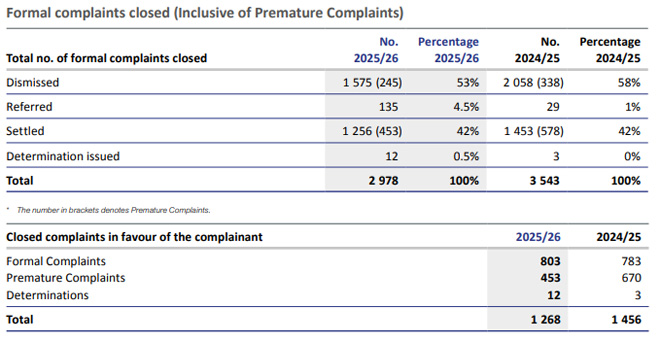
The Ombud opened 3 006 formal and premature complaints within its jurisdiction and closed 2 978 during the year. These totals include matters carried over from the previous reporting period, so the number of complaints closed should not be read as a direct measure of how many of the year’s new complaints were resolved.
Of the closed complaints, 42.18% were settled in favour of consumers or resulted in an award, compared with 41% in 2024/25. The report attributes the higher compensation total partly to several large settlements and to the increase in the Ombud’s jurisdiction in 2024, from R800 000 to R3.5 million.
The average time taken to close formal and premature complaints fell to 55.85 working days, from 59.28 days in the previous year.
Fewer complaints opened, but enquiries remain high
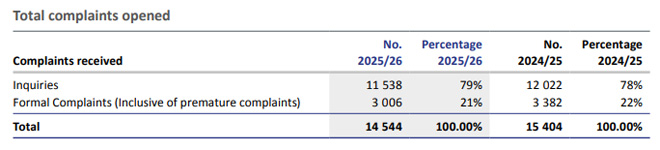
The office received 14 544 complaints and enquiries in 2025/26, a 5.58% decrease from 15 404 in 2024/25.
Of the total, 11 538 were enquiries, while 3 006 were formal and premature complaints. Enquiries generally fall outside the FAIS Ombud’s jurisdiction or do not relate to a financial service, and are referred to the appropriate forum where possible.
The office referred 9 414 enquiries to other ombud schemes or appropriate forums during the year. It says complaints that fell within another scheme’s jurisdiction were referred within one to four days of receipt.
Simpson said the office continued to encourage consumers to approach their financial services provider first and give it an opportunity to resolve the complaint. Where a complaint had not first been lodged with the provider, the Ombud could direct it through the premature complaints process, allowing the provider six weeks to resolve the matter or respond.
The report records 2 007 premature complaints opened during the year. Of these, 526 were closed without a formal investigation, and 373 were resolved directly by the provider in favour of the complainant.
The Ombud says this process, together with providers’ willingness to settle complaints earlier, has helped reduce the number of disputes that require a full investigation.
Unfair treatment tops complaint categories
Being treated unfairly was the most frequently recorded complaint category in 2025/26, with 1 175 complaints. Advice-related complaints accounted for another 613, while 505 concerned non-payment of claims.
The report’s separate Treating Customers Fairly classification also identified fairness culture as the largest category, with 1 205 complaints. Claims, switching and complaint processes accounted for 818, while 595 related to appropriate advice.
These figures reflect different ways of classifying complaints and should not be added together.
Funeral policies dominate product complaints
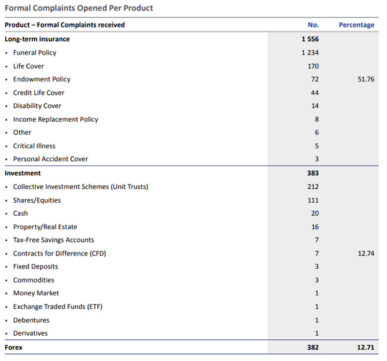
Long-term insurance, particularly funeral policies, was the largest product category, accounting for 1 556 complaints, including 1 234 involving funeral policies.
The Ombud issued 12 determinations during 2025/26, compared with three in the previous year. Simpson noted that 11 concerned the same funeral policy provider, which had failed to pay claims despite repeated undertakings to do so. Following ongoing complaints, the FSCA first suspended and later withdrew the provider’s licence.
Investment products accounted for 383 complaints, including 212 involving collective investment schemes, 111 involving shares and equities, and seven involving contracts for difference (CFDs). The report also recorded 382 complaints involving forex.
Tribunal refers only three cases back to Ombud
The Financial Services Tribunal dismissed 130 of the 133 applications for reconsideration of the FAIS Ombud’s decisions in 2025/26, referring only three matters back to the office.
The number of applications rose from 79 in the previous financial year to 133. The report records a 97.74% dismissal rate, indicating that the vast majority of challenged decisions were not sent back for reconsideration.
The office also achieved 21 of its 22 annual performance targets and received another clean audit.
Amalgamation with NFO
The FAIS Ombud is continuing to align its processes with the National Financial Ombud Scheme (NFO) ahead of a planned amalgamation, but consumers should not expect the change to happen in the immediate future.
Responding to a question about the timeline, Ombud Advocate John Simpson said the process would follow the promulgation of the Conduct of Financial Institutions (COFI) Bill and the repeal of the Financial Advisory and Intermediary Services (FAIS) Act.
“We are working very closely with the NFO and the Ombuds Council, who are facilitating the process,” Simpson said, adding that various parties were involved in developing the process.
Although he said the amalgamation would take place, the timing remained uncertain.
“The best indication I can give you is probably not within the next year,” he said.