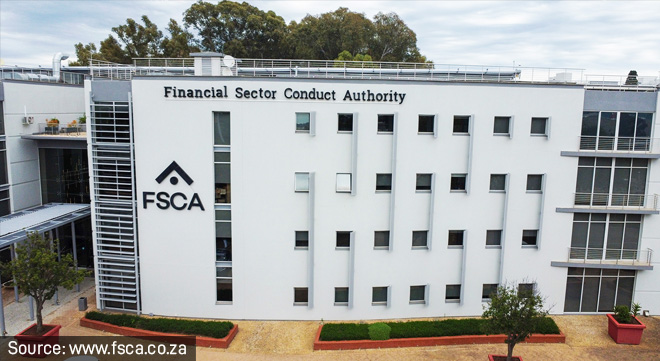

The Financial Sector Conduct Authority identified “certain systemic governance and oversight weaknesses” in non-life insurance broker-fee practices during 2025/26.
The FSCA’s latest Integrated Report, released this week, says the weaknesses emerged from the second phase of a thematic review focused on compliance with disclosure, customer consent, and activity-classification requirements.
The FSCA said it is considering the findings internally to determine possible future interventions.
The report does not describe the specific practices involved, quantify their impact on customers, state how many firms were reviewed, identify individual brokers, or announce enforcement action.
Authorised FSP population reaches 12 900
The FSCA granted 499 financial services provider licence applications during the reporting period, increasing the number of authorised FSPs from 12 401 to 12 900. This compared with 779 licences reported for 2024/25.
Five non-bank over-the-counter derivatives provider licence applications were approved, while three non-bank providers voluntarily lapsed their licences. The total number of approved over-the-counter derivatives providers increased from 42 to 44, comprising 16 banks and 28 non-bank entities.
Other licensing developments included:
- the approval of 15 foreign hedge fund managers;
- the licensing of two pension fund administrators, taking the number of active section 13B benefit administrators from 112 to 114; and
- a decline in approved friendly societies from 197 to 194 following three deregistrations.
Where both financial sector regulators are responsible authorities, the Financial Sector Regulation Act requires the other regulator’s concurrence before a licence is issued, varied, suspended, or revoked.
During the year, the FSCA concurred with the Prudential Authority’s approval of one new local commercial bank and one representative office of a foreign bank. It also concurred with the deregistration of another foreign bank representative office.
In the insurance sector, the FSCA concurred with the licensing of two microinsurers, two traditional insurers, and three controlling companies of insurance groups.
Crypto supervision expands
There were 310 licensed crypto asset service providers (CASPs) at the end of March 2026.
The number of inspections of CASPs increased from 10 to 30, with some conducted jointly with the Financial Intelligence Centre (FIC).
The FSCA also established the Crypto Asset Supervisory Engagement Forum, a multistakeholder platform aimed at strengthening collaboration, information sharing, and engagement between supervisory bodies and the CASP sector.
The forum brought together the FIC, the State Security Agency, the South African Reserve Bank, and newly licensed providers.
Banks’ sales practices and incentives reviewed
The FSCA completed the first phase of a review assessing whether banks’ sales practices, governance arrangements, and incentive structures support fair customer outcomes under Conduct Standard 3 of 2020.
The first phase involved gathering information from selected banks about their sales practices, oversight mechanisms, and customer engagement.
The FSCA said insights drawn from the information would inform more structured and targeted engagements during the second phase, aimed at identifying opportunities to strengthen market-conduct practices and improve customer outcomes.
The project followed concerns about inadequate disclosure of certain fees and charges and poor understanding among financial customers.
The FSCA said there appeared to be significant disparities between the fee structures applied by different banks to the same or similar financial products or services. The Integrated Report does not provide further details about the specific fee structures or products concerned.
Separate mystery-shopping exercises assessed customer treatment at:
- 136 bank branches;
- seven banking kiosks;
- 16 call centres; and
- two retail stores.
The exercises identified:
- compromised customer privacy and confidentiality;
- ineffective queue-management practices;
- insufficient consideration of vulnerable customers;
- inconsistent and inaccurate customer guidance;
- operational inefficiencies and service-delivery gaps;
- weak awareness of, and access to, complaints-management mechanisms; and
- what the report describes as “poor sales-driven practices and insufficient suitability assessments”.
The Integrated Report does not identify the banks or outlets involved, quantify how often each problem occurred, or indicate that every concern arose across all the channels examined.
Supervision of advisers and intermediaries
The number of authorised Category I and Category IV FSPs increased from 11 336 to 11 653 during the year.
The FSCA reviewed 9 322 financial statements submitted by these FSPs, compared with 9 918 in the previous year.
It also:
- processed 648 extension requests;
- received 61 material irregularity reports relating to Category I and Category IV FSPs;
- made 1 081 referrals involving FSPs for regulatory action; and
- conducted 31 on-site inspections to assess compliance with the General Code of Conduct and the fit and proper requirements under the Financial Advisory and Intermediary Services Act.
The report says necessary action was taken where required following the material irregularity reports but does not describe the matters reported or the resulting action.
Referrals for regulatory action declined from 1 871 in 2024/25 to 1 081.
Across its mandate, the FSCA also conducted 50 general market-conduct inspections of investment providers and 141 anti-money laundering and counter-terrorist financing inspections of accountable institutions.
The Integrated Report also summarises enforcement activity previously published in the FSCA’s 2026 Regulatory Actions Report (see Banxso, Medbond, and Steinhoff drive FSCA penalties to R2.9bn) and its latest three-year Regulation Plan (see COFI at the heart of FSCA’s 2026 regulation plan).
To download the report, go to www.fsca.co.za > About Us > Annual Reports