
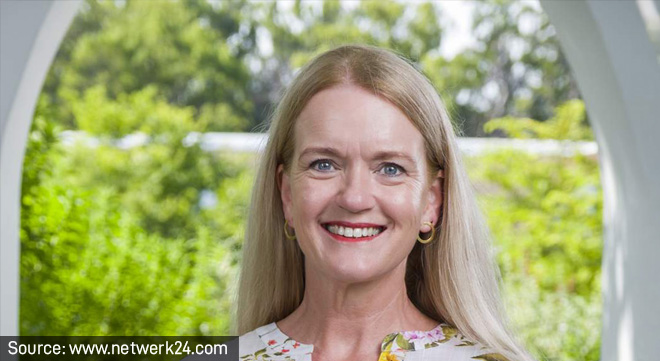
By 4pm at the end of a full day at The Insurance Conference held last week, delegates had heard from a succession of speakers and spent hours discussing the issues shaping the industry – markets, regulation, technology, artificial intelligence, geopolitics, and the risks facing the business.
The programme had covered plenty of ground. Now, with the final sessions approaching, the natural question was perhaps less what else was there to discuss than where could the conversation possibly go next.
Then came Dr Ronel Retief (pictured), institutional registrar at Stellenbosch University.
For an insurance professional who had spent the day hearing from people working directly in the industry, there was an obvious question: what does a university registrar have to say that is relevant to me?
Retief knew that too.
“I am, essentially, the compliance function of a university,” she said. “So, I have a very realistic sense of how thrilled a room is to see me arrive.”
It was a neat way to acknowledge the obvious difference between her world and theirs. But Retief had not come to talk about universities. She had come to talk about something the two worlds have in common: making decisions and commitments about a future that nobody can reliably see.
An insurer takes a premium today against a claim that may only be made decades from now. A university takes an 18-year-old today and promises that the qualification they receive will still mean something in 2050.
“Neither of us knows. Both of us have to sound as though we do.”
Retief’s question was what leadership looks like when certainty is no longer available.
Her answer was not another prediction. It was a case for learning how to lead without one.
When the problem keeps changing
Retief drew first on the work of Ronald Heifetz, a scholar at the Harvard Kennedy School who developed the influential Adaptive Leadership framework. Heifetz distinguishes between technical problems, where the expertise needed to solve a problem exists, and adaptive challenges, where the solution requires people to change how they think and work.
A technical problem may be difficult, but the expertise and solution exist. An adaptive challenge is different: the problem itself may be contested, the answer may not yet exist, and people may have to change how they think or work.
That has implications well beyond universities.
AI, climate change, and organisational culture are not problems that can be solved by buying the right technology or producing another report. They require people to change.
Heifetz’s observation, Retief said, is that people do not resist change. They resist loss.
A new technology may threaten an established skill. A restructuring may affect status. A new way of working may challenge someone’s professional identity.
“So, when something you are trying to change gets stuck,” she said, “the useful question is not: what have these people not understood? What are they not getting?
“It is: what am I asking them to give up?”
Retief then turned to Dave Snowden, creator of the Cynefin Framework and a researcher in organisational complexity and decision-making. His central point is that not every problem should be approached in the same way.
His Cynefin framework distinguishes complicated situations from genuinely complex ones. Complicated problems can be analysed and solved through expertise. In complex situations, cause and effect may only become clear afterwards.
It is an uncomfortable idea for professions built around analysis and prediction.
“Our professions are optimised for the complicated – which is exactly why the complex feels really hard,” Retief said.
The answer, she suggested, is not to abandon analysis, but to recognise when another approach is needed: observe, experiment, see what happens, and adapt.
The third framework was the one Retief said she uses most: Adaptive Action, developed by Glenda Eoyang, whose work focuses on helping organisations and people to make sense of complexity and change. Eoyang founded the Human Systems Dynamics Institute, which developed and applies this way of working with complex human systems.
The idea is deceptively simple. Ask three questions: What? What is actually happening, before we interpret it? So what? What does it mean, and what are the options? And now what? What is the next wise action?
The first question is deceptively simple: what is actually happening? Before deciding what something means or what should be done about it, look carefully at what is happening and separate what has been observed from the interpretation being placed on it.
The second asks what those observations mean. What are the possible explanations? What options are available? What might happen if one course of action is chosen over another?
Only then comes the third question: now what? What is the next wise action based on what is known at that point?
Retief emphasised the word “next”. In a complex situation, the objective is not necessarily to identify the perfect action or to produce a plan that predicts everything that will happen. It is to take a sensible next step, see what happens, learn from it, and then ask the three questions again.
“Not the right action. Not the final action. The next wise action – and then you go round again.”
The decision that has no safe answer
A few months ago, heavy rains flooded parts of Stellenbosch, giving Retief a practical example of what this looks like in real time.
University leaders were watching weather reports and road conditions late into the evening, trying to decide whether the campus should close. Closing could disrupt thousands of people if the storm proved less severe than expected. Staying open could put people at risk if conditions deteriorated.
There was no risk-free option. And there was no model that could make the decision for them.
As Retief recalled, while the university was weighing the risks, some students were outside being towed through the floodwater behind a vehicle – for fun.
The story drew a laugh, but it also illustrated something risk models cannot capture completely: people respond to decisions in ways that cannot always be predicted.
Retief learned a similar lesson during the university’s replacement of its 30-year-old student information system, SUNStudent, the largest system implementation in the institution’s history.
As executive owner, she had to make repeated go-or-no-go decisions. Every delay carried a cost. Going live too early risked the academic records of the institution.
There was no safe answer.
What she learned was less about technology than leadership.
Communicate, particularly when you would rather disappear. Acknowledge the pain instead of trying to manage it away. Explain the reasoning behind a decision, not simply the decision itself. And show up.
“People live with a decision they dislike far more easily than one they cannot understand,” she said.
For Retief, the answer came down to this: “What people remember is how you behaved while the system was breaking.”
What leaders can control
If certainty cannot be supplied, Retief argued, leaders can still offer something else.
The first is collaboration.
Status can create the impression that a leader is supposed to know more than everyone else. No one person does.
There will always be someone who has been in the organisation longer and says, “We tried that before.” Sometimes that person is right. Sometimes circumstances really have changed. Either way, listening can save an organisation months of work and considerable money.
Retief linked this to the cybernetics principle known as the law of requisite variety: a system needs enough internal variety to cope with the complexity it faces. Leadership teams that think alike may simply not see enough of the world outside them.
The second is compassion.
A customer who cannot afford an insurance premium does not experience a “retention challenge”. They experience anxiety and uncertainty. A prospective student who cannot gain admission does not experience a “cut-off score”. They experience disappointment.
Compassion does not remove accountability. It recognises the person behind the organisational problem.
The third is authenticity.
Retief joked that she had been told several times that she did not fit the profile of a registrar. Her predecessor was “a tall, serious, bearded man”.
“I am not that – neither tall, nor bearded,” she said.
When she started in the role, she felt she should at least try to fit that profile. She soon discovered that constantly correcting herself to be someone she was not consumed energy she needed for the work.
The same, she suggested, applies to leadership. The people she has learned the most from did not try to present themselves as flawless versions of what a leader was supposed to look like. They showed up with their strengths and their flaws and were recognisably themselves.
“There is nothing more appealing than authenticity,” she said.
The fourth is honesty, particularly the ability to say: I do not know.
Not “I do not know” as an excuse, and not “I do not know” when the decision has already secretly been made. Rather: “I do not know. What do you think?”
That turns uncertainty into an invitation.
A leader can admit that the outcome is unclear while still giving people something solid to work with: I do not know exactly what is going to happen, but I know what we are going to do next.
The final practice is to act.
Retief returned to one of her favourite sayings: “The perfect is the enemy of the good.”
In a changing environment, waiting until every variable is understood can mean never moving. A plan can be treated as a hypothesis, tested on a scale small enough to survive being wrong, and changed when the evidence demands it.
Trying again is not necessarily failure.
Sometimes it is how an organisation learns.
The next wise action
Retief ended with a quote from Yogi Berra, the American baseball player famous for his memorable one-liners: “When you come to a fork in the road, take it.”
The danger, she suggested, is not simply choosing the wrong road. It is standing at the fork indefinitely, commissioning another analysis and waiting for certainty that may never arrive.
The answer is to take the next wise action, based on what is known at that moment, and not to make the decision alone. Different experiences and perspectives allow a leadership team to see more of the system it is trying to navigate.
“We don’t know what’s coming,” Retief said. “But that’s fine.”
Leadership does not require knowing the future. It requires knowing who you are, what you will not compromise, whom you will listen to and what you are going to do next.
And then, when the road forks, take it.
“And if we can, have a blast doing it.”

