
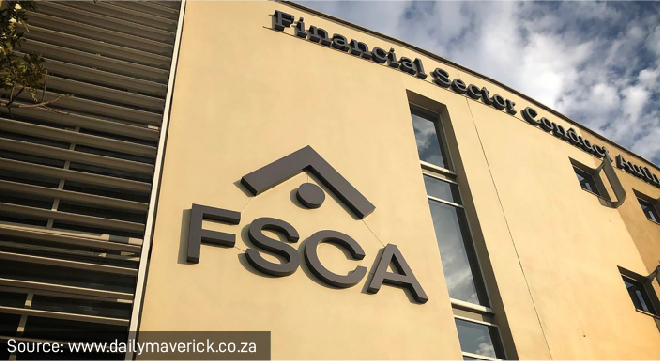
National Treasury has gazetted the final Financial Sector Conduct Authority levy amounts applicable to financial services providers for the 2026/27 levy year.
Government Notice 7820, published in Government Gazette 55198 on 14 August 2026 substitutes Schedule 2 to the Financial Sector and Deposit Insurance Levies Act. The final amounts applicable to FSPs are unchanged from those proposed by Treasury in June.
Read: Treasury proposes higher levies for 2026/27
The notice applies only to Schedule 2. In calculating their combined levy liability, FSPs must also take account of the amounts calculated under Schedule 3 for the Financial Services Tribunal (FST), Schedule 4 for the Ombud Council, and Schedule 5 for the Ombud for Financial Services Providers.
For Category I and IV FSPs, the Schedule 2 levy consists of a R4 111.39 base amount, plus R593.87 multiplied by the average combined number of key individuals (KIs) and representatives.
The average is calculated over the period from 1 September of the preceding levy year to 31 August of the levy year.
A different variable amount applies to a Category I or IV FSP authorised only for Long-term Insurance Subcategory A, Friendly Society Benefits, or both. The base amount is also R4 111.39, but the variable amount is R250 multiplied by the average combined number of KIs and representatives.
For Category II, IIA, and III FSPs, the base amount is R8 565.39, plus R593.87 multiplied by the average combined number of KIs and representatives.
A further variable component of 0.0021236% applies to the total value of investments managed or administered on behalf of clients under the FSP’s authorisation. The value is measured on 31 August of the levy year, with foreign-currency investments converted using the exchange rate published in the press on that date.
The maximum Schedule 2 levy for these FSP categories is R2 855 131.
An FSP authorised for more than one category pays a single levy. The calculation uses the most onerous applicable base amount and maximum, while KIs and representatives approved or appointed under more than one category are counted only once. Where applicable, investments managed or administered under the different categories are aggregated.
The higher Schedule 2 amounts will also affect two other components of an FSP’s combined levy, although the percentages used to calculate them have not changed.
The Ombud Council component remains 2.5% of the amount calculated under Schedule 2. Because the underlying Schedule 2 amount has increased, the amount allocated to the Ombud Council will generally increase as well.
The Tribunal component remains 2.76% of the combined amounts calculated under Schedules 1 and 2. For an FSP liable only under Schedule 2, the FST component is therefore effectively 2.76% of its Schedule 2 amount.
The levy allocated to the FAIS Ombud is calculated separately under Schedule 5. Its base amount remains R1 100, plus R720 multiplied by the average combined number of KIs and representatives. Because this levy is not calculated as a percentage of the Schedule 2 amount, the higher Schedule 2 amounts do not automatically increase this component.
When they published their respective draft budgets for the 2026/27 financial year, both the FAIS Ombud and the Tribunal indicated they would not ask for a levy increase.
The substituted Schedule 2 also contains levy formulae for other FSCA-supervised entities, including banks, insurers, retirement funds, retirement fund administrators, collective investment schemes, market infrastructures, credit rating agencies, and benchmark administrators.
Calculate your levy
Moonstone compliance officer Paull Lawrence has devised a spreadsheet that takes the hassle out of calculating the levies you will pay in 2026/27.
The spreadsheet displays the Schedule 2, Ombud Council, Tribunal, and FAIS Ombud components separately and provides an indicative combined calculation based on the information entered by the FSP.
Click here to download the levy calculator.
The calculator should be regarded as a guide.

