
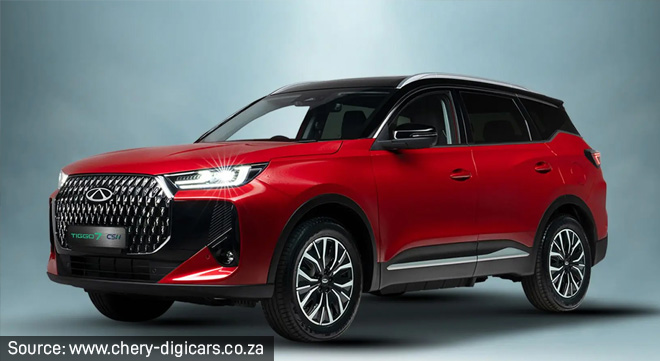
Emerging vehicle brands are gaining measurable traction among South African buyers, with new data from Naked Insurance showing a sharp increase in interest over the past year.
However, while consumers expand their consideration sets beyond traditional favourites, insurers and industry data point to persistent risk and cost factors – including theft patterns and rising global supply pressures – that continue to shape premiums and the true cost of ownership.
Data from Naked Insurance shows that emerging brands accounted for 10% of car insurance quotes on its platform in January 2026, up from 5% in January 2025. According to the insurer, Chery and Haval are attracting the highest levels of interest among buyers, with Jetour – part of the Chery group – gaining momentum.
Naked co-founder Ernest North said this reflects a shift in how consumers evaluate vehicles.
“South Africans are clearly becoming more open to emerging vehicle brands as they look for cars that offer a strong balance of price, features, design, and practicality.”
He added that consumer conversations increasingly centre on trust and long-term viability.
“In many conversations about cars today, people are asking whether these brands are worth considering, whether they can be trusted, whether parts and servicing will be available, and whether they offer the kind of value and reliability that could make them a serious long-term alternative to the established favourites.”
Naked’s data indicates that these brands are firmly in the consideration set. North cautioned against viewing the shift as purely price driven.
“Many consumers are gravitating towards these makes because they are building a reputation for offering strong specifications, comfortable interiors, and modern designs that compare favourably with more established brands,” he said. “‘Value for money’ used to mean fewer features and more compromise. The new entrants are challenging that perception.”
Total cost of ownership comes into focus
North said buyers considering emerging brands should assess the total cost of ownership rather than focusing solely on the purchase price.
This includes insurance, fuel, servicing, and depreciation. He noted that insurance remains a critical component, particularly where vehicles are financed, and advised consumers to obtain quotes before committing to a purchase to understand the full monthly cost.
Fuel consumption should be assessed using real-world data rather than manufacturer claims. On servicing, he pointed to increasingly competitive warranties and service plans offered by newer brands but cautioned that exclusions and conditions need to be carefully reviewed, particularly in relation to consumables, dealer footprint, and parts availability.
Depreciation is another key factor. Vehicles that lose value more quickly may prove more expensive over time because of weaker resale value.
“The surge in interest in emerging brands shows that South African consumers are increasingly open to alternatives to long-established vehicle brands, especially as they are trying to make smart financial decisions,” North said. “The exciting part is that consumers today have more choice than ever, with less compromise on quality, features, and design.”
Popular vehicles – and persistent risk patterns
Despite growing interest in newer brands, established models continue to dominate South Africa’s vehicle landscape.
Data from the National Association of Automobile Manufacturers of South Africa (NAAMSA) shows that vehicles such as Toyota Hilux, Ford Ranger, Volkswagen Polo Vivo, and Toyota Corolla Cross remain among the country’s top-selling models.
These vehicles also feature prominently in vehicle crime statistics. The Tracker Vehicle Crime Index, drawing on national tracking data, consistently identifies the Toyota Hilux, Ford Ranger, and Volkswagen Polo as among the most targeted vehicles for theft and hijacking.
Tracker attributes this to strong demand for these vehicles and their parts in legal and illicit markets. The index also shows that hijackings now account for a growing share of vehicle crime, reflecting a shift in criminal activity.
For insurers, these patterns translate directly into pricing and underwriting decisions. Industry data published by insurers and risk analysts indicates that high-risk vehicles may attract higher premiums, stricter policy conditions, and requirements such as tracking devices or higher excesses.
Global pressures begin to feed through
In addition to local risk factors, global developments are beginning to influence vehicle and insurance costs.
Local insurers are already warning of potential knock-on effects. OUTsurance Group chief executive Marthinus Visser said, in comments reported by News24, that although premium inflation has recently moderated – partly because of lower claims, particularly in motor – the conflict in the Middle East could reverse that trend.
He indicated that higher oil prices and disruptions to key shipping routes are adding pressure to global supply chains, increasing the cost of goods such as vehicle parts. This, in turn, is expected to feed into claims costs.
Visser said these developments are likely to be inflationary, with both consumer price inflation and claims inflation expected to rise as supply chain pressures build. However, he noted that the impact may not be immediate, because insurers may absorb some of the costs in the short term, and the extent of the effect will depend on how long the conflict lasts.
Sanlam chief executive Paul Hanratty has also warned of broader economic consequences. Speaking to BusinessDay, he said a prolonged Middle East conflict could have a significant impact on financial markets, driven by higher oil prices and rising inflation.
Hanratty indicated that sustained price pressures could reverse the recent trend of easing interest rates, placing additional strain on consumers and slowing economic growth. He also cautioned that the situation presents material risks for insurers and financial services firms more broadly, both through market volatility and potential operational disruptions in affected regions.
Economists and industry analysts point to fuel as a key transmission mechanism. Higher oil prices increase manufacturing and transport costs, while disruptions to global shipping routes add further pressure to vehicle and parts supply chains.
For insurers, this translates into higher claims costs. Rising parts prices, longer repair times, and delays in sourcing components increase the cost of settling claims – a factor that typically feeds into premium adjustments over time.
This dynamic may become increasingly relevant for newer entrants. Although emerging brands are gaining traction on value and features, their long-term insurance profile will depend on factors such as parts availability, repair networks, and claims experience.

