

Retail hedge funds have overtaken qualified investor hedge funds for the first time since South Africa’s hedge fund industry was formally regulated a decade ago.
Statistics released by the Association for Savings and Investment South Africa (ASISA) this week show that South African retail hedge funds accounted for 56.6% of industry assets under management at the end of December 2025, marking a decisive shift in the structure of the local hedge fund market.
The milestone came as the hedge fund industry closed 2025 with R216 billion in assets under management (excluding funds of funds) – a 17% increase from R185bn at the end of 2024.
Hayden Reinders, convenor of the ASISA Hedge Funds Standing Committee, said the shift reflects a steady expansion of retail participation in the industry.
“There has definitely been a shift towards retail hedge funds,” he said during a media briefing, noting these portfolios are increasingly distributed through advisers, brokers, and investment platforms and are becoming accessible to a broader range of investors.
Industry growth driven mainly by performance
The R216bn in hedge fund assets was invested across 219 portfolios managed by 13 management companies with hedge fund schemes.
Although net inflows of R6bn contributed to the increase in assets, Reinders said the main driver of growth in 2025 was market performance.
Including fund-of-funds investments, total hedge fund assets now stand at R274bn, up from R217bn a year earlier.
The sector has expanded significantly since hedge funds were brought under the Collective Investment Schemes Control Act (CISCA) framework in 2015. At the time, the industry managed about R64bn in assets, meaning it has more than quadrupled in size over the past decade.
Reinders described the trajectory as positive, although he noted the sector could still represent a larger share of the local investment market.
Retail investors drive flows
Retail investors were the main source of new money entering the industry in 2025.
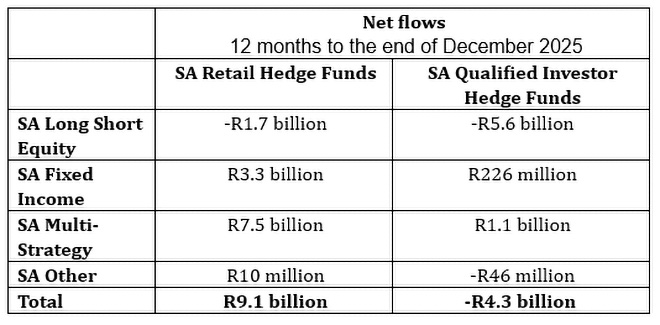
Retail hedge funds recorded net inflows of R9.1bn, while qualified investor hedge funds experienced net outflows of R4.3bn.
When hedge funds were first regulated under CISCA, the industry was heavily skewed towards qualified investors, reflecting its origins as a space largely used by institutional and high-net-worth investors.
Qualified investor hedge funds require a minimum investment of R1 million and are designed for investors with a solid understanding of hedge fund strategies and risks. Retail hedge funds, by contrast, operate under stricter investment and risk limits but are accessible to investors able to meet a minimum investment of about R50 000.
From 2015 to the end of 2024, qualified investor hedge funds consistently held most industry assets, finishing 2024 with 56% of total assets.
The reversal in 2025 therefore represents the first time that retail hedge funds have overtaken their qualified investor counterparts in size.
Reinders said the shift reflects both stronger retail demand and structural changes within the industry, with some managers recognising that their strategies could operate successfully within the stricter retail framework.
Strategy preferences evolve
Hedge funds in South Africa are classified into four main strategies: Long Short Equity, Multi-Strategy, Fixed Income, and Other.
Historically, Long Short Equity portfolios have been the dominant strategy. These funds generate returns by pairing long positions in shares expected to rise with short positions designed to benefit from falling prices.
In 2025, however, Multi-Strategy hedge funds attracted the strongest inflows. Retail investors directed R7.5bn in net inflows to Multi-Strategy portfolios, while qualified investors added R1.1bn to the category.
Multi-Strategy funds combine multiple asset classes and investment techniques rather than relying on a single approach, allowing managers to adapt to changing market conditions.
At the same time, Long Short Equity funds recorded net outflows, with R1.7bn leaving retail portfolios and R5.6bn flowing out of qualified investor funds.
Retail Fixed Income hedge funds attracted R3.3bn in net inflows, reflecting demand for strategies focused on opportunities in interest-rate markets. In the qualified investor segment, Fixed Income funds recorded R226m in inflows, while the Other category saw net outflows of R46m.
Industry consolidation
Despite rising assets, the number of hedge fund portfolios has stabilised.
The latest data shows 219 hedge funds operating in the regulated market, following a period of consolidation in the years after regulation was introduced.
Higher operational and compliance requirements led some smaller funds to close or merge, reducing the number of portfolios while assets under management continued to expand.
Reinders said the number of funds has since stabilised at about 220 portfolios.
Strong performance supports growth
Performance has also supported the industry’s expansion.
According to the HedgeNews Africa South African Single Manager Composite, hedge funds delivered a median return of 15.07% in 2025, continuing a positive trend seen in recent years.
Reinders said hedge funds continue to compare favourably with many traditional collective investment scheme portfolios.
Retail shift years in the making
The rise of retail hedge funds has been building over several years.
Moonstone reported previously that retail funds had already begun narrowing the gap with qualified investor portfolios. In 2024, retail hedge funds attracted R11.84bn in inflows, while qualified investor funds experienced small net outflows.
Retail assets accounted for 42% of the industry at the end of 2024, compared with 63% in the qualified investor category in 2020.
Reinders said the gradual rebalancing reflects how hedge funds have become more integrated into mainstream investment portfolios.
Regulatory developments ahead
Several policy developments could influence the industry’s outlook.
In the 2026 Budget Review, National Treasury acknowledged that collective investment schemes and retail hedge funds remain well-regulated vehicles that play an important role in encouraging savings. Treasury indicated that revised proposals on the taxation of these portfolios will aim to encourage savings and provide greater tax certainty, while qualified investor hedge funds will be considered separately from the proposed collective investment scheme tax framework.
At the same time, the industry is watching developments around Board Notice 90, which prevents long-only unit trust portfolios from investing in hedge funds despite both being regulated as collective investment schemes.
Reinders said the Financial Sector Conduct Authority has indicated that engagement with the industry will continue, including discussions around aligning Board Notice 52 and Board Notice 90.
The industry hopes that renewed engagement could eventually allow greater investment into retail hedge funds.
Retailisation reshaping the industry
For now, however, the most notable development is the continued “retailisation” of the hedge fund sector.
With retail hedge funds now accounting for most assets and attracting the bulk of inflows, the industry is gradually moving beyond its traditional reliance on institutional and high-net-worth investors.
If the current trajectory continues, retail investors are likely to play an increasingly central role in shaping the future of South Africa’s hedge fund industry.

