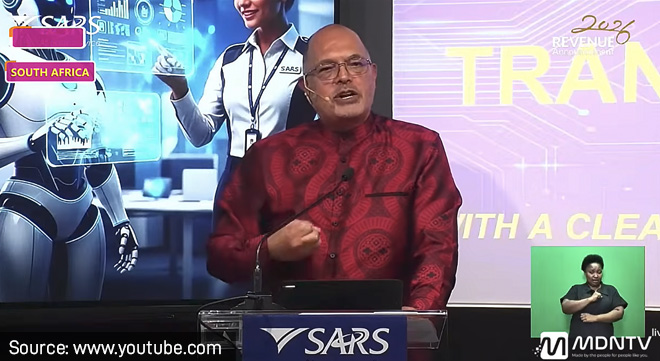
The South African Revenue Service has announced that it collected R2.010 trillion in net revenue for the 2025/26 financial year, marking the first time collections have exceeded the R2 trillion threshold.
Presenting the preliminary results, SARS Commissioner Edward Kieswetter said revenue grew 8.4% year-on-year, outpacing nominal GDP growth of 5.4%, and exceeding the revised Budget 2025 estimate by R24.7 billion. The target required an increase of R151.7bn (8.2%), which SARS slightly surpassed, reflecting what it described as “discipline and consistency in execution”.
Kieswetter said the final outcome was R3.34bn above the revised estimate, with collections reaching R2.010 trillion by midnight on 31 March. That represents an increase of R155bn on the previous year, achieved in a low-growth environment.
He noted that it took 22 years to reach the first R1 trillion, but only 10 years to double that to R2 trillion, despite COVID-19, load shedding and weak economic growth.
Over seven years, revenue has grown at a 5.8% compound annual rate, with a tax-to-GDP ratio of 25.9% and tax buoyancy of 1.70. Of the R25.1 trillion collected since 1997, R11.5 trillion – nearly half – has been raised in this period.
Kieswetter added that gross collections reached R2.468 trillion, with R458bn in refunds, resulting in net revenue just above R2 trillion.
The stronger outcome also enabled Finance Minister Enoch Godongwana to avoid a planned VAT increase.
VAT and PAYE drive revenue growth
VAT and personal income tax remained the backbone of revenue growth.
Domestic VAT collections reached R604bn, up 7.6% year-on-year, outperforming forecasts of 5.3% to 7.0%.
- Large businesses: R291.4bn (48.2%)
- Non-large vendors: R312.6bn (51.8%), largely from the finance sector
Growth was supported by stronger consumption, lower interest rates, contained inflation, and two-pot retirement withdrawals, alongside R37 billion from compliance interventions.
Kieswetter said VAT reflects consumption across the economy – “what we all pay at the till”.
The VAT compliance index improved from 66.59% to 67.19%.
PAYE totalled R767bn, up R59.9bn (8.5%), exceeding estimates by R4bn.
Personal income tax remains the largest contributor at roughly R790bn.
Growth was driven by wage increases, fiscal drag and R11bn from two-pot withdrawals (down from R11.9bn the previous year).
Corporate tax strong, but slightly below target
Corporate income tax reached R355.5bn, growing 9.9%, but falling short of revised estimates by R1.3bn.
- Large corporates: +7.5% (R16.1bn)
- SMMEs: +14.7% (R16.0bn)
This exceeded earlier projections of 6.3% to 8.7%, although momentum softened against the final estimate.
Kieswetter said CIT remains the third-largest contributor at about R350bn, behind personal income tax and VAT.
Trade taxes reflect subdued import growth
Trade taxes were more muted, reflecting weak import demand.
Imports grew just 0.1%, resulting in:
- Import VAT: +R5.6bn (2.2%), below estimates
- Import duties: +R5.1bn (6.6%), exceeding estimates by R1.2bn
Passenger vehicle imports drove the increase, suggesting modest recovery in demand.
Imports totalled about R1.85 trillion, exports just over R2 trillion, producing a R240bn trade surplus.
SARS’s trade facilitation index improved from 52% to nearly 75% over four years.
Refunds and enforcement remain central
SARS paid R371.1bn in VAT refunds, up 1.5%, with total refunds across taxes reaching R458bn – about 5.9% of GDP.
Kieswetter described refunds as a critical liquidity injection into the economy.
Enforcement remained a key driver. SARS prevented about R75bn in revenue leakage, while compliance interventions generated R316bn – just over 15% of total collections – including:
- R111bn from debt recovery
- R20bn from the illicit economy
- R42bn from audits and investigations
AI-driven systems prevented a further R103bn in leakage.
“These interventions reflect the work that we do,” Kieswetter said, linking revenue directly to enforcement rather than economic windfalls.
Commodities: smaller than expected contribution
While commodity prices supported revenue, their contribution was limited relative to compliance gains.
Kieswetter said the mining sector generated about R25 billion in net revenue, up 112% year-on-year from roughly R12.5bn.
He noted that of the additional revenue expected at Budget, around R5bn would come from mining and about R7bn from broader economic buoyancy.
However, he stressed that compliance was the dominant driver, noting that:
“Two thirds of that would come from our compliance programme.”
He added that financial services and compliance efforts contributed more to revenue growth than mining, underscoring the limited role of commodities in the overall result.
US protectionism: minimal direct effect
Kieswetter indicated that US protectionist policies have had limited direct impact on revenue collections.
He said most South African exports to the United States fall under zero or preferential tariff arrangements, reducing the immediate effect of tariff changes on tax receipts.
The United States has slipped from South Africa’s second- to third-largest export destination, which he attributed to softer trade volumes rather than tariff-driven disruption.
The extension of AGOA – the African Growth and Opportunity Act, a US trade programme that grants qualifying African countries duty-free access to the US market for certain exports – further limits near-term risk.
“The direct impact of that is still not immediate,” Kieswetter said.
Any impact is therefore more likely to arise through declining trade volumes than changes in tariff structures.
Middle East conflict: indirect pressure via oil
Geopolitical tensions in the Middle East are expected to affect revenue primarily through energy markets rather than direct trade.
Kieswetter said South Africa’s trade exposure to the region is about 1% of total trade, limiting any direct impact on customs revenue.
However, he warned that the key risk lies in oil supply, noting that around 80% of global oil flows through the Strait of Hormuz, making fuel prices highly sensitive to disruption. He indicated that increases in fuel prices were expected to begin filtering through immediately.
This comes as the government introduced a temporary R3 fuel levy reduction in April, estimated to cost about R6 billion, to cushion consumers from rising fuel prices.
Kieswetter said SARS’s stronger-than-expected revenue performance helped offset part of the cost:
“We have given 50% of the funding of that one month to you by collecting R3.5bn more.”
Commissioner exits after seven-year turnaround
Kieswetter will step down at the end of April, concluding a seven-year tenure marked by rebuilding SARS after state capture.
Speaking at the announcement, Godongwana credited Kieswetter with restoring credibility, describing SARS as a “national treasure” rebuilt into a modern, technology-driven institution.
A new commissioner has been appointed and will take office from 1 May, with an announcement expected shortly.
Reflecting on his tenure, Kieswetter said: “As I come to the end of the seven years of national service, I recall the President’s challenge… to step forward… where real change happens.”
He added: “I want to thank the President, the Minister, and all South Africans for affording me the rare privilege…”
And acknowledged taxpayers: “The record achievement we reached today is because of all compliant taxpayers…”
Paying tribute to staff, he said: “The 14 500 SARS employees are the mainstay of our organisation…”
Kieswetter said he leaves behind “an institution more valuable than what we inherited”, with SARS positioned for its next phase.