

The Standing Committee on Public Accounts (SCOPA) has questioned whether the 25% cap on contingency fees in Road Accident Fund claims is too high.
In its RAF Enquiry Draft Report: Legal Costs shared last week, the committee says the cap creates a situation in which it is in attorneys’ interests to inflate claims. It also notes that a portion of money intended for claimants is instead paid to attorneys for their services.
The finding comes after SCOPA examined the RAF’s legal costs, allegations of misconduct by plaintiff attorneys, and the way claimants access legal representation.
It was not a conclusion reached simply by looking at the RAF’s legal bill. The committee heard evidence from the Legal Practice Council (LPC) and the Law Society of South Africa on contingency-fee arrangements before examining what the RAF’s figures showed about payments to its largest plaintiff law firms.
That protection comes with a financial trade-off.
Contingency fees can give people who could not otherwise afford a lawyer access to the courts. But the arrangement also places a financial incentive on the outcome of a claim, while the RAF’s own figures show billions of rand in legal costs moving through a relatively small group of firms.
What is the 25%?
A contingency-fee agreement is essentially a no-win, no-fee arrangement.
The system is governed by the Contingency Fees Act. Its purpose is to allow people who cannot afford litigation to pursue a claim while encouraging legal practitioners to take on the financial risk of doing so.
In an RAF matter, an attorney working under such an agreement does not charge the claimant an ordinary fee based on the hours spent on the case.
If the case is unsuccessful, there is no success fee.
If it succeeds, the attorney can charge a success fee of no more than 25% of the capital amount awarded, or twice the attorney’s normal fee, whichever is lower. The 25% is therefore a ceiling rather than an automatic deduction.
Disbursements – expenses such as medico-legal reports and other expert costs – are treated separately as out-of-pocket expenses.
According to SCOPA, contingency agreements are the overwhelming norm where RAF claimants use attorneys.
A claimant can make a claim directly against the RAF. But SCOPA heard that the disputed RAF 1 Form, the collapse of the direct claims strategy, and delays in finalising claims have made the process difficult for claimants to navigate.
The committee also heard that using an attorney is not always a matter of choice. The LPC told it that touting – the unlawful solicitation of clients – is widespread, although difficult to prove. Low-income accident victims and people who do not understand the RAF process can be particularly vulnerable.
What happens when the claim is paid?
If the claimant succeeds, the RAF pays the claim amount and any court-ordered legal costs into the attorney’s trust account.
The attorney may then retain the permitted success fee. Disbursement costs can also be retained for payment to service providers or to cover expenses already incurred. Any balance must be paid to the claimant. Where an advocate is part of the contingency arrangement, that cost falls within the overall success-fee limitation; where the advocate is not part of the arrangement, the fee is treated as a disbursement.
SCOPA illustrated the mechanics in its draft report with a hypothetical R500 000 claim.
The claimant agrees to a 25% contingency fee and wins R500 000. The court awards R80 000 in costs, made up of R30 000 in legal fees and R50 000 in disbursements.
Twenty-five percent of the R500 000 claim would be R125 000. But twice the normal legal fee is R60 000, so the lower amount applies.
The RAF pays R580 000 into the attorney’s trust account. R60 000 is retained as the success fee and R50 000 goes towards the disbursements. The claimant receives R470 000.
The example also shows why the 25% should not simply be read as “lawyers get 25% of every RAF payout”.
It is a maximum, and the second part of the statutory test can produce a lower fee.
SCOPA’s concern is what happens when the fee is tied to the size of the claim: the bigger the claim, the bigger the fee. The committee says that can create an incentive to inflate claims.
Billions in RAF legal costs go to a handful of firms
The RAF supplied the committee with a table covering its 20 largest plaintiff law firms between 1 April 2020 and 31 December 2025. The table contains legal costs, disbursements, interest, sheriff and writ costs, as well as a separate column for amounts recorded as Requested Not Yet Paid (RNYP) at 31 December 2025.
Across those 20 firms, the total was R8.63 billion, associated with 37 188 claims.
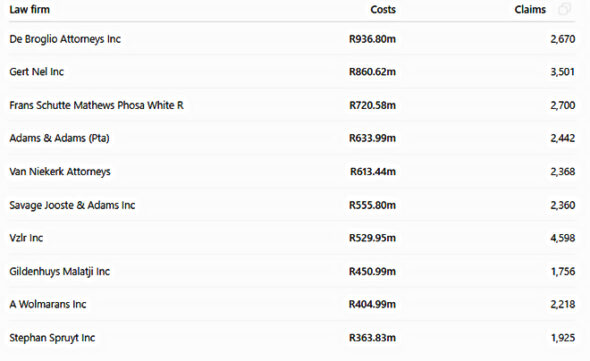
The top 10 firms ranked by total legal costs were:
The next 10 firms ranged from R333.69 million for De Vries Shields Chiat (DSC) to R213.51m for Chuene SJ Attorneys. They were Salome Le Roux Prokureurs (R307.05m), Kruger & Co (R289.98m), Mphela & Associates Attorneys (R272.38m), Macrobert (R247.66m), Askew Martin and Adrain (R232.16m), A C de Sousa Attorneys (R222.41m), Adendorff (R222.14m), and Marais Basson (R214.53m).
Firms handling more claims did not necessarily have the highest legal costs.
Vzlr handled the most claims, at 4 598, but its total legal costs were R529.95m. De Broglio handled 2 670 claims but had the highest total, at R936.80m. Adendorff handled only 521 claims and recorded R222.14m.
SCOPA cautions that claim value is not necessarily linked to legal costs, because the complexity and trajectory of a matter can drive the fees.
What is actually inside the R8.63 billion?
The R8.63bn is not R8.63bn in attorney fees.
The RAF’s figures classify R4.88bn, or 56.5%, as plaintiff legal costs, including attorney, counsel, and correspondent attorney fees. The other 43.5% consists of disbursements, interest, and sheriff and writ costs.
Disbursements include expert costs, travel, accommodation, and other expenses. Interest includes interest on capital and court-awarded costs. Sheriff and writ costs relate to the service and execution of writs.
There is also a timing issue in the numbers: the tables include amounts the RAF recorded as requested but not yet paid at 31 December 2025.
De Broglio provides the clearest example of how the categories differ.
Its R936.8m total consisted of:
- R439.26m in plaintiff legal costs;
- R347.04m in disbursements;
- R150.47m in interest; and
- R25 806 in sheriff and writ costs.
But R439.26m in plaintiff legal costs does not mean that is what De Broglio ultimately kept.
The RAF’s table does not show which matters were subject to contingency agreements. Where one applies, the attorney’s fee is calculated according to the statutory formula. SCOPA notes that some or all of the amount recorded as legal fees may ultimately have to be returned to the claimant.
What happened to the allegations against attorneys?
Former RAF chief executive Collins Letsoalo accused some plaintiff attorneys of theft, fraud, and inflated claims and raised concerns about alleged bias in the judiciary.
The RAF had referred 10 of the top 20 firms to the LPC in 19 claims, citing allegations including unethical conduct, touting, fraudulent claims, theft of funds, and false mandates. Kruger & Co accounted for seven.
Five of the top 20 firms were also referred to the South African Police Service in 43 claim-related matters between April 2020 and October 2025. Kruger & Co accounted for 37. The RAF put its actual loss from the 43 matters at R3.61m, with a potential loss of R37.7m. For Kruger & Co, the figures were R1.84m and R36.4m respectively.
The referrals were not findings of misconduct.
The LPC told SCOPA in June 2025 that it had recorded 9 671 RAF-related complaints involving 2 622 legal practitioners between January 2019 and 19 June 2025. Of these, 280 practitioners had been found guilty and 4 754 complaints remained open.
Very few practitioners had been accused of misappropriating RAF funds, and even fewer had been found guilty on that basis. Most complaints concerned clients’ understanding of legal processes, delays in finalising claims and RAF payment delays.
The LPC also said RAF practices, including double payments and failures to finalise and pay claims, had contributed to complaints against attorneys.
The 62 LPC and SAPS referrals involving the top 20 firms represented 0.17% of their 37 188 claims between April 2020 and December 2025.
SCOPA also put questions about the largest firms to former board members in the context of the proposed Road Accident Benefit Scheme. Dr Nomonde Mabuya-Moloele, the RAF’s former deputy chairperson, said the firms were described to the board as the biggest beneficiaries of the existing system.
“The ecosystem is there to feed them. That’s real.”
However, SCOPA found that the referrals did not account for the scale of the legal bill. It said the bulk of plaintiff legal costs arose from the RAF’s failure to investigate and settle claims timeously, followed by its approach to litigation.
Read: SCOPA blames RAF’s litigation failures for billions in legal costs


