

The Financial Intelligence Centre (FIC) has warned specified accountable institutions that fail to submit their 2026 Risk and Compliance Returns (RCRs) by the prescribed deadlines that they face administrative financial penalties, after fewer than half of the first group of institutions had submitted their returns more than two weeks after the deadline.
The warning follows the first RCR submission deadline of 30 June, which applied to crypto asset service providers (CASPs), company service providers, non-bank credit providers, trust service providers, and casinos under Directive 11, issued on 31 March.
A second group of accountable institutions has until 31 July to submit their returns. This group includes legal practitioners, estate agents, non-casino gambling institutions, motor vehicle dealers, other high-value goods dealers, dealers in precious metals (including Krugerrand dealers) and dealers in precious stones.
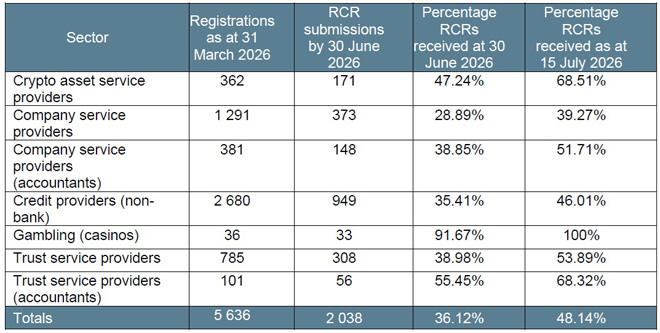
According to the FIC, only 2 038 of the 5 636 institutions required to file by 30 June had done so by the deadline – a submission rate of just 36.1%. Although additional returns were received during the following two weeks, the overall submission rate had increased to only 48.1% by 15 July.
Institutions that failed to meet the 30 June deadline are regarded by the FIC as being in a state of non-compliance. The Centre says it is required to take enforcement action against non-compliant institutions, which may include administrative financial penalties, while urging late filers to submit their returns to minimise the risk of such penalties.
Among the sectors in the first filing group, casinos recorded the highest compliance, with all 36 registered institutions having submitted their returns by 15 July. CASPs also performed relatively well, with 68.5% having filed by mid-July. Company service providers recorded one of the lowest compliance rates, with just 39.3% submitting returns by 15 July, while fewer than half of registered non-bank credit providers had complied.
Given the low submission rate thus far, the FIC reminded the second group of specified institutions that they have until close of business on 31 July to submit the RCR.
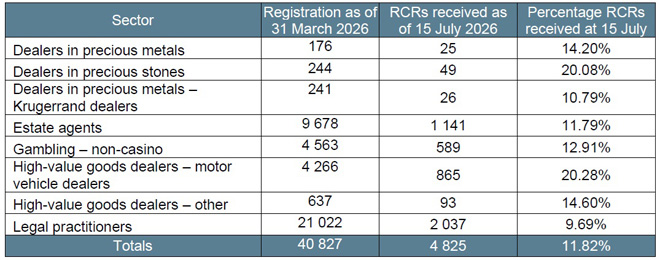
As of 15 July, only 11.82% of the 40 827 institutions required to submit by 31 July had done so. Legal practitioners recorded the lowest compliance rate at 9.7%, followed by Krugerrand dealers (10.8%) and estate agents (11.8%). Motor vehicle dealers had the highest submission rate at 20.3%, ahead of dealers in precious stones (20.1%) and dealers in precious metals (14.2%).
Christopher Malan, executive manager: compliance and prevention at the FIC, said the returns are an important measure of how well institutions understand and manage their money laundering and terrorist financing risks.
“The completion and submission of RCRs is a necessary indicator of institutions’ perception, preparedness, and remedies for identifying and combating money laundering and terrorist financing in their businesses,” he said.
He added that institutions that do not understand their exposure to these risks cannot implement appropriate risk-based controls to mitigate them.
The FIC uses the information collected through the RCR process to assess money laundering, terrorist financing, and proliferation financing risks across sectors and to inform its risk-based supervisory approach.
The FIC introduced the RCR mechanism in May 2023 in support of its risk-based supervision framework and to assist South Africa’s work towards exiting the Financial Action Task Force’s grey list. The FATF required the country, and by extension the FIC as the supervisor, to implement assessment tools to identify higher-risk businesses and professions as a basis for risk-based supervision.
The FIC has published Public Compliance Communication 60 of 2026 to provide practical guidance to the specified accountable institutions on how to submit their 2026 RCR.
PCC 60 states that third-party service providers may not submit the 2026 RCR on behalf of an accountable institution. The return must be submitted by the compliance officer, assisted by the compliance function, while ultimate responsibility for compliance remains with the institution’s board, senior manager, or person with the highest authority.
Read: FIC finalises guidance on how to complete 2026 RCR
The specified accountable institutions can only submit their RCR on the online platform and can find more information, including sample questionnaires, on the FIC website.
The online filing facility remains available for institutions that missed the 30 June deadline, although submitting late does not remove their non-compliant status. The FIC has urged them to file to minimise the risk of financial penalties.