A financial adviser presents a client with a recommendation developed with the help of artificial intelligence. The figures look right, the analysis is thorough, and the proposal is professionally presented. Then the client asks a simple question: why is this the right course of action?
Can the adviser explain the reasoning, or are they relying on an answer the technology produced?
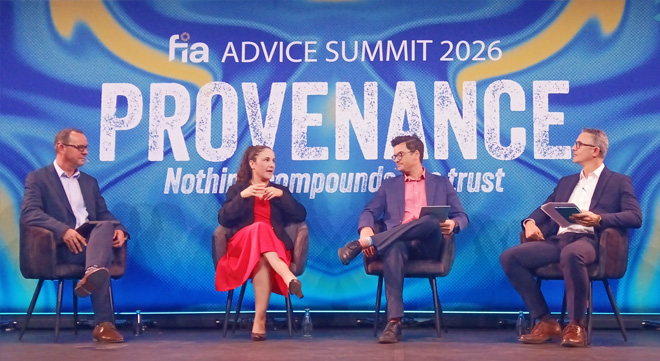
Mauritz van den Heever, senior wealth manager at Wealth Associates, put this question to advisers during a panel discussion at the FIA Advice Summit 2026 on 13 October 2026.
“If an adviser can’t independently explain, challenge, or change an AI recommendation, then AI is no longer assisting you. It’s actually making the decision for you, and you have lost control of your financial plan,” he said.
Van den Heever was speaking during “Wisdom over Noise: Why Human Judgement Matters More in the Age of AI”, alongside Nicola Comninos, the chief executive of EasyRetire, an EasyEquities business, and Carl Coetzee, executive head of distribution at Auto & General. The session was facilitated by Theoniel McDonald, a director of the Financial Intermediaries Association of Southern Africa and head of financial planning at Wealth Associates.
The discussion covered everything from routine administration and personalised client tools to staff training and regulatory accountability. The common thread was that using AI well takes more than getting a convincing answer from it.
When a correct answer is not enough
Van den Heever said AI was already useful for the work around financial advice. It can bring together client discovery information and analysis, help advisers to prepare for client meetings, and assist with the documentation that follows.
But a technically sound answer does not automatically make a recommendation suitable for a particular client.
“A technically accurate answer doesn’t necessarily equal good financial advice,” he said.
Coetzee illustrated the problem from a short-term insurance perspective. If two businesses provide the same information to an AI tool, it may produce the same assessment for both. Yet a broker who knows the businesses may understand that their priorities differ, or that a particular risk has very different implications for each one.
That knowledge of the client, built through the relationship, can influence where the risk is placed and what cover is appropriate.
Comninos pointed to another part of advice that is harder to replicate: understanding people. Financial decisions are shaped by behaviour, personal circumstances, and life challenges, not just the figures in front of an adviser. Emotional intelligence helps advisers to understand what matters to a client and how they approach difficult decisions.
She applies the same thinking when using AI herself. Rather than accepting an answer because it sounds plausible, she pushes the tool to consider other viewpoints.
“Stop agreeing with me. Actually, just bring in other perspectives,” she tells it.
She expects employees to do the same. A generic AI response is a starting point, not finished work. Staff must question the answer, bring their own knowledge to it, and keep refining it until the result reflects their judgement, as well as the technology’s capabilities.
As she put it, she wants them to have “multiple debates with AI” until the result shows the value of a human being working alongside the technology.
EasyEquities tells staff they must use AI
Comninos described EasyEquities’ approach to adoption as “quite a dictatorial approach”.
“We just said you shall use AI, all of you, and you need to prove how much you’re using it,” she said.
The instruction extended across the business, including legal, compliance, finance, procurement, and client services. Employees were expected to explore how AI could improve their work and the client experience.
“Test it, break it, push it as hard as you can.”
EasyEquities encourages staff to experiment, including by building tools to solve practical problems. It also runs internal AI competitions in which employees demonstrate what they have developed. But experimentation has limits. When staff started creating programs on their own computers, Comninos said these had to go through formal IT and change-management processes before being adopted across the business.
She also warned against simply banning AI. Employees may turn to public tools regardless, potentially exposing company intellectual property.
Van den Heever said businesses should be more concerned about staff using AI without management’s knowledge than about whether competitors are using it more effectively. He warned that the last thing a business should do is operate without an AI policy or strategy, because employees may already be using the technology without their employer knowing.
At Wealth Associates, which has about 90 employees, the response was to start with training on appropriate use, including the risks of free tools to data and intellectual property. The business then introduced AI champions and working groups, with AI tools integrated into its technology.
For smaller practices, the lesson is to set clear rules rather than leave staff to work it out for themselves. They need to know which tools they may use, what information they can share and when an AI-generated result needs closer scrutiny. Without that guidance, AI use can happen under the radar, leaving the business exposed to risks it may not discover until something goes wrong.
Personalised tools – and a question about better decisions
AI can do more than speed up existing tasks. It can also make tools and services available that might previously have been too expensive or time-consuming to develop.
Van den Heever encouraged advisers to think about what they could do now that they could not do three years ago. With the right skills and training, he said, an adviser could use AI to build an app for a particular client, tailored even to a specific meeting. He estimated that this could take about 20 minutes, without requiring a traditional coding background.
EasyEquities has also used AI to help investors who open an account but are unsure where to begin. Comninos said the business partnered with Telescope AI to develop a tool that lets users explore investment options based on their interests and preferences. Someone interested in environmentally conscious investing, for example, can explore relevant shares, exchange-traded funds and other investment products.
The tool provides information and options; it does not provide financial advice. Comninos also said EasyEquities had not analysed whether it had improved clients’ investment decisions, so the business could not claim that it had.
Saving time is one benefit; improving decisions is another, and the two should not be confused.
Comninos’ own use of Claude Enterprise illustrates the potential efficiency gains. She uses it across applications such as Word, Excel, and Outlook for tasks including financial modelling, document reviews, presentations, emails, and diary management. She said it had freed up time and mental space.
But she raised a question that businesses should consider when measuring the results: “Is it because of the AI making better decisions, or is it because I’ve got more time?”
The extra time may give an adviser more room to think, question assumptions, or speak to a client. Whether that leads to better advice depends on what the adviser does with it.
When does it become a KI problem?
McDonald asked who would be responsible if an AI-assisted process went wrong: the adviser, the financial services provider, or the key individual responsible for overseeing the business?
Van den Heever said responsibility would typically rest with the adviser but warned that the business also had obligations. If an FSP had not established proper processes for the use of AI, the consequences could reach its leadership.
“Don’t be scared when the FSCA comes knocking, and it’s actually sitting with the KI,” he said.
Comninos agreed that accountability could extend beyond the individual adviser. At EasyEquities, AI governance involves compliance, IT, legal, cybersecurity, and risk teams. It is not simply a technology decision, particularly where a tool could affect clients or expose the business to regulatory risk.
She compared AI with any other third-party service an advice business might use. If a system fails and clients are affected, the business cannot simply blame the provider. It needs to know how it will respond and have a backup plan.
“AI is just a third-party service that you’re using,” she said. “The client keeps you accountable at the end of the day.”
She added that regulators would want to see an AI governance framework and clear accountability.
“The KIs, the FSP licence, those two are at risk. You remain accountable,” she said.
At Wealth Associates, Van den Heever said the AI policy classifies activities across four risk levels, from minimal to prohibitive, with some uses considered too risky. Human checks are built into the process rather than left until the end.
Should advisers tell clients when they use AI?
As AI becomes more involved in preparing financial advice, a question for advisers is how much they should tell clients about the technology used along the way.
Van den Heever compared AI with other tools advisers rely on. “I don’t disclose to the client that I’m using the latest version of Microsoft Excel,” he said, adding that “obviously AI is a lot bigger than that”.
He suggested that regulation may eventually require advisers to disclose when they have used AI in preparing advice. However, clients should not have to identify every tool involved in producing a recommendation. As he put it, if clients have to work out whether an adviser used AI, a cash-flow system or a medical scheme comparison tool, “you’re actually not packaging your advice in a professional manner”.
The adviser should be able to present the recommendation professionally, with the supporting work done behind the scenes.
That does not mean simply passing on an AI-generated answer. The adviser must understand the recommendation, explain its basis, and exercise their own judgement.
Coetzee said clients may increasingly expect advisers to use AI.
“I think clients would expect us to use AI in today’s day and age,” he said. “I don’t think they would expect anything else.”
But using AI is not the same as relying on it without question. Coetzee said a client could recognise when a document had been generated without the adviser applying their mind. Trust, he said, comes when an adviser speaks “authentically about an outcome” and demonstrates “a deep understanding of it”.
The responsibility stays with the adviser
In his closing remarks, McDonald returned to the question of what clients actually pay for. They do not pay advisers simply for facts, calculations, or a plan. They pay for judgement – and for someone willing to stand behind a decision when circumstances are difficult.
AI can help with research, analysis, and preparation. It can bring information together, suggest options, and help advisers to develop more personalised tools. But it cannot take responsibility for the advice a client receives.
For advisers, that means being able to explain why a recommendation is suitable, challenge the technology’s assumptions, and change its output when necessary. For FSPs, it means giving staff the tools and training to use AI safely, protecting client information, and establishing governance arrangements that make accountability clear.
When a client asks why a recommendation is right for them, the adviser still needs to answer in their own words – and be prepared to stand behind that answer.